How raw material analysis testing helps prevent supplier quality failures
Why Supplier Failures Often Start Before Production
Supplier quality failures are frequently discovered at the most expensive point in the process: after material has entered production, after components have been assembled, or after finished goods have reached a customer. By then, the immediate problem may look like a machining defect, a coating issue, an unexpected safety incident, or an unstable production yield. Yet the underlying cause can be much earlier: raw materials that did not match the approved specification, were contaminated during handling, or changed without adequate disclosure.
For quality control and safety teams, raw material analysis testing is therefore not simply a laboratory activity or a supplier qualification formality. It is a control point for verifying whether incoming materials are genuinely fit for their intended use. It can confirm chemical composition, identify contaminants, assess physical properties, and reveal variation between supplied batches before that variation becomes a production or safety event.
This matters particularly in cross-border supply chains. Long sourcing routes, multiple trading entities, substitutions made during shortages, variable storage conditions, and inconsistent documentation can make a certificate of analysis necessary but insufficient. A document may reflect a tested sample, a previous batch, a supplier's internal acceptance standard, or a parameter that does not fully represent the buyer's actual application risk.
The Practical Question Is Not “Should We Test?”
Most organizations accept the principle that raw materials should be checked. The more difficult question is where testing delivers meaningful risk reduction, and where it becomes routine activity without improving decisions.
Testing should be tied to failure modes. A polymer used in a non-critical packaging application does not face the same risk profile as a resin used in a medical, electrical, food-contact, or high-temperature component. Likewise, a steel grade for a cosmetic enclosure may not require the same verification depth as steel used in pressure-bearing equipment, lifting structures, fatigue-sensitive machinery, or regulated infrastructure.
Quality teams should begin with four operational questions:
- What material attributes are essential to product performance, worker safety, regulatory compliance, or customer acceptance?
- Which attributes are most likely to vary between suppliers, production sites, lots, or regions?
- How quickly would a nonconforming material be detected without incoming verification?
- What would be the cost of detecting it only after production, shipment, installation, or an incident?
These questions help distinguish a high-value testing program from a generic inspection checklist. The objective is not to test everything at the maximum possible level. It is to establish evidence proportionate to the consequence of failure.
What Raw Material Analysis Testing Actually Protects Against
Different materials fail in different ways, but several recurring risks appear across industrial supply chains.
Composition that does not match the declared grade
Material can be supplied under a familiar commercial name while its actual composition sits outside the buyer's required range. In metals, this may involve alloying elements, carbon content, residual elements, or trace contaminants that affect corrosion resistance, weldability, hardness, conductivity, and fatigue behavior. In polymers and chemicals, the issue may be an altered formulation, incorrect additive level, unexpected filler, moisture content, or the use of recycled material where virgin-grade performance was assumed.
Such deviations are not always deliberate. A supplier may use an equivalent internal grade, change a feedstock source, consolidate production, or apply a specification tolerance that differs from the customer's requirements. But unintentional variation can still cause the same downstream damage as misrepresentation.
Contamination introduced before delivery
Contamination is often underestimated because it may not be visible at receiving inspection. Metal particles in powders, moisture in hygroscopic resins, residual solvents in coatings, cross-contamination in chemical packaging, or biological and particulate contamination in sensitive applications can all alter process stability.
In many cases, contamination is a supply-chain control issue rather than a purely technical one. Shared storage areas, reused containers, inadequate cleaning between product runs, poor sealing, long port dwell times, and exposure to heat or humidity can compromise material that initially met specification.
Properties that meet a paper specification but fail in use
A supplier certificate may show compliance with a general material standard while leaving out the property most relevant to the actual application. For example, a material may meet a nominal composition range but exhibit unsuitable particle size distribution, viscosity, tensile performance, thermal behavior, impurity profile, or batch consistency for the customer's process.
This is one reason why “compliant” and “fit for purpose” should not be treated as identical. A standard provides a common baseline. The production environment determines whether that baseline is enough.
Build the Testing Plan Around the Material and Its Failure Consequence
A useful program typically combines supplier documentation, risk-based incoming checks, periodic independent verification, and clear escalation rules. The exact mix should vary by material criticality.
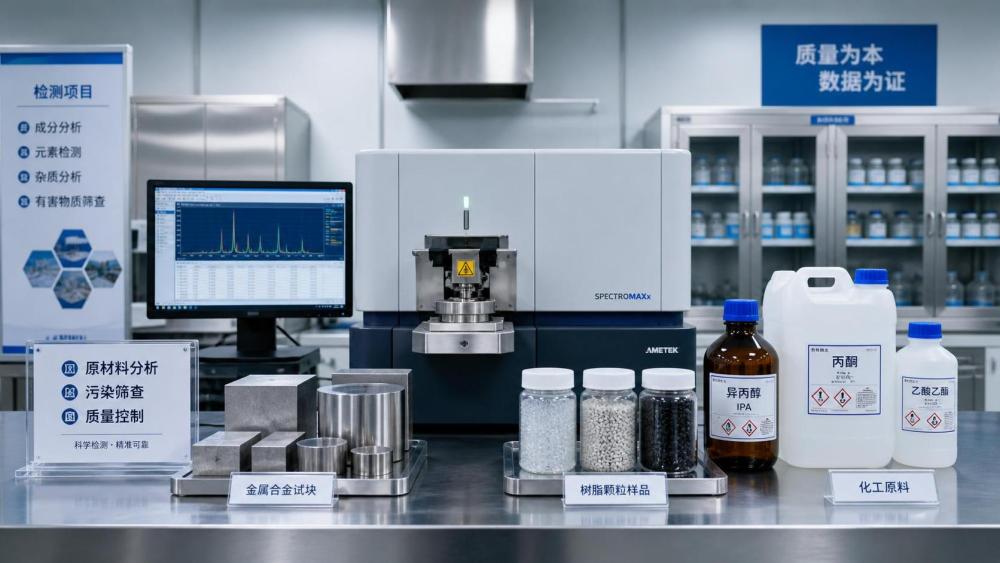
The most effective plans identify a small number of decisive tests for each material family. For metallic inputs, this may include positive material identification, elemental analysis, hardness, microstructure review, or mechanical testing depending on the application. For polymers, it may involve melt flow behavior, moisture, density, ash content, thermal analysis, or contaminant screening. Chemical raw materials may require identity confirmation, purity testing, water content, pH, viscosity, residual analysis, or stability checks.
Method selection should be validated against the question being asked. A fast handheld screening method may be valuable for confirming alloy identity at receiving, but it may not detect every light element or contamination issue relevant to the product. A certificate review can support release decisions, but it cannot independently prove that the delivered lot is the one described in the document. Speed, coverage, precision, and sampling confidence are separate considerations.
Sampling Is Often the Weakest Link
Even a technically sound laboratory method produces limited assurance when the sample does not represent the material received. This is especially important for bulk powders, blended chemicals, granules, recycled materials, drums, coils, and shipments assembled from several lots.
Quality teams should define how samples are selected, who is authorized to collect them, how contamination during collection is prevented, and how the material lot is linked to the result. A test result without an unbroken connection to the receiving lot has weak value during a supplier dispute or customer investigation.
Sampling plans should also reflect material variability. A homogeneous, sealed, single-lot product may justify a different approach from material that can segregate during transport or is transferred between containers. For high-risk materials, retained samples can provide important evidence when an issue emerges months later.
One common mistake is relying on a supplier-provided sample for approval while assuming that future deliveries are equivalent. Another is testing only the first shipment after qualification, then reducing controls before enough delivery history exists. Supplier approval should be treated as a condition that must be maintained, not a one-time event.
Certificates of Analysis Need Verification, Not Blind Acceptance
Certificates of analysis remain important. They support traceability, provide declared test data, and can enable faster release where a supplier has earned confidence. But they should be reviewed as controlled records, not merely filed as shipping paperwork.
A practical review asks whether the certificate identifies the specific lot, test method, acceptance limits, test date, production site, and authorized issuer. It should also be clear whether reported values are actual measured results or statements of conformance. In global procurement, document consistency matters: mismatched lot numbers, generic certificates, changed templates, or repeated identical results across many deliveries may warrant investigation.
Independent verification does not mean every supplier is presumed unreliable. It establishes a fact base. When results align over time, the buyer can make more defensible decisions about reduced inspection frequency. When discrepancies appear, the organization has evidence to trigger containment, root-cause analysis, corrective action, and possible supplier requalification.
Connect Test Results to Supplier Management Decisions
Testing creates value only when its findings influence operations. Results should feed a supplier performance process that distinguishes isolated anomalies from recurring capability problems.
For example, a single out-of-specification result may stem from receiving error, sampling error, packaging damage, or a genuine manufacturing deviation. The response should preserve the material, confirm the result where appropriate, review related lots, and assess whether any production has already consumed the affected input. A recurring pattern, however, may indicate that the supplier's process capability, change-control discipline, or traceability system is inadequate for the application.
Clear disposition rules are essential. Teams should know in advance who can place material on hold, what evidence is required for conditional release, when a deviation requires engineering approval, and when a supplier must submit corrective action. Without these rules, testing can identify risk but still fail to prevent use of suspect material under schedule pressure.
Watch for Change Signals Outside the Laboratory
Laboratory data should be interpreted alongside supply-chain signals. A sudden price reduction, a change in country of origin, revised packaging, new manufacturing location, delayed delivery, unusually broad specification language, or unexplained certificate formatting changes may all justify increased verification. None proves a quality problem on its own. Together, they may indicate that the original control assumptions no longer hold.
Regulatory developments can also raise the stakes. Requirements related to chemical restrictions, product safety, environmental declarations, recycled content, origin traceability, and sector-specific material controls continue to evolve across markets. Organizations should confirm the current applicability of relevant rules and standards for their products and destination markets rather than assuming that a historic supplier declaration remains sufficient.
For cross-border operations, raw material analysis testing is most effective when it becomes part of a broader supply resilience model: approved specifications, controlled supplier changes, traceable lots, competent sampling, independent verification, and disciplined response to deviations. The laboratory result is not the whole answer. It is the evidence that allows quality and safety teams to make a timely decision before a questionable input becomes a costly failure downstream.
Weekly Insights
Stay ahead with our curated technology reports delivered every Monday.
Recommended News
 Supply ChainOct 15, 2026How to choose a supply chain strategy for unpredictable demand
 Supply ChainOct 14, 2026How to assess an industrial equipment supplier's spare parts support
 Supply ChainOct 14, 2026EU Updates CSDDD Guidance on Global Supply Chain Due Diligence
 Global SourcingOct 13, 2026How to assess industrial automation suppliers for legacy integration