
How to assess an industrial equipment supplier's spare parts support
A strong industrial equipment supplier should be able to demonstrate how a failed component will be identified, supplied, and returned to service within the equipment’s acceptable downtime. Assess that capability before comparing spare parts prices. A large catalog, a nearby warehouse, or an emergency telephone number provides limited assurance without evidence that the correct replacement is available and that its delivery commitment covers the actual installation location.
Start with the components whose failure would stop production, compromise safe operation, or require a lengthy repair. Request equipment-specific parts records, stock evidence, delivery performance, and lifecycle commitments for those items. The strongest support offer connects each promise to a defined part, equipment configuration, supply route, and contractual responsibility.
Build the assessment around failure consequences
A generic recommended spares list often mixes inexpensive consumables with costly assemblies while leaving the reasoning unclear. Ask for a list tied to the proposed machine configuration, supported by maintenance intervals, replacement procedures, and the consequences of failure. A filter used during scheduled servicing has a different support requirement from a proprietary controller that disables the entire machine.
Separate routine maintenance parts from components needed to recover from an unexpected shutdown. Then identify which shutdown parts have a practical substitute, which require factory configuration, and which depend on specialist installation. This reveals where supplier support must extend beyond shipping a box.
Operating conditions also change the assessment. Abrasive material increases the relevance of wear liners and seals; washdown exposure makes enclosure integrity and connector compatibility more significant. Frequent starts, high ambient temperatures, or corrosive fluids can change which components deserve local stock. A standard spares package should therefore be reconciled with the intended duty cycle and environment.
For each critical item, compare the tolerable interruption with the complete recovery time: diagnosis, order release, preparation, transport, customs clearance, installation, and commissioning. If recovery takes longer than the process can tolerate, an emergency freight promise leaves a gap that requires on-site inventory, a reserved regional spare, or another technically validated arrangement.
Establish whether the replacement will actually fit
Reliable parts support begins with accurate identification. Request an equipment-specific bill of materials, illustrated parts drawings, and a clear method for linking the machine serial number to the supplied configuration. A catalog organized only by model name is weak evidence when the same model has different motors, hydraulic circuits, control systems, or mechanical revisions.
Part numbers should connect to revision history and replacement instructions. Ask how superseded items are handled: whether the new version is interchangeable, whether associated parts must also change, and whether installation requires a firmware update or parameter conversion. A replacement controller that physically fits can still fail to communicate with existing drives or remote input/output modules.
For mechanical parts, dimensional similarity alone is insufficient. Bearing clearance, seal material, shaft hardness, pressure rating, and mating tolerances can determine whether a substitute survives the application. “Equivalent” should be supported by the relevant specifications and a documented compatibility decision. Safety-related components require particular care because substitution can affect the equipment’s validated safety functions.
The documentation should also distinguish the purchased assembly from its serviceable subcomponents. If a failed sensor is available only with a complete actuator, repair cost and stocking strategy change substantially. Establish whether subcomponents are supplied separately, whether field replacement is permitted, and whether the necessary drawings, settings, or tools are available.
Test stock claims against a realistic breakdown
“Available from stock” needs a location, quantity, status, and timestamp. Inventory held at the factory has a different recovery value from stock within reach of the installation site. Material already allocated to other orders, awaiting inspection, or missing configuration work should not be treated as immediately dispatchable.
Request a dated availability statement for a representative group of critical parts. Include a routine consumable, a proprietary wear component, an electrical assembly, and an expensive item with low demand. This tests whether the supplier’s support capability extends beyond common parts that are easy to obtain elsewhere.
Inventory ownership matters where availability is critical. Reserved stock should identify the covered equipment, release rights, replenishment trigger, and responsibility for deterioration or obsolescence. Consignment stock needs equally clear rules for access and replacement after use. A spare stored nearby but unavailable outside normal hours does not meet an around-the-clock recovery requirement.
Storage quality deserves attention too. Elastomer seals age, electronic assemblies need suitable handling, and machined surfaces require corrosion protection. Ask how shelf life, storage conditions, periodic inspection, and stock rotation are controlled for sensitive items. Warehouse quantity alone does not establish serviceability.
Separate dispatch speed from restoration time
Lead-time quotations frequently measure different things. One supplier starts the clock when payment clears; another starts after technical approval. An exchange assembly might require acceptance of the failed unit before release. Compare commitments using the same starting event and endpoint, with calendar time or working time explicitly stated.
Use a breakdown scenario involving a named part and the actual delivery address. Request the sequence from the first fault report through technical identification, order authorization, warehouse release, shipment, and installation. The response should expose dependencies such as export documentation, software loading, lifting equipment, or specialist attendance.
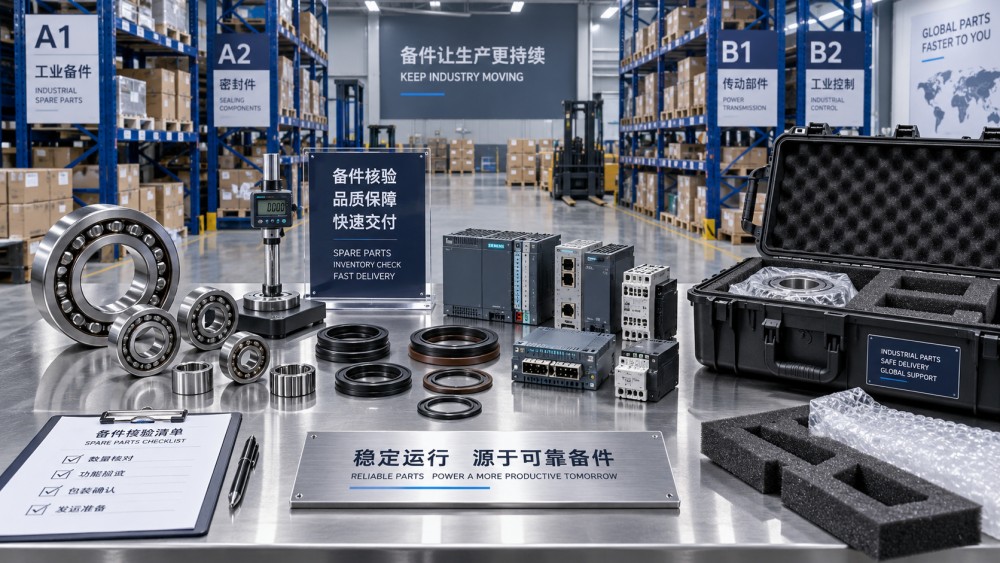
For cross-border supply, examine the physical route and responsibility at each handover. Incoterms allocate specified delivery obligations, costs, and risks; they do not establish the full restoration schedule. Identify who arranges freight, prepares the commercial invoice, supplies the part description and origin information, coordinates customs clearance, and handles a shipment held for missing documentation.
Shipping restrictions require attention when relevant. Batteries, pressurized items, lubricants, or unusually heavy assemblies can limit available transport services. An emergency courier option should be confirmed for the actual shipment characteristics. Likewise, a regional distributor’s proximity offers little advantage if the necessary part must first travel from the original factory.
Ask for anonymized recent records covering comparable parts and destinations. Assess how often promised dates were met and how delays were explained. Averages can conceal the long delays that matter during a shutdown, so inspect individual late orders and the recovery actions taken. Small samples should be treated as limited evidence, particularly when they cover only routine replenishment.
Examine technical support and lifecycle dependencies
A replacement part does not resolve downtime if the fault was diagnosed incorrectly. Evaluate whether remote support can interpret alarms, review relevant measurements, and distinguish a failed component from a wiring, contamination, alignment, or process problem. Request an example of the troubleshooting information required before an emergency part is released.
Support access must match the equipment’s operating schedule. Clarify the languages available, escalation route, response commitment, and access to technicians familiar with the installed configuration. Where remote access is proposed, establish how it will be authorized and whether diagnosis remains possible when the machine network is unavailable.
Controls and software create additional dependencies. Establish who retains parameter backups, configuration files, licenses, and compatible software versions. Ask whether a replacement drive or controller arrives configured and how settings are restored after failure. Proprietary access tools and unavailable passwords can make an otherwise obtainable component unusable.
Lifecycle support should state when the commitment begins and which parts it covers. A promise measured from model launch can expire much earlier than one measured from final equipment delivery. Request the discontinuation notification period, last-order procedure, and arrangements for redesigned replacements. For externally sourced components, examine how withdrawal notices from the original component producer reach the equipment owner.
Repair and exchange programs can reduce the need to purchase complete new assemblies, but their terms affect availability. Establish core-return deadlines, deposit treatment, rejection criteria, and warranty coverage. Confirm whether the exchanged unit has a traceable identity and documented test status, and whether its hardware and software revisions suit the installed equipment.
Compare offers using evidence and binding commitments
Use mandatory acceptance conditions before applying a weighted score. An unresolved compatibility issue, inaccessible critical spare, or missing configuration backup can outweigh attractive pricing elsewhere. Set those conditions from the equipment’s operating requirements rather than treating every machine as equally critical.
For the remaining comparison, give greater weight to demonstrated recovery capability for shutdown parts. Assess identification accuracy, usable stock, delivery reliability, technical response, and lifecycle support against the same equipment-specific scenarios. Record whether each finding rests on a contract, a verified record, a demonstration, or an unsupported statement. A precise promise with weak evidence should remain visibly uncertain.
Compare the commercial effect over a representative maintenance and repair basket. Include minimum order quantities, packaging, freight, configuration charges, exchange deposits, and specialist installation where applicable. Low unit prices lose relevance when parts are sold only in oversized kits or urgent orders carry undefined charges. Keep assumed downtime costs separate from quoted costs so the comparison remains transparent.
Translate the selected support arrangement into the purchase agreement. Define covered part numbers or categories, stock locations, response and dispatch targets, performance measurement, escalation, and remedies for missed commitments. Delivery obligations should identify the destination and the exclusions that remain outside the supplier’s control. Broad wording such as “best efforts” leaves the central recovery promise difficult to assess or enforce.
Finally, make spare parts documentation and configuration backups part of equipment acceptance. Where practical, run a trial order for a selected critical item and verify identification, paperwork, packaging, and receipt. Any gap discovered before acceptance can be assigned a corrective action and deadline, while the equipment and its support obligations are still being finalized.
Have questions about this sector analysis, or seeking best practices specific to your niche? Drop us a line below and let the senior consultants at GTIIN assist you.
“We respect your privacy. Your information is strictly confidential.”
Weekly Insights
Stay ahead with our curated technology reports delivered every Monday.
Recommended News
 Supply ChainNov 10, 2026China Extends Pause on 24% Additional Tariff on US Goods by Two Months
 Industry StandardsNov 10, 2026Which imports are subject to EU carbon border compliance?
 Global SourcingNov 09, 2026USTR Extends 178 China Section 301 Tariff Exclusions to January 2027
 Supply ChainNov 09, 2026How can a tariff risk management dashboard track cost exposure?



