How Manufacturers Can Prepare for Industrial Standards Compliance Audits
How Manufacturers Can Prepare for Industrial Standards Compliance Audits
The mistake many manufacturers make is treating an audit as a documentation event. It is not. Industrial standards compliance for manufacturers is really a test of whether the written system, the factory floor, and management behavior still match when an external party looks closely. Auditors are not only checking whether procedures exist. They are checking whether controls are defined, understood, followed, recorded, and corrected when they fail. That distinction matters because a site can appear well organized and still produce major non-conformities if operators use one method, supervisors describe another, and the quality manual says something else entirely.
For quality and safety teams, the practical question is not “Do we have the certificate requirement covered?” It is “Can we demonstrate control under the specific standard that applies to this process, product, or facility?” That may involve ISO 9001 for quality management, ISO 14001 for environmental management, ISO 45001 for occupational health and safety, sector-specific schemes, customer codes, national technical regulations, or product-level conformity rules. The audit outcome usually depends less on how impressive the system looks on paper and more on whether traceability, risk controls, competence, maintenance, calibration, change management, and corrective action can withstand sampling.
Compliance starts with scope, not paperwork
A surprising number of audit problems begin before the auditor arrives, when the organization defines the wrong scope. “Compliance” is often discussed as if it were one universal condition, but manufacturing audits are always tied to boundaries: a site, a production line, a legal entity, a product family, a process category, or a supplier-controlled step. If those boundaries are vague internally, teams start preparing too much in some areas and too little in others.
A metal fabrication plant, for example, may be fully confident in its general quality management system, yet still face findings if heat-treatment records, subcontract coating controls, or material certificate traceability sit outside the effective audit scope. In electronics, the weak point may not be assembly itself but ESD controls, incoming inspection criteria, firmware revision traceability, or storage conditions for moisture-sensitive components. In food-contact packaging or chemical handling environments, operational hygiene, labeling discipline, and segregation controls can become central. The standard may be broad, but the audit trail is usually very specific.
The best preparation work therefore begins with a plain-language map of obligations: which standards apply, which customer requirements sit on top of them, which regulatory provisions are mandatory in the export market, and which internal procedures are supposed to control each risk. If that map does not exist, audit preparation becomes reactive and fragmented.
What auditors usually test beneath the surface
Auditors rarely rely on declarations alone. They sample evidence across time and across functions. A training matrix may look complete, but if one operator on a critical process cannot explain the control limit or escalation path, the issue is no longer administrative. It becomes a competence failure. A calibration register may be current, but if a measuring instrument on the line is missing identification or used beyond its due date, the control has already broken.
This is why mature audit readiness tends to focus on a handful of control themes that appear again and again across standards:
- Document control: whether the current version is available where work happens and obsolete instructions are effectively removed.
- Operational control: whether critical parameters, inspection points, and hold or release decisions are clearly defined.
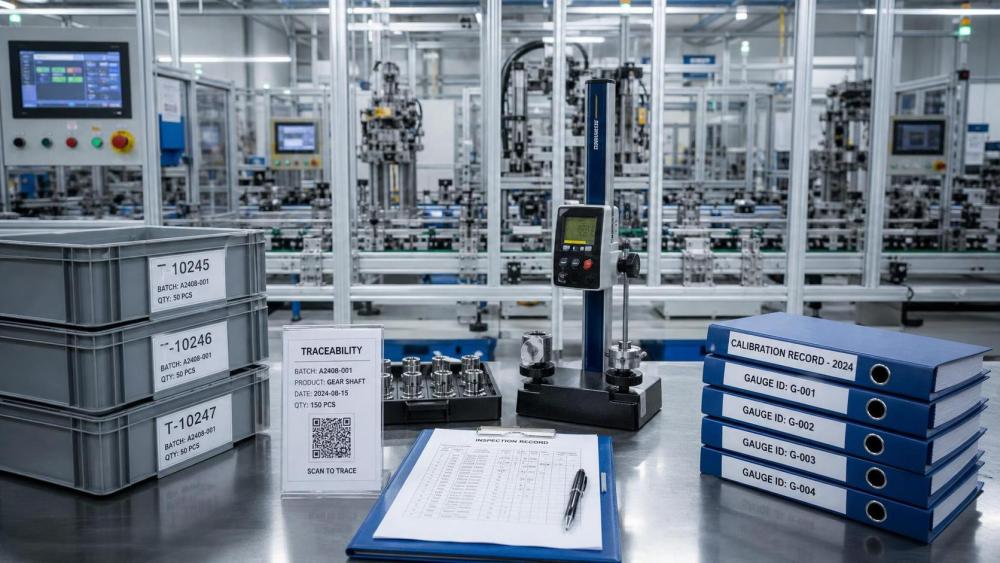
- Traceability: whether a batch, lot, serial number, or process history can be followed backward and forward without gaps.
- Equipment assurance: whether calibration, preventive maintenance, and fitness-for-use records align with actual equipment status.
- Non-conformance handling: whether defective output is identified, segregated, dispositioned, and prevented from unintended use.
- Corrective action: whether root causes are investigated credibly and actions are verified for effectiveness, not just closed administratively.
These are not abstract management-system topics. They are the points where standards become visible in production reality.
The most common misunderstanding: passing the last audit does not mean the system is audit-ready
Factories often inherit a false sense of security from a previous successful audit. But surveillance cycles, customer scrutiny, and regulatory expectations do not stand still. Product mix changes, new machinery is installed, shift structures evolve, and suppliers are replaced. Each of those changes can alter compliance conditions even if the certificate on the wall is still valid.
Change management is one of the least glamorous and most consequential parts of audit readiness. When a process is modified, teams usually focus on throughput, cost, scrap rate, or delivery impact. They are less disciplined about asking whether the documented control plan, inspection method, hazard assessment, work instruction, training record, validation evidence, or customer approval condition also changed. Auditors look for these discontinuities because they reveal whether compliance is embedded in operations or only reviewed at audit time.
A practical internal test is simple: pick one recent engineering or process change and reconstruct its compliance trail. Can the site show who approved it, what risks were assessed, what documents were revised, what personnel were retrained, and how effectiveness was confirmed? If not, the weakness is already visible.
Documents matter, but only if they mirror the floor
There is a reason experienced auditors spend time walking the line after reviewing procedures. They know documentation can be cosmetically complete. Strong manufacturers avoid this trap by treating procedures as operational tools rather than audit artifacts. A work instruction should be written at the level of the task, use the same process language the team actually uses, and specify what must be controlled, measured, recorded, or escalated. If a procedure is too generic to guide real work, it is also too weak to defend during an audit.
The same applies to records. Many organizations retain large volumes of forms without checking whether they prove anything meaningful. An auditor does not need more paperwork; the auditor needs reliable evidence. A complete production record should allow an informed person to understand what was made, under which conditions, by whom, using which approved materials and equipment, and what happened when something deviated. Missing signatures are visible problems, but records filled out mechanically with no decision value can be just as damaging.
Training should be tested as competence, not attendance
Audit preparation often triggers a rush to update training files. That is understandable, but a sign-off sheet alone does not prove competence. Most standards are concerned with whether personnel are capable of performing tasks that affect quality, safety, compliance, or conformity. In practice, this means the organization should be able to show a connection between role requirements, training content, qualification criteria, and shop-floor behavior.
For high-risk operations, this point becomes sharper. Lockout/tagout practices, confined-space work, hazardous chemical handling, critical welding parameters, sterile or controlled-environment behaviors, and release authority for non-conforming product all require more than attendance records. The organization should know what competence looks like and how it is verified. Some sites handle this well through observation checklists, periodic requalification, layered process audits, or supervised release authority. The mechanism may differ, but the principle is consistent: training records should connect to controlled execution.
Internal audits are useful only when they are willing to find trouble
Many manufacturers conduct internal audits on schedule and still remain vulnerable. The problem is not frequency; it is depth. If internal audits only verify that forms exist and departments can answer expected questions, they create comfort without revealing risk. A credible internal audit should sample actual transactions, actual batches, actual training effectiveness, actual maintenance execution, and actual closure of previous findings.
Good audit programs also avoid auditing in isolation. A quality issue may trace back to purchasing controls. A safety incident may expose weak contractor management. A labeling problem may originate in ERP master data. Compliance failures usually move across functions faster than organizational charts admit. Cross-functional audit trails are harder to run, but they are closer to how real findings emerge.
One useful discipline is to review not only whether a corrective action was closed, but whether the original condition can still be recreated. If a previous finding concerned uncontrolled documents or repeated measurement errors, revisit the point months later without notice. If the same pattern reappears, the prior action addressed symptoms, not causes.
Supplier controls are now part of your audit story
Manufacturers are increasingly audited as nodes in a larger supply chain, not as isolated factories. That changes the standard of proof. It is no longer enough to say a supplier is approved because they have been used for years or because they provided a certificate. Auditors may ask how supplier risk is categorized, how incoming conformity is verified, what happens when a supplier changes a material or process, and whether subcontracted operations remain traceable to final output.
This matters especially in cross-border sourcing environments where documentation formats, technical norms, labeling conventions, and enforcement practices vary by country. A supplier may be commercially capable but still weak in traceability discipline, regulatory familiarity, or change notification. Quality and safety leaders should therefore prepare audit evidence that shows supplier control as an active process: qualification, monitoring, non-conformance feedback, and re-evaluation based on risk, not habit.
What a pre-audit review should actually look for
The most effective pre-audit reviews are selective and evidence-based. They do not try to re-read every file in the system. They choose a few critical processes and test whether the management system can hold together from requirement to execution to record to corrective action.
That kind of review reveals far more than a blanket checklist ever will.
Audit readiness is really system credibility
When manufacturers prepare seriously for compliance audits, they are not only trying to avoid findings. They are testing whether the factory can prove disciplined control to customers, regulators, certifiers, and internal leadership. That is why industrial standards compliance for manufacturers should be treated as a live operating condition, not an annual preparation exercise.
A useful way to think about readiness is this: if an auditor starts with one shipment, one work order, one safety-critical task, or one complaint, can the organization show a coherent chain of control without improvising? If the answer is yes, the site is usually closer to true compliance than its documents alone might suggest. If the answer is no, the gap is not only about the next audit. It is about how reliably the business is managing risk today.
Weekly Insights
Stay ahead with our curated technology reports delivered every Monday.
Recommended News
 Supply ChainSep 22, 2026How heavy equipment lifecycle data can reduce unexpected downtime
 Supply ChainSep 21, 2026How export regulations affect logistics lead times and delivery risk
 Industry StandardsSep 20, 2026What evidence is needed to pass a carbon reporting audit?
 Industry StandardsSep 19, 2026When does manufacturing compliance consulting reduce audit risk?