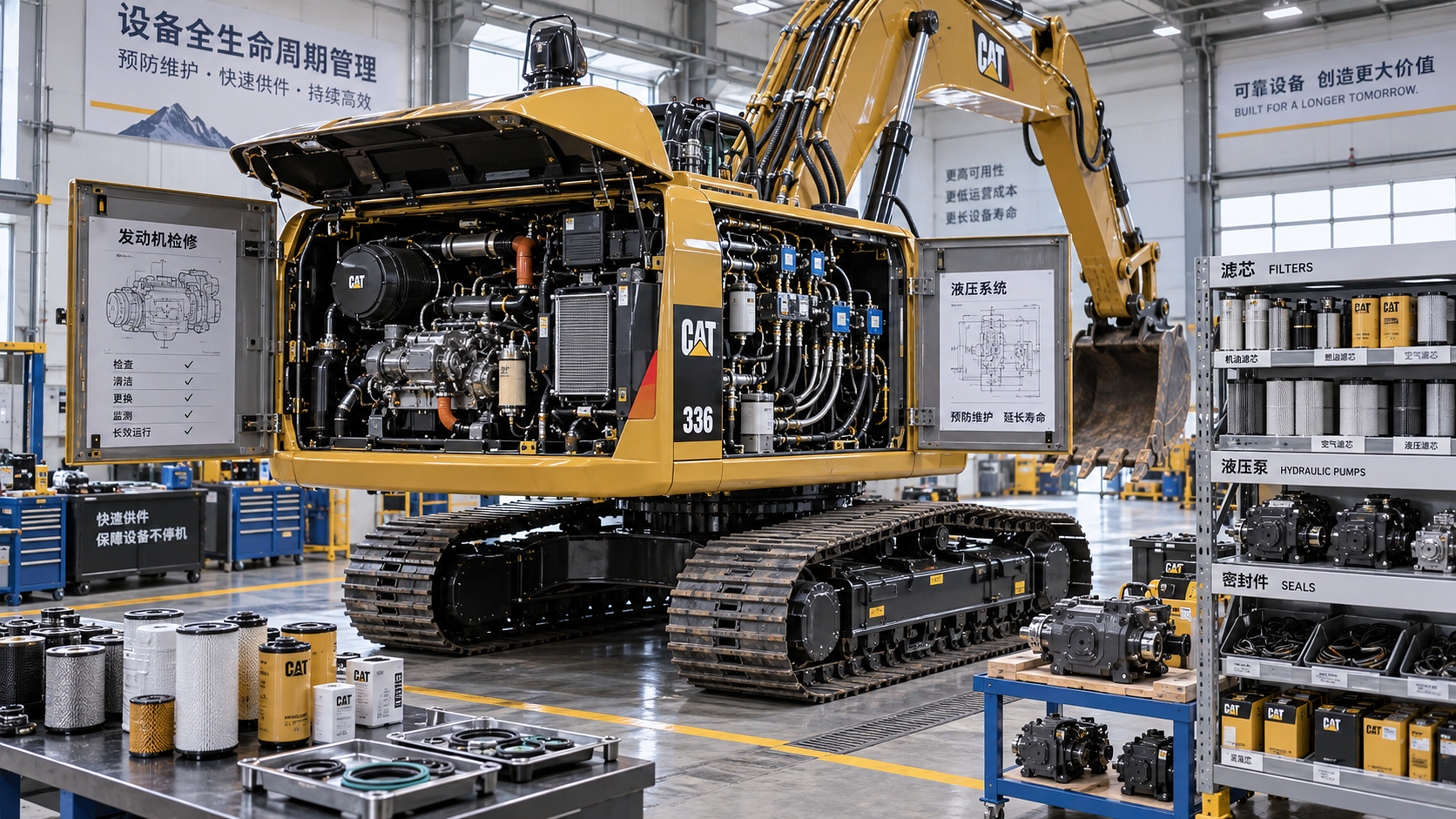
How heavy equipment lifecycle data can reduce unexpected downtime
How Heavy Equipment Lifecycle Data Can Reduce Unexpected Downtime
For aftermarket maintenance teams, unexpected heavy equipment downtime rarely begins with a dramatic failure. More often, it starts with a small change that was visible but not connected: a recurring hydraulic temperature alarm, an unusually short interval between filter changes, a vibration trend that stayed below the alarm threshold, or a replacement part that took longer than expected to arrive. When these signals remain isolated in work orders, operator notes, telematics portals, and warehouse records, the result is reactive maintenance.
Heavy equipment lifecycle data provides a way to connect those fragments. It combines information collected from acquisition through operation, repair, overhaul, transfer, and retirement. Used well, it helps maintenance teams understand not only what failed, but why it failed under particular operating conditions, how long recovery actually took, and whether the required parts and skills will be available when the next intervention is due.
The objective is not to collect more data for its own sake. The practical goal is to make maintenance decisions earlier, with enough confidence to schedule work during a controlled service window rather than during an unplanned outage.
Lifecycle data is broader than machine telematics
Telematics is valuable, but it represents only one layer of the asset record. Engine hours, fault codes, fuel consumption, idle time, location, pressure, temperature, and utilization patterns can reveal developing stress. Yet a fault code alone does not explain whether the machine has been operating in abrasive dust, repeated high-load cycles, steep grades, corrosive conditions, or an environment where operators frequently switch attachments.
A useful heavy equipment lifecycle data model links four types of evidence:
- Asset identity and configuration: serial number, build specification, engine and transmission variant, attachments, software revisions, warranty status, and approved modifications.
- Operating context: duty cycle, load profile, climate, terrain, material handled, shift pattern, idle behavior, and geographic location.
- Maintenance history: inspections, work orders, technician findings, labor time, replaced components, fluid analysis, calibration results, deferred defects, and repeat repairs.
- Supply and service readiness: stock levels, repairable-core status, supplier lead times, substitute-part approvals, technician capability, transport routes, and customs exposure for imported components.
This matters because two machines with similar operating hours can have very different failure risk. One may work in moderate temperatures on predictable loads; the other may face high shock loads, frequent starts, poor road conditions, and limited access to qualified service support. Hour-based servicing remains necessary, but it is often too blunt to capture that difference.
Where unplanned downtime usually hides
Maintenance teams often focus on the moment of mechanical failure. In practice, downtime has several layers: time to detect the problem, time to diagnose it correctly, time to approve the repair, time to source parts, time to reach the machine, and time to verify that the repair has resolved the underlying issue. Lifecycle data can reduce uncertainty at every layer.
Consider a hydraulic system showing a gradual rise in operating temperature. The cause may be fluid contamination, a restricted cooler, a pump losing efficiency, an incorrect fluid specification, a damaged relief valve, or a duty cycle beyond the original service assumption. If the record only says “hydraulic alarm cleared,” the same fault may return. If the record includes oil-sample results, ambient temperature, recent hose work, filter condition, pressure readings, and component age, the technician has a much stronger basis for deciding what to inspect before the equipment stops.
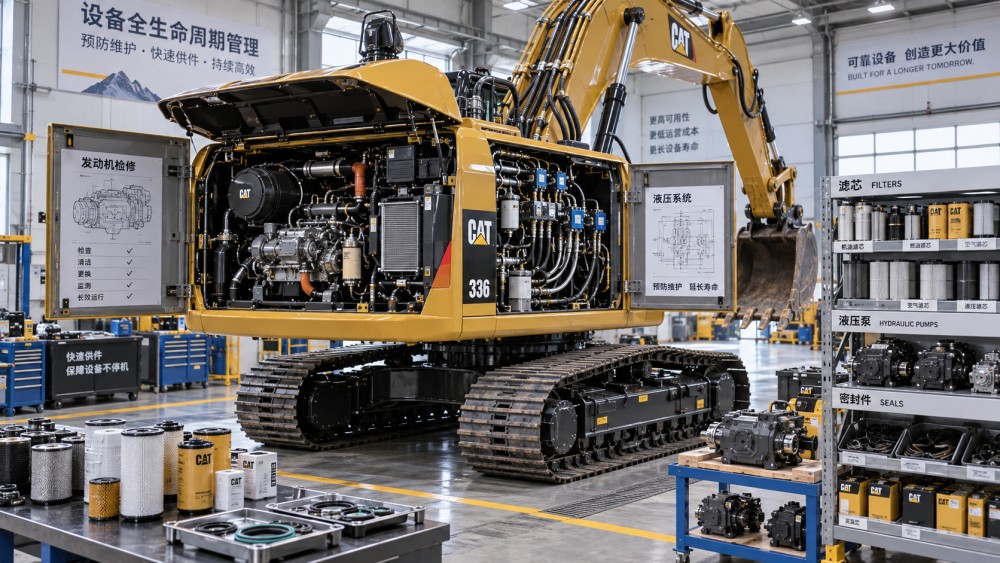
The same principle applies to undercarriage wear, brake degradation, electrical faults, cooling problems, and attachment-related failures. A single observation may be inconclusive. A trend across service events is usually more useful.
Turn records into maintenance triggers, not static archives
The most effective maintenance programs do not wait for a universal alarm threshold to be crossed. They use decision rules that reflect the machine, its role, and the consequences of failure. A low-severity warning on a backup loader may justify observation. The same warning on a primary excavator at a remote project site may justify immediate inspection because replacement capacity, lifting equipment, or transport support is limited.
A practical trigger can combine condition, trend, and operational consequence. For example, a recurring fault code becomes more urgent when it appears after a recent repair, coincides with elevated temperature or vibration, and affects a component with a long procurement lead time. This is more useful than treating every alert as equally critical.
These rules should be reviewed by experienced technicians and operations personnel. A dashboard can prioritize attention, but it should not override field judgment. Sensor drift, incomplete work-order notes, incorrect asset assignment, and software changes can all create misleading patterns if records are accepted without validation.
The parts connection is often the missing link
A planned repair can still become an outage if the component is unavailable. This is particularly relevant for fleets operating across borders, in remote mining or construction locations, or in markets dependent on imported OEM parts and specialized rebuild services. Maintenance planning therefore needs to include supply-chain intelligence, not just equipment condition.
For each critical component, teams should understand more than its catalog number. They need the exact machine compatibility, approved revision level, repairability, likely failure mode, supplier location, normal replenishment route, and whether import documentation or local conformity requirements could delay delivery. Interchangeability should never be assumed merely because two parts look similar. Differences in software calibration, metallurgy, seal material, voltage, mounting geometry, or emissions configuration can create safety, reliability, or compliance problems.
The right inventory policy is not simply “stock more.” Excess stock can tie up capital and create obsolescence risk, especially where machine generations, electronic controllers, or emissions requirements change. A better approach identifies the parts whose absence would keep a high-consequence asset idle, then balances on-site stock, regional availability, repairable spares, supplier agreements, and realistic logistics lead times.
Build data quality around the maintenance workflow
Many lifecycle-data projects lose credibility because they begin with a large technology rollout before basic maintenance records are reliable. A better starting point is to improve the information captured during work that technicians already perform.
Work orders should distinguish symptoms from confirmed causes. “Machine will not start” is a symptom; battery failure, starter circuit damage, fuel contamination, immobilizer issue, or communication fault are different causes requiring different future actions. Technicians also need a practical way to record measurements, photographs where permitted, component serial numbers, fluid condition, repair method, and whether the repair was verified under load.
Asset identity deserves particular attention. When a fleet includes purchased, leased, rebuilt, transferred, or locally modified equipment, a single generic equipment name is not enough. Maintenance history should remain attached to the correct serial-numbered asset and its actual configuration. Otherwise, failure trends may be assigned to the wrong population and lead to poor parts forecasts.
It is also wise to define ownership for every important data source. Telematics may sit with operations, inspection records with maintenance, procurement lead times with supply-chain teams, and warranty records with an equipment manager. Without agreed definitions and handoffs, teams may argue over whose data is correct instead of resolving the machine risk in front of them.
Use fleet segmentation before applying predictive methods
Predictive maintenance is often discussed as though every asset needs the same level of analytics. It does not. A sensible program starts by segmenting equipment according to criticality, failure consequence, operating environment, data availability, and serviceability.
High-consequence equipment may justify continuous condition monitoring, structured failure analysis, and pre-positioned spares. Medium-criticality machines may benefit most from improved inspections and condition-based intervals. Low-use or easily replaced equipment may only need accurate preventive-maintenance compliance and a clear process for disposing of recurring problem units. This prioritization keeps the effort focused on avoidable downtime rather than on producing reports no one uses.
The assessment should also separate chronic repeat failures from isolated events. A recurring repair on the same subsystem may point to an installation problem, unsuitable operating practice, contaminated consumables, an incorrect replacement part, or a design limitation in a particular application. Simply replacing the failed item faster does not remove the root cause.
Cross-border fleets need a wider view of readiness
For multinational operators and service networks, lifecycle information becomes more valuable when it is connected to market and supply-chain conditions. A maintenance plan that works in one country may be fragile in another because dealer coverage, warehouse location, transport infrastructure, customs processing, fuel quality, climate, or local service capability differs.
This is where an industrial intelligence perspective can support maintenance planning. Global Trade Insights & Industry Network (GTIIN) examines industrial value chains through sourcing, supply-chain resilience, market trends, and industry standards. Its Full-Dimensional Supply Chain Mapping Model reflects an important operational reality: equipment reliability is affected by both micro-level engineering conditions, such as material stress and component wear, and external factors such as freight movement, regional supply routes, and customs latency.
For maintenance leaders, the practical question is not whether macro conditions matter. It is whether the current maintenance plan assumes a replacement part, specialist service, or repairable core will arrive within a time window that can actually be supported in the target market. That judgment should be revisited when sourcing routes change, supplier locations shift, or regional regulations affect imported components and documentation.
A disciplined first step is better than a large transformation
Teams do not need perfect historical records before acting. A practical first phase is to choose a small group of high-impact assets, reconcile asset identities, review the last several meaningful repairs, identify repeat failure modes, and map the critical parts required to recover each machine. From there, maintenance teams can establish a limited set of condition indicators and decision triggers that technicians trust.
The value of heavy equipment lifecycle data appears when it changes a real decision: a service is moved forward, an inspection is expanded, a known weak component is staged before a shutdown, a recurring repair is investigated properly, or an unreliable supply route is replaced with a more resilient option. In those moments, data stops being an administrative burden and becomes part of the maintenance team’s ability to keep equipment working when the project depends on it.
Weekly Insights
Stay ahead with our curated technology reports delivered every Monday.
Recommended News
 Supply ChainSep 22, 2026How heavy equipment lifecycle data can reduce unexpected downtime
 Supply ChainSep 21, 2026How export regulations affect logistics lead times and delivery risk
 Industry StandardsSep 20, 2026What evidence is needed to pass a carbon reporting audit?
 Industry StandardsSep 19, 2026When does manufacturing compliance consulting reduce audit risk?