How Industrial Safety Regulations Shape Manufacturing Compliance Plans
Why do safety regulations change the compliance plan instead of just adding paperwork?
Because in manufacturing, regulation is not sitting outside the process. It reaches straight into machine guarding, chemical handling, lockout/tagout, contractor access, training records, maintenance intervals, and even how nonconforming product is isolated after an incident. For quality and safety managers, that means a compliance plan is not a folder of certificates. It is the operating logic that connects legal duties to daily plant decisions.
A good plan usually changes in three visible ways once industrial safety regulations manufacturing sites must follow are mapped correctly. First, hazards are ranked by task and exposure, not by department labels. Second, controls are written into production routines, purchasing rules, and change management. Third, audit evidence is collected as work happens, instead of being recreated in a rush before an inspection or customer visit.
That is why two factories making similar parts can need very different compliance plans. The equipment, energy sources, operator interaction, chemicals used, and local legal framework all change what “compliant” looks like in practice.
Which regulations usually have the biggest impact on a manufacturing compliance plan?
The biggest impact usually comes from rules tied to high-consequence hazards. In most plants, that includes machine safety, electrical safety, hazardous chemicals, confined spaces, working at height, fire protection, personal protective equipment, and incident reporting. Depending on the market, the compliance plan may also need to reflect ISO 45001 management system requirements, local labor safety law, and sector-specific equipment rules.
For safety and QC teams, the useful question is not “Which regulation exists?” but “Which regulation changes how work must be done?” Focus on the rules that affect:
- equipment design and safeguarding;
- standard operating procedures;
- maintenance shutdown and energy isolation;
- chemical labeling, storage, and exposure control;
- competency requirements for operators, technicians, and contractors;
- record retention for inspections, incidents, and corrective actions.
If a rule affects one of those areas, it belongs inside the compliance plan, not in a separate legal register that nobody uses on the shop floor.
How do you decide which safety rules apply to one plant and not another?
Start with activities, not assumptions. Many compliance gaps happen because teams classify themselves too broadly as “general manufacturing” and miss the triggers hidden in actual operations. Applicability should be judged from the process map, equipment list, materials used, and site layout.
At minimum, review these inputs:
Once those inputs are clear, the plan can be built around legal triggers that are real, not generic.
What should be inside a manufacturing compliance plan if safety is the main concern?
A workable plan is more than a policy statement. It should tell people what must be controlled, who owns it, what evidence proves it happened, and what happens when something fails. If any of those pieces are missing, the plan may look complete but still collapse during an audit or after an incident.
Most strong plans include:
- A legal and standard register linked to site activities.
- Risk assessments for tasks, equipment, and materials.
- Required operational controls such as guarding, permits, isolation, ventilation, and PPE.
- Training matrices by role, including refresher intervals.
- Inspection and preventive maintenance schedules.
- Incident, near-miss, and corrective action workflow.
- Contractor control requirements.
- Document control and record retention rules.
- Internal audit checks and management review triggers.
QC teams often overlook the last two items. That is a mistake. Without controlled records and periodic verification, you cannot prove that the plan exists beyond the document itself.
Where do quality control and safety management overlap most in practice?
They overlap most where process variation and unsafe conditions share the same root cause. A bypassed interlock, worn fixture, poor housekeeping around packaging lines, uncontrolled rework, or the wrong chemical in the wrong container can create both a product defect and a safety event. In real plants, these are rarely separate problems.
That is why compliance plans work better when safety checks are inserted into quality gates. For example, line clearance before startup can verify not only material status and tooling, but also guard position, emergency stop accessibility, and spill-free work areas. Maintenance release can confirm machine capability and safe operating condition at the same time. One inspection point can serve both quality assurance and regulatory control, provided the criteria are written clearly.
How detailed should risk assessments be?
Detailed enough to guide a control decision at task level. Not so broad that they become decorative. A risk assessment saying “machinery may cause injury” is almost useless. A useful one identifies the exact task, exposure moment, severity, likelihood, existing controls, and missing controls. It should also show whether the hazard appears during normal production, cleaning, setup, maintenance, jam clearing, or changeover. Those non-routine steps are where many serious incidents happen.
For compliance purposes, the key test is simple: can a supervisor use the assessment to decide what must be installed, trained, inspected, or prohibited? If not, it is too generic.
What documents do auditors usually ask for first?
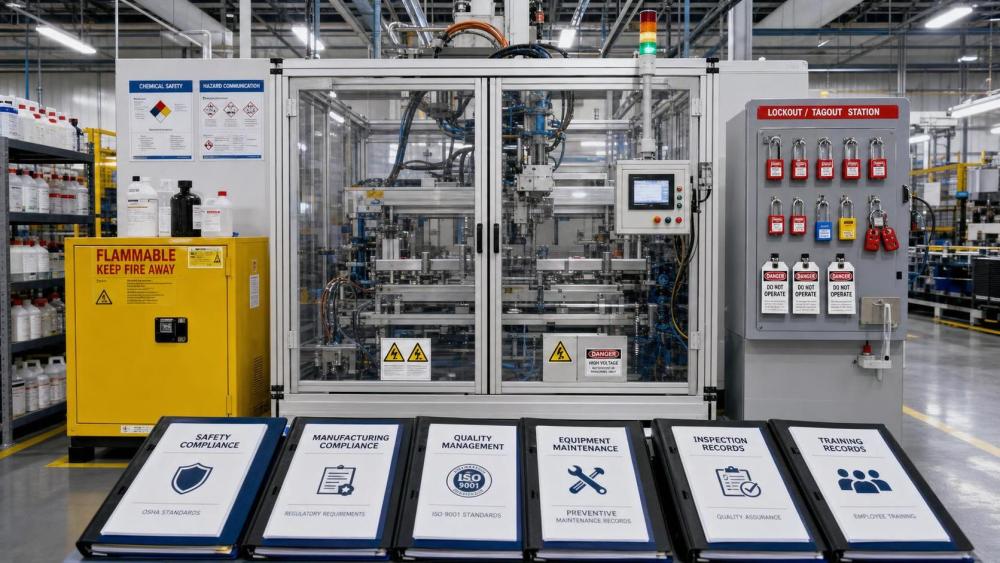
Auditors usually begin with the documents that show whether the system is alive. Policies matter, but records carry more weight. Expect early attention on risk assessments, training records, inspection logs, maintenance records, incident investigations, corrective action closures, permit-to-work forms, chemical inventories, and contractor induction records.
What they are really testing is consistency. If the lockout/tagout procedure says annual retraining is required, the training matrix should show the due dates, attendance records should match the names of exposed employees, and maintenance observations should not show people bypassing isolation steps. The same logic applies to PPE issue records, forklift authorization, hot work permits, and emergency drill reports.
What are the most common mistakes when companies build compliance plans around industrial safety regulations?
A few problems come up again and again:
- Copying corporate procedures without checking local equipment and legal triggers.
- Treating training as attendance only, with no competency check for critical tasks.
- Writing controls for normal production but not for cleaning, repair, or setup.
- Keeping EHS and QC records in separate systems that never reconcile.
- Closing corrective actions on paper while the physical condition remains unchanged.
- Ignoring contractors, especially during shutdowns, expansions, and temporary projects.
The pattern is clear: plans fail when they are written around organization charts instead of real work. If a hazard appears during a task, the plan has to meet the task there.
Do supplier and contractor controls belong in the same compliance plan?
Yes, when their work can affect plant safety, product integrity, or regulatory exposure. A contractor replacing a motor, calibrating a control panel, cleaning a tank, or handling industrial chemicals can introduce serious risk in a very short time. The same goes for suppliers that provide safety-critical components, PPE, pressure items, or chemical materials with labeling and handling obligations.
The compliance plan should define entry requirements: approved documentation, competency evidence, site induction, permit conditions, supervision rules, and incident reporting lines. For suppliers, link incoming inspection and purchasing approval to the documents that matter, such as technical specifications, SDS, conformity paperwork where applicable, and traceability records. This is where cross-border sourcing gets tricky: different markets may accept different documents, but the plant still needs one internal rule for what can be received, stored, installed, and used.
How often should the compliance plan be reviewed?
Review it whenever the risk picture changes, not only on a calendar cycle. An annual review is common, but it is not enough by itself. The plan should also be revisited after a process change, new machine installation, layout change, serious near miss, incident investigation, new chemical introduction, customer audit finding, or contractor-related event.
One practical rule works well: if the change affects exposure, task steps, energy sources, competency needs, or required records, update the plan before full production resumes. Waiting until the next scheduled review creates a gap between the real plant and the documented control system.
What is the clearest way to tell whether the plan is actually working?
Look for alignment between four things: the hazard, the written control, the physical condition, and the record. If one of those is missing, the system is weak. A guarded machine with no inspection record may drift out of compliance. A complete training file with repeated unsafe behavior means the training did not translate into control. A closed corrective action that leaves the same exposure in place is not a corrective action.
For quality and safety managers, the most reliable checkpoint is a floor-based verification routine. Take one critical process each month and trace it end to end: applicable rule, task risk, operator instruction, machine condition, current records, and supervisor response to deviations. That kind of review shows very quickly whether industrial safety regulations manufacturing teams claim to follow are actually shaping behavior on the line.
The practical takeaway is straightforward: build the compliance plan around real exposure points, not around a document index. If a regulation cannot be connected to a task, a control, an owner, and a record, it is still outside the operation, and that is where compliance problems usually begin.
Weekly Insights
Stay ahead with our curated technology reports delivered every Monday.
Recommended News
 Supply ChainSep 22, 2026How heavy equipment lifecycle data can reduce unexpected downtime
 Supply ChainSep 21, 2026How export regulations affect logistics lead times and delivery risk
 Industry StandardsSep 20, 2026What evidence is needed to pass a carbon reporting audit?
 Industry StandardsSep 19, 2026When does manufacturing compliance consulting reduce audit risk?