EU Enforces Carbon Footprint Declarations for Industrial Sealants
As of July 1, 2026, a revised EU standard has brought a new compliance requirement into force for imported industrial sealants and adhesive products. Following the release of EN 15332:2026 by CEN on June 28, all such products entering the EU must now be accompanied by a certified life-cycle carbon footprint declaration under ISO 14067, with that documentation included in CE technical files. This development is worth close attention from chemical material exporters, overseas distributors, certification-related teams, and customs-facing compliance functions because it directly affects market access, document readiness, and shipment timing.
What the revised EN 15332:2026 now requires
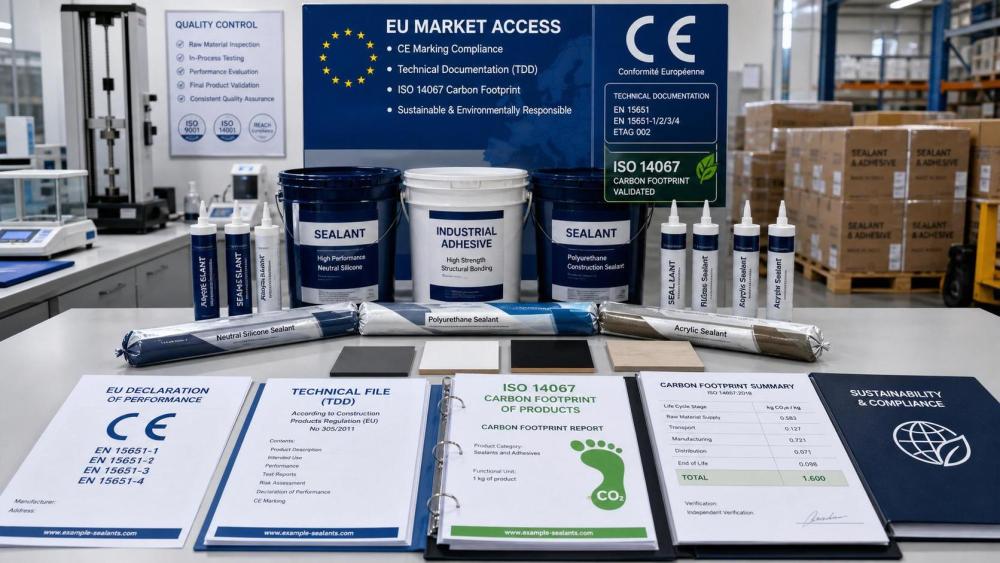
The confirmed facts are clear. CEN released the revised EN 15332:2026 on June 28, 2026. From July 1, 2026, all industrial sealants and adhesive products imported into the EU are required to carry a certified full life-cycle carbon footprint declaration in line with ISO 14067. The carbon footprint declaration must also be included in CE conformity technical documentation.
The information provided also confirms that this requirement directly affects product entry into the EU, testing and certification timelines, and customs compliance for Chinese chemical material exporters. For overseas distributors, the stated practical issue is the need to verify whether suppliers can provide traceable carbon data.
Where the pressure is likely to appear across the supply chain
Exporters facing a new document threshold
From an industry perspective, direct exporters are likely to feel the impact first because the new requirement is tied to EU market access. The immediate business effect is not only whether a product can be shipped, but whether supporting documentation is complete enough to support CE technical files and customs-facing compliance steps.
Certification and testing timelines may become more exposed
Analysis shows that teams responsible for certification preparation, technical dossiers, and shipment scheduling will need to pay closer attention to timing. The information provided explicitly points to an effect on testing and certification cycles, which means compliance work may no longer sit separately from delivery planning.
Distributors need deeper supplier verification
For overseas distributors, the issue is less about manufacturing itself and more about supplier validation. Observably, the new requirement puts pressure on distributors to confirm whether upstream suppliers can provide certified and traceable carbon footprint data, rather than relying only on conventional product and regulatory paperwork.
Customs and supply chain coordination become more sensitive
Supply chain service functions, including teams managing export documents and clearance coordination, may also be affected. The reason is straightforward: once carbon footprint declarations become part of required technical documentation, any inconsistency or delay in supporting files can affect customs compliance and delivery execution.
What companies should watch in day-to-day operations
Whether carbon data is certification-ready
What deserves closer attention is whether existing carbon data can actually meet the requirement for a certified life-cycle carbon footprint declaration under ISO 14067. A general sustainability statement is not the same as a document that can be placed into CE technical files.
How CE documentation workflows need to change
Companies involved in EU-bound products should review how technical documents are assembled, updated, and handed over across regulatory, quality, export, and sales functions. The practical issue here is document integration: the requirement is not limited to having carbon information somewhere in the business, but to having it incorporated into conformity documentation.
Which products and shipments face the nearest risk
Analysis shows that firms with active EU shipments of industrial sealants and adhesives should pay particular attention to product lines already in transaction or delivery cycles. The key concern is whether documentation readiness aligns with shipment timing, especially where customs compliance may depend on complete files.
How supplier and customer communication should be handled
For exporters and distributors alike, supplier qualification and customer communication are now more closely linked. Current attention should be on whether upstream partners can provide traceable carbon data, and whether downstream customers need confirmation that CE-related documents have been updated to reflect the new standard requirement.
Why this looks like more than a short-term procedural change
Observably, this is not just a minor paperwork revision. The requirement connects carbon footprint disclosure directly to CE technical documentation, which gives carbon data a more operational compliance role than a purely voluntary or marketing-oriented one. Analysis shows that the immediate effect is procedural, but the broader signal is that product access, documentation quality, and traceability are becoming more tightly linked.
It is more appropriate to understand this as both an immediate compliance change and a longer-term regulatory signal. The effective date is already in place, so this is not only something to monitor from a distance. At the same time, the practical interpretation, documentation handling, and verification expectations may still need continued observation in real business execution.
How to read this development at this stage
At this stage, the most balanced reading is that EN 15332:2026 has created a concrete new compliance threshold for industrial sealants and adhesives entering the EU. The confirmed impact is on market entry, certification timing, CE file preparation, and customs-facing readiness. For the industry, the issue is not whether the rule matters, but how quickly affected companies can align product documentation, carbon data traceability, and shipment processes with the new requirement.
What deserves continued attention is the gap that can emerge between a formal standard requirement and day-to-day execution across exporters, distributors, and service providers. This is best understood as an active compliance development with immediate relevance and ongoing implementation implications.
Basis of this report and points for follow-up
This article is based on the user-provided news title, event date, and event summary regarding the revised EN 15332:2026 requirement taking effect on July 1, 2026. For this type of industry update, commonly relevant source categories may include official notices, standard organization documents, company statements, industry association releases, and reporting from authoritative trade media.
No specific official source link was provided in the input, so the exact official publication path still needs to be continuously verified. Follow-up attention should remain on any further official wording, implementation details, and documentation expectations related to CE technical files, certified ISO 14067 declarations, and supplier carbon data traceability.
Weekly Insights
Stay ahead with our curated technology reports delivered every Monday.
Recommended News
 Supply ChainOct 15, 2026How to choose a supply chain strategy for unpredictable demand
 Supply ChainOct 14, 2026How to assess an industrial equipment supplier's spare parts support
 Supply ChainOct 14, 2026EU Updates CSDDD Guidance on Global Supply Chain Due Diligence
 Global SourcingOct 13, 2026How to assess industrial automation suppliers for legacy integration