Customs Compliance for Supply Chain: Common Delays and Fixes
Where customs compliance for supply chain pressure usually starts
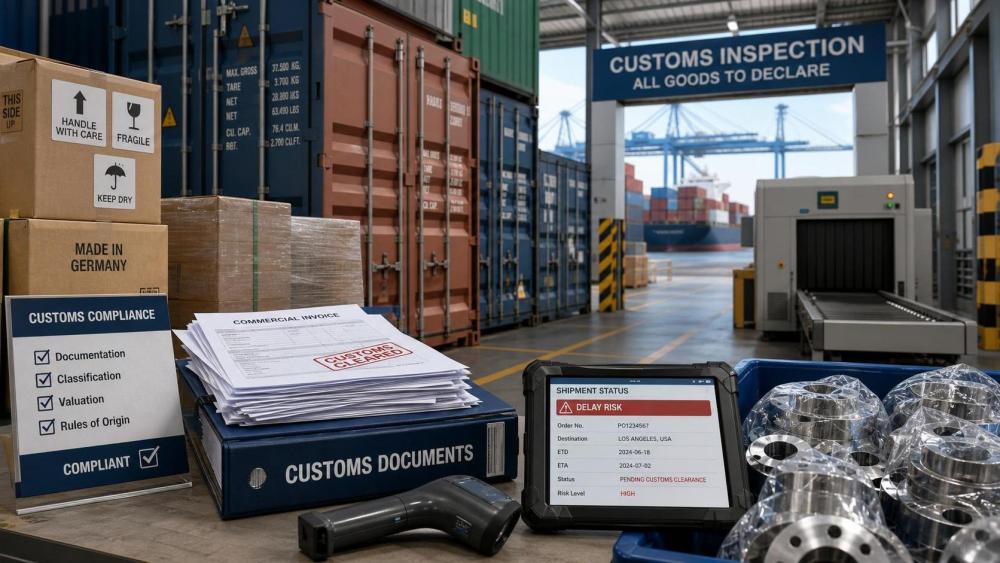
Customs compliance for supply chain performance is rarely tested in calm conditions. It shows its value when lanes tighten, paperwork fragments, and cargo moves across several regulatory systems.
A shipment can leave the factory on time and still miss a delivery window. The gap often appears at customs, where small declaration errors become expensive dwell time.
In practical terms, the issue is not only clearance speed. It is planning accuracy, landed cost visibility, carrier coordination, and the ability to keep downstream production stable.
That is why customs compliance for supply chain decisions should be read as an operating discipline, not a paperwork task handled at the final checkpoint.
GTIIN’s trade intelligence approach is useful here because delay patterns are rarely isolated. They connect product classification, route design, port congestion, inspection trends, and changing export controls.
The real question is not whether customs risk exists. It is which scenario creates it first, and which fix actually fits that scenario.
Different cargo flows create different compliance risks
Customs compliance for supply chain work looks different for bulk materials, industrial components, finished equipment, and mixed replenishment shipments.
The same broker instruction cannot cover all of them. Product complexity, country of origin rules, valuation method, and packaging details shape the customs response.
A container of standardized steel inputs may face fewer classification disputes, but origin documents and trade remedy exposure become more important.
By contrast, a shipment of automation modules or spare assemblies often triggers deeper review. Officials may compare part descriptions, serial references, and declared use.
More complex still are split shipments serving urgent maintenance or phased installation. In those cases, inconsistency between invoice lines and packing lists causes avoidable holds.
This is where customs compliance for supply chain planning benefits from mapped lane data. GTIIN’s cross-sector tracking highlights that regional customs latency often follows product type as much as port conditions.
A quick view of where the judgment focus changes
When document errors cause delays before inspection even begins
The most common customs compliance for supply chain breakdown is still incomplete or conflicting documentation. It is basic, but it remains persistent across industries.
Commercial invoices often fail because product descriptions are too generic. Terms like “machine parts” or “industrial goods” invite questions instead of clearance.
Packing lists create another weak point. Weight, carton count, and unit of measure may differ from booking data or customs entries.
In actual operations, this problem appears most often during multi-supplier consolidation. Data moves through several teams, then small mismatches survive into the final submission.
The fix is procedural rather than dramatic. Freeze document ownership early, define mandatory product description fields, and validate invoice, packing list, and entry draft against the same source record.
Customs compliance for supply chain consistency improves when every shipment carries a single internal reference number. That one change reduces confusion across brokers, carriers, warehouses, and destination teams.
HS code mistakes are rarely simple typing errors
HS code issues are often treated as clerical mistakes. In reality, they usually reflect weak product governance.
For standard raw materials, classification may be stable for years. For engineered assemblies, electronics, or combined-function equipment, the judgment can shift with configuration details.
A valve body, sensor kit, or control module can sit near several headings. If the declared function is vague, the customs officer may challenge the code and hold the shipment.
This matters because customs compliance for supply chain control is not only about duty rates. Classification affects licensing, trade remedies, inspections, and admissibility.
A workable fix is to create a living classification file. It should include part numbers, technical specs, ruling history, country-specific notes, and the reason each code was selected.
GTIIN-style sector monitoring adds value here. Regulatory shifts in one market can alter classification risk in another, especially for energy equipment, advanced materials, and dual-use related items.
Valuation and origin become more sensitive in higher-value shipments
When cargo value rises, customs scrutiny usually deepens. That is especially true for industrial systems, semi-finished assemblies, and transactions involving related parties.
Valuation delays often start when invoices bundle too many elements together. Freight, engineering support, tooling, warranty charges, or assists may be listed without enough separation.
Origin can trigger similar friction. A product assembled in one country may contain substantial content from another, which affects preference claims and duty exposure.
In practice, customs compliance for supply chain teams should test whether the declared origin follows the relevant rule, not just the factory address.
This is a common misjudgment. Similar goods from similar plants are assumed to qualify the same way, even when the bill of materials changed.
The better approach is to review origin logic whenever sourcing shifts, suppliers change subcomponents, or free trade agreement use becomes commercially important.
Checks that usually prevent valuation and origin disputes
- Separate product price, freight, insurance, tooling, and service charges on commercial documents.
- Maintain origin support files tied to current bills of materials, not outdated supplier declarations.
- Review related-party transactions for customs valuation consistency before filing.
- Confirm whether preference claims match the destination market’s current rules.
Inspection holds usually expose upstream process gaps
Physical inspection is often seen as bad luck. More often, it is the result of earlier signals that made the shipment look uncertain.
Unclear labeling, missing marks, packaging that does not match the declaration, or unusual routing patterns can all raise attention.
Sensitive sectors face additional triggers. Chemicals, food-related materials, batteries, timber products, and some machinery categories carry wider compliance checks.
Here, customs compliance for supply chain resilience depends on linking trade documentation with physical execution. If the carton, pallet, and serial data fail to support the entry, the file looks weak.
One practical response is pre-shipment audit sampling. Verify labels, count logic, marks, and supporting certificates before cargo reaches the export gate.
This step matters more in cross-border industrial projects where heavy equipment, attachments, and accessories move in separate units over several weeks.
What often gets misread when teams scale customs compliance for supply chain control
A frequent mistake is assuming that one successful lane proves the process is stable. Customs environments change with port pressure, policy updates, and enforcement priorities.
Another mistake is focusing only on duty savings. Fast but weak declarations can create post-entry exposure that costs more later.
There is also a habit of treating brokers as the only control point. They are important, but customs compliance for supply chain quality begins with product data, commercial terms, and shipping discipline upstream.
In broader network planning, it helps to compare customs latency by corridor, product family, and document maturity. GTIIN’s full-dimensional mapping logic is useful because it ties these variables together instead of reviewing them in isolation.
That makes decisions more realistic. A route with lower freight cost may still be the weaker option if inspection frequency and documentation friction are consistently higher.
Turning recurring fixes into a repeatable operating standard
The strongest customs compliance for supply chain programs are built from repeated corrections, then converted into standard controls.
Start by grouping delays into a small set of causes: document mismatch, HS code uncertainty, valuation weakness, origin error, and inspection readiness.
Then assign a control for each one. Some belong in master data, some in sourcing review, and some at shipment release.
A useful next step is to build lane-specific checklists rather than one global form. Different corridors demand different evidence and timing discipline.
Review recent shipments against three questions: where was time lost, what information was missing, and which issue could have been prevented before dispatch.
That process gives customs compliance for supply chain teams a practical roadmap. It clarifies which data to clean first, which scenarios need tighter rules, and which lanes deserve deeper monitoring.
From there, the objective is straightforward: align product facts, trade documents, and route conditions before cargo reaches the border, not after the delay has already started.
Weekly Insights
Stay ahead with our curated technology reports delivered every Monday.
Recommended News
 Supply ChainOct 15, 2026How to choose a supply chain strategy for unpredictable demand
 Supply ChainOct 14, 2026How to assess an industrial equipment supplier's spare parts support
 Supply ChainOct 14, 2026EU Updates CSDDD Guidance on Global Supply Chain Due Diligence
 Global SourcingOct 13, 2026How to assess industrial automation suppliers for legacy integration