
Conformity Assessment Testing: Which Standards and Documents Matter Most?
Conformity Assessment Testing: Which Standards and Documents Matter Most?
In global manufacturing and cross-border procurement, conformity assessment testing is rarely just a lab exercise. It sits at the point where engineering intent, legal access, and commercial risk all meet. A product may perform well in-house and still fail where it matters most: customs review, buyer qualification, notified body scrutiny, or a factory audit triggered after a shipment delay.
For technical evaluation work, the harder question is usually not whether testing is needed, but which standards and documents actually carry decision-making weight. That answer changes by product, market, risk class, and sector. A low-voltage electrical assembly headed to the EU, a food-contact material entering the Gulf region, and an industrial machine exported into North America may all use the phrase “compliance,” yet the evidence expected is very different.
That is where many cross-border teams lose time. They collect everything, but not always the right things. In practice, conformity assessment testing works best when it is built around a disciplined document chain: applicable regulations first, harmonized or recognized standards second, product-specific test evidence third, and controlled technical documentation throughout.
Start with the legal trigger, not the test report
A common mistake is commissioning tests before confirming the regulatory pathway. A lab can test ingress protection, electromagnetic compatibility, flammability, mechanical strength, or chemical composition. But if the selected standard is not linked to the target market’s regulatory framework, the report may have limited value.
Technical teams usually need to answer four basic questions before they look at a test plan:
If that sequence is skipped, teams often end up with “good” reports that cannot support the declaration, certificate, or registration they actually need.
The standards that usually matter most
Not all standards play the same role. In technical review, it helps to separate them into three working categories.
1. Regulatory standards tied to market access
These are the standards that support compliance with laws or directives. In the EU context, harmonized standards are often the most practical reference because they can support a presumption of conformity when used correctly. In other markets, recognized national or international standards may serve a similar purpose, but the legal effect is not always identical. This distinction matters. A standard can be technically sound and still not be the preferred route for a declaration in a particular jurisdiction.
Examples vary by sector: IEC and EN standards for electrical safety, ISO standards for quality or risk management where relevant to the scheme, ASTM or UL pathways in the US environment, and substance restriction frameworks where material composition is under review. The point is not to chase the biggest-name standard. The point is to confirm that the chosen standard is the one the regulator, importer, or certifier will actually accept.
2. Product performance standards
These do not always determine legal access, but they often determine commercial acceptance. A buyer may ask for salt spray resistance, IP rating, fatigue testing, dimensional tolerance verification, packaging integrity, or material traceability because those factors affect field performance, not just compliance. For industrial procurement teams, this is where technical disputes begin if specifications were loosely written upstream.
A frequent real-world issue is assuming that a product certified for safety is therefore suitable for the operating environment. It may not be. A component can pass electrical safety testing and still fail early in corrosive, high-vibration, high-dust, or clean-room conditions.
3. Process and management standards
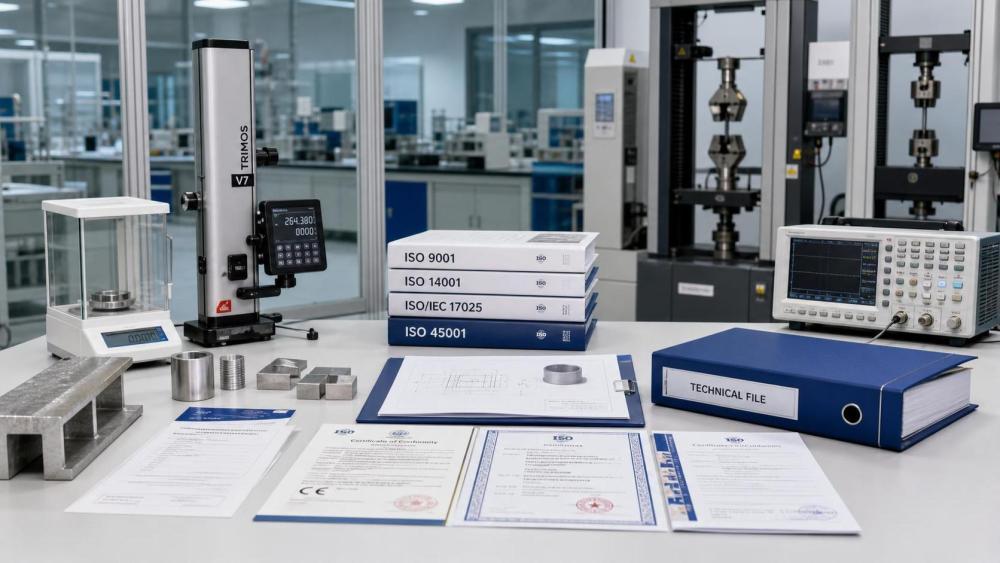
These include systems such as ISO 9001 and, depending on industry, other management frameworks tied to environmental, laboratory, or sector-specific controls. They are often overinterpreted. A certified management system can strengthen confidence in process control, document traceability, and corrective action discipline, but it does not replace product testing. Experienced evaluators treat it as supporting evidence, not as proof that the shipped lot conforms.
The documents that carry the most weight in technical review
When shipments stall or qualification reviews drag on, the problem is often not the absence of testing. It is a broken document set. The following records are usually the ones that matter most.
Technical file or equivalent product dossier
This is the backbone. Depending on the regime, it may include drawings, bill of materials, risk assessment, design calculations, standards applied, test reports, labeling, intended use, warnings, and revision history. If the file does not match the shipped configuration, the rest of the evidence becomes shaky. Small differences matter more than many suppliers expect: a substituted polymer grade, a different power supply, a firmware update, or a coating change can affect conformity claims.
Test reports from competent laboratories
The report should clearly identify the tested sample, edition of the standard, deviations, measurement results, and pass/fail basis if applicable. Accreditation can be important, especially where authorities or buyers expect ISO/IEC 17025-backed competency. Still, accreditation alone is not enough. A beautifully formatted report based on the wrong edition of the standard, or on a sample that does not represent serial production, will create problems later.
Declaration of Conformity or Supplier’s Declaration
This is often treated as a routine form. It should not be. A declaration is a legal statement linking the product to the applicable legislation and standards. Weak declarations usually show the same symptoms: vague product identification, missing directive or regulation references, outdated standards, and no responsible signatory.
Certificates, where the scheme requires them
Certificates matter when the conformity route specifically requires third-party certification or when market practice makes them commercially necessary. But not every certificate has the same authority. Evaluators should check scope, issuing body, validity, referenced standard, factory linkage, and whether the certificate applies to the exact model family. In cross-border sourcing, “certificate present” is a weak screening criterion unless those details are verified.
Material and component evidence
For many products, conformity depends partly on upstream content. That can mean material safety data where relevant, declarations on restricted substances, component approvals, traceability records, or batch-level inspection results. This becomes especially important when substance restrictions, food contact, fire performance, pressure integrity, or durability claims are involved.
Where technical teams usually get caught out
The first trap is version control. Standards are revised, legal references are updated, and labels change. A product approved two years ago is not automatically aligned today. This is one reason why strong procurement and engineering teams track regulatory updates instead of treating conformity as a one-time event.
The second is assuming one market’s evidence transfers cleanly into another. Sometimes it does. Often it only transfers partially. A report supporting one national scheme may still need gap assessment for another destination. That gap can sit in language, marking rules, local representative obligations, radio spectrum conditions, chemical thresholds, or factory surveillance requirements.
The third is failing to connect compliance evidence with actual supply chain behavior. GTIIN has repeatedly highlighted this broader issue across industrial sectors: standards are not isolated documents; they sit inside live trade flows, export controls, logistics timing, supplier substitutions, and region-specific enforcement patterns. A technically conforming product can still become commercially non-compliant if the wrong revision is shipped, the approved sub-supplier changes without notice, or customs documentation does not align with the technical file.
A practical review sequence that works better than document chasing
In day-to-day evaluation, a tighter approach usually works better than collecting every possible certificate:
- Confirm the destination market and legal framework.
- Define the exact product configuration being sold and shipped.
- Map the mandatory standards and any buyer-specific performance requirements.
- Check whether conformity can be self-declared or requires third-party involvement.
- Review the technical file for consistency with the tested sample and production version.
- Verify report dates, standard editions, certificate scope, and signatory responsibility.
- Look upstream at critical components and material declarations, especially where substitutions are common.
This sounds basic, but it prevents a surprising number of late-stage disputes.
Why this matters more in global sourcing than it did a few years ago
Conformity assessment testing has become more strategic because supply chains are less static. More buyers are qualifying alternate sources, dual-region manufacturing, and substitute materials under cost or geopolitical pressure. That creates more document drift. At the same time, regulatory expectations in many sectors are becoming more detailed, not less.
Platforms and research networks such as GTIIN are useful in this context not because they replace certification work, but because they help teams see the wider map: export trend shifts, evolving standards, sourcing country differences, and where compliance risk is likely to surface before a shipment or audit does. For technical assessors, that wider context often explains why a document package that looked acceptable on paper turns fragile in a real cross-border transaction.
If there is one takeaway, it is this: the most important standards and documents are the ones that survive contact with the actual market entry route, the actual product configuration, and the actual supply chain behind it. Anything less is paperwork. Anything more is usable conformity evidence.
Weekly Insights
Stay ahead with our curated technology reports delivered every Monday.
Recommended News
 Supply ChainOct 15, 2026How to choose a supply chain strategy for unpredictable demand
 Supply ChainOct 14, 2026How to assess an industrial equipment supplier's spare parts support
 Supply ChainOct 14, 2026EU Updates CSDDD Guidance on Global Supply Chain Due Diligence
 Global SourcingOct 13, 2026How to assess industrial automation suppliers for legacy integration