CBP Tightens Origin Checks on Chinese Fasteners
Effective October 1, 2026, a new CBP requirement will place all industrial metal fasteners imported from China under full origin verification and supply chain traceability filing. For companies dealing in HS 7318 products such as bolts, nuts, and washers, the issue is not only a customs rule change but a practical shift in clearance preparation, document control, and delivery planning across distribution, OEM sourcing, and MRO channels.
What the new CBP directive requires
According to the information provided, U.S. Customs and Border Protection issued an emergency memorandum on August 9, 2026, identified as CBP Directive No. 342-26. The measure applies from October 1, 2026 to industrial-grade metal fasteners imported from China under HS code 7318.
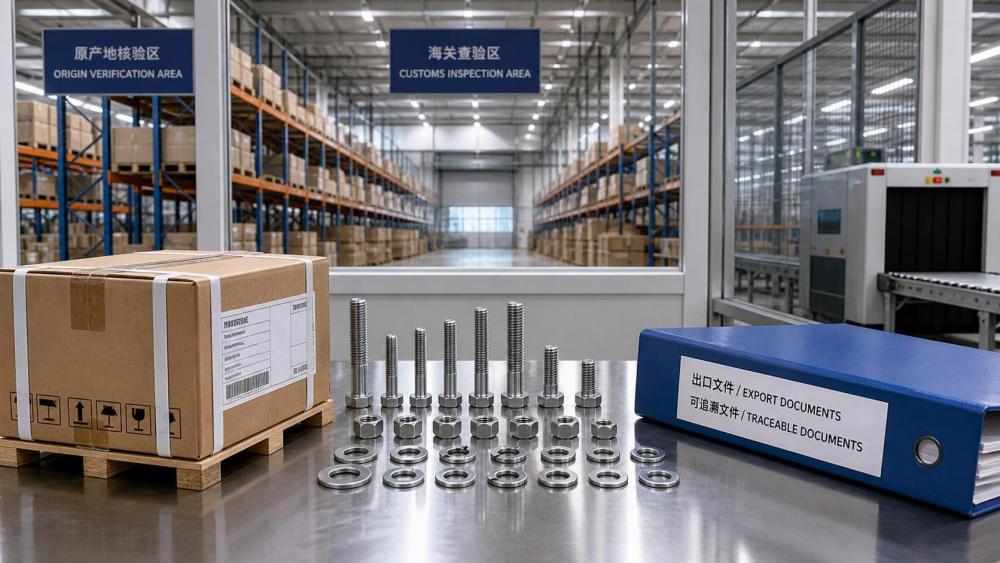
The stated requirement is that covered shipments must be accompanied by certified supply chain traceability documents and will be subject to 100% manual origin review. The products referenced include bolts, nuts, washers, and related industrial fasteners within the HS 7318 category.
The summary provided also states that the rule directly affects customs clearance timing and compliance costs for global distributors, OEM buyers, and MRO channel participants.
Where the pressure is likely to appear first
Importers and trading companies may face heavier document dependence
From an industry perspective, importers and direct trading parties are likely to feel the change first because the new requirement is tied to shipment entry, origin review, and traceability documentation. The main business impact may appear in pre-clearance file preparation, document consistency checks, and the ability to present origin-related records in a form that can withstand manual review.
What deserves closer attention is whether existing origin files, supplier declarations, and shipment records are organized well enough to support repeated customs scrutiny at the transaction level.
OEM sourcing teams may need to revisit supplier evidence chains
For OEM procurement functions, the issue is broader than customs processing alone. Analysis shows that if a purchased fastener falls within the covered HS category and comes from China, sourcing teams may need to pay closer attention to how supplier traceability evidence is assembled, certified, and linked to each shipment. The risk point is not necessarily product demand, but whether procurement documents and supply chain records are aligned closely enough for import compliance.
This makes supplier qualification, document requests, and purchase order support materials more relevant to delivery execution than before.
Distributors and MRO channels may see delivery uncertainty shift downstream
Distributors and MRO suppliers often work under tighter replenishment and service expectations. Observably, a rule built around 100% manual origin checks can draw attention to customs processing time and file completeness at the distribution stage. Even where product demand remains unchanged, any additional review at entry can affect stock planning, replenishment timing, and downstream service commitments.
Companies operating in these channels should therefore watch not only the rule itself, but also how customers begin to ask for traceability support, origin documentation, or additional shipment-level compliance records.
Supply chain service providers may be pulled into compliance workflows
Logistics coordinators, customs support parties, and related supply chain service providers may also be affected because the requirement is structured around traceability filing and manual origin verification. Analysis shows that their role may expand from document transmission to document validation support, record coordination, and exception handling when shipment files are incomplete or inconsistent.
The practical concern is whether all parties in the shipment chain are working from the same version of origin and traceability records before goods reach customs review.
What companies should monitor before execution settles
Traceability files should be treated as shipment-critical documents
Based on the information provided, certified supply chain traceability documents are no longer peripheral paperwork for covered shipments. Companies involved in exports, imports, or sourcing should closely review whether their existing document sets are complete enough to support origin review without gaps between supplier records, shipment papers, and product identification.
Manual origin review may affect timing assumptions
Because the rule involves 100% manual origin verification, businesses should pay attention to whether their current delivery planning assumes routine clearance timing. Analysis shows that lead-time expectations, booking windows, and procurement schedules may need closer review where covered fasteners are involved, even if no further execution detail has yet been provided.
Supplier qualification may need a stronger compliance lens
What deserves closer attention is not only whether a supplier can provide product, but whether that supplier can support certified traceability records in a consistent and auditable manner. For buyers and channel operators, this may become a practical screening factor in addition to price, availability, and technical fit.
Further official interpretation still matters
The provided information confirms the rule direction and effective date, but it does not include detailed execution language beyond the traceability filing and manual origin review requirements. Companies should therefore keep watching for later official wording, operational guidance, or clarifications that could affect document scope, review practice, or customs handling at the shipment level.
Why this looks like an execution signal, not just a headline
Analysis shows that this development is better understood as a concrete compliance signal rather than a general trade-policy headline. The reason is that the requirement is framed around two operational levers at once: certified traceability documentation and 100% manual origin checks. That combination points directly to execution at the shipment and clearance stage.
At the same time, it is more appropriate to understand this as a rule change whose practical contours still require observation. The available information confirms the measure and its scope, but market participants will still need to watch how consistently it is enforced, how documentation expectations are interpreted in practice, and how customers and channel partners adjust their own compliance demands.
How the market may need to read this development now
At this stage, the most balanced reading is that the CBP measure creates an immediate compliance and documentation threshold for covered Chinese industrial fasteners entering the United States. The confirmed facts already point to higher filing discipline and closer origin scrutiny.
Observably, the larger industry question is not whether the rule exists, but how businesses will absorb its effect across procurement, customs preparation, delivery planning, and channel service. For now, this is best understood as an implemented rule change with real operational consequences, while its detailed execution impact still deserves continued monitoring.
Basis of this article and what still needs verification
This article is generated from the user-provided news title, event date, and event summary. For developments of this type, relevant source categories typically include official notices, releases from regulatory authorities, customs or trade administration updates, industry association communications, standard-setting documents, and reporting by established trade media.
No specific official source link was provided in the input, so the exact official publication path still needs continued verification. Further observation should focus on any later policy detail, certification interpretation, customs execution language, tender or procurement document changes, industry feedback, and how affected companies implement traceability and origin review requirements in practice.
Weekly Insights
Stay ahead with our curated technology reports delivered every Monday.
Recommended News
 Supply ChainOct 15, 2026How to choose a supply chain strategy for unpredictable demand
 Supply ChainOct 14, 2026How to assess an industrial equipment supplier's spare parts support
 Supply ChainOct 14, 2026EU Updates CSDDD Guidance on Global Supply Chain Due Diligence
 Global SourcingOct 13, 2026How to assess industrial automation suppliers for legacy integration