
Composite Materials Engineering Standards That Matter for Quality Approval
Why composite standards are often misunderstood during quality approval
The phrase materials engineering standards composites is often treated as if it refers to one clean rulebook. In practice, it does not. Composite materials are approved through a layered system: material specifications, process controls, test methods, qualification protocols, and sector-specific compliance rules. Quality teams run into trouble when they expect a single certificate to prove everything. A resin system may meet one flammability requirement, a laminate may pass a mechanical test, and a supplier may hold a recognized management certification, yet none of those alone confirms that the finished composite part is fit for the intended service environment.
That distinction matters because composites are not just “materials” in the same way steel or aluminum are discussed in purchasing documents. Their performance depends heavily on architecture and processing: fiber type, fiber orientation, matrix chemistry, curing conditions, void content, interlaminar quality, moisture uptake, and surface preparation all influence results. For quality approval, the standard attached to the raw material is only the beginning. The real question is whether the approved combination of constituent materials, process window, and verification tests matches the risk profile of the end use.
Standards are not interchangeable
A common mistake in supplier evaluation is to mix up three different things: test standards, product standards, and system certifications. Test standards define how a property is measured. ASTM, ISO, and in some sectors EN standards are frequently used here. A tensile strength value, for example, only has meaning if the specimen geometry, conditioning, loading direction, and calculation method are known. Product or material specifications set acceptance criteria for a defined grade, form, or application. System certifications such as ISO 9001 or AS9100 say something about management discipline and traceability, but they do not substitute for technical qualification of the composite itself.
This is where cross-border procurement decisions often go off course. A supplier may present a package of compliance documents that looks complete on paper, but the documents may belong to different levels of control. For a quality manager, the useful question is not “What standards do you comply with?” but “Which standard governs the test method, which one governs the product acceptance, and which one governs your manufacturing controls?” When those are separated clearly, risk becomes easier to assess.
In composite approvals, several standard families appear repeatedly:
For sectors such as aerospace, automotive, marine, wind energy, and pressure-related industrial equipment, the standards stack becomes even more specific. The same carbon fiber reinforced polymer can be evaluated very differently depending on whether the service condition emphasizes crash energy absorption, flame/smoke/toxicity behavior, saltwater exposure, fatigue life, or dielectric properties. Approval therefore has to stay anchored to the application, not to the headline material name.
What quality teams should examine beyond the datasheet
Datasheets are useful, but they are also one of the easiest places to misread composites. Published values may come from ideal lab coupons, controlled layups, or specific cure schedules that do not mirror actual production. In woven glass fiber laminates, chopped fiber systems, sandwich panels, or hybrid composites, nominal values can hide wide differences in through-thickness strength, peel resistance, or environmental durability. A QC review that focuses only on top-line tensile or flexural data is incomplete.
A more defensible approval process usually checks at least five things. First, identity of constituent materials: fiber grade, resin family, hardener or catalyst, core material if used, and any surface film or coating. Second, process control evidence: storage conditions, out-time limits for prepregs, mixing ratios for wet systems, cure records, and calibration status of critical equipment. Third, test traceability: which standard was used, which laboratory performed it, and whether the sample was representative of production. Fourth, inspection methods: visual criteria, dimensional checks, and where relevant, non-destructive testing such as ultrasonic or tap testing under a defined procedure. Fifth, change control: what happens if the supplier changes the fiber source, resin batch, tooling release agent, or cure cycle.
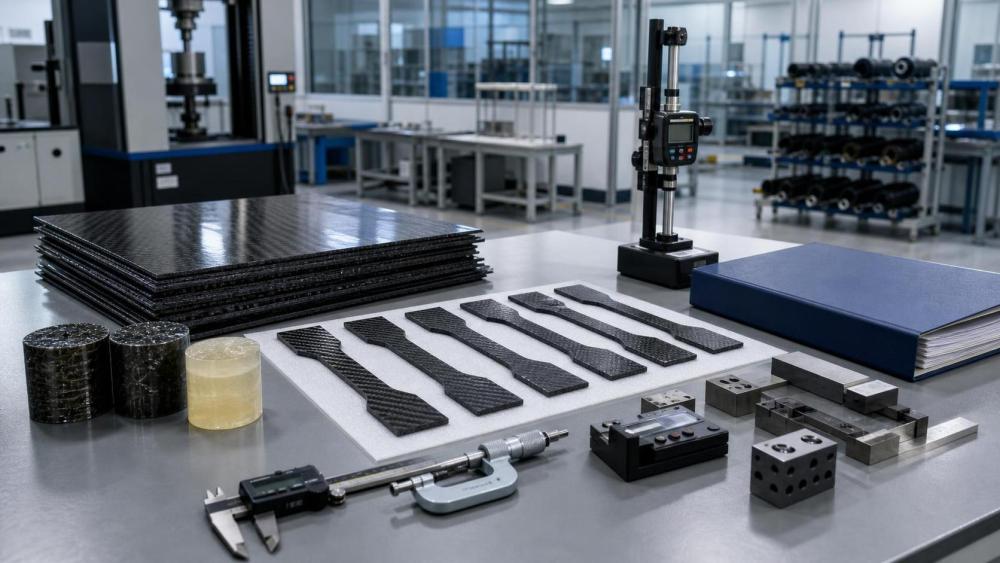
Those checks are not bureaucratic padding. In composites, small process changes can shift failure mode even when the declared material remains “the same.” A part may still meet a simple static strength screen while becoming much more vulnerable to delamination, moisture degradation, or bond failure in service. That is why mature approval systems rely on traceability and process discipline as much as on test reports.
The approval risk is often in the boundary conditions
For safety and compliance personnel, boundary conditions deserve more attention than they usually get. Composite standards often require or imply conditioning steps because temperature, humidity, UV exposure, chemical contact, and loading rate can materially change performance. A laminate that behaves well in a dry room-temperature test may respond differently after water immersion or thermal cycling. In structural use, the issue is not merely peak strength; retention of properties after exposure can be the more relevant indicator.
This is also why direct substitution is risky. Replacing one resin system with another that has a similar room-temperature tensile number does not guarantee equivalent fire behavior, outgassing profile, dielectric performance, or long-term creep resistance. For imported components and global sourcing programs, substitution risk increases when suppliers translate standards loosely or cite legacy approvals without revision alignment. A certificate attached to an older revision may still look impressive, but unless the controlled specification and current customer requirement are matched line by line, approval remains exposed.
Common misunderstandings that delay or weaken approval
One misunderstanding is to assume that “certified composite material” is a stable category. It rarely is. Certification usually applies to a defined product form, process route, or use case. Another is to assume that passing one recognized test method proves field durability. Test methods generate comparable data; they do not automatically define the acceptance logic for every application. A third is to overvalue supplier declarations that are not backed by revision-controlled records, accredited testing where required, or customer-specific qualification packages.
There is also a practical misunderstanding around traceability. In metals, heat numbers and mill certificates are familiar anchors. In composites, traceability may need to extend across fibers, resin lots, prepreg shelf life, cure logs, and even operator-controlled stages such as layup or bonding. When that chain is weak, nonconformance investigations become slow and inconclusive. For cross-border supply chains, this problem is magnified by translation gaps, inconsistent batch labeling, and uneven document retention practices across sites.
What a sound standards framework looks like in procurement and inspection
A useful framework does not start with collecting as many standard references as possible. It starts with defining the approval question properly. Is the team approving a raw material for stock, a semi-finished laminate or panel, a bonded assembly, or a finished component for a regulated sector? Each of those requires a different evidence package. Once that is clear, the standard map becomes more coherent: required test methods, mandatory customer or industry specifications, inspection plan, requalification triggers, and document retention requirements.
For procurement teams working with technical quality and safety functions, the strongest screening questions are usually precise ones. Which exact standard revisions were used? Were test panels made with production tooling and production cure cycles? Are there controlled acceptance criteria for voids, fiber misalignment, porosity, bondline thickness, or core crush, where relevant? Is the supplier approved to make engineering changes independently, or is customer reapproval required? Those questions reveal more than a generic compliance statement ever will.
From a GTIIN-style global sourcing perspective, standards literacy is not just about technical correctness. It is also a way to reduce hidden commercial risk. Weak approval logic leads to delayed shipments, disputed responsibility after failure, uneven incoming inspection results, and expensive rescreening when a product enters a new market with different regulatory expectations. Composite materials make those failures harder to unwind because the issue may sit at the intersection of chemistry, process control, and documentation rather than a single visible defect.
A practical way to read composite compliance claims
When reviewing a composite supplier file, read every claim in context. Ask what was tested, under which method, in what form, after what conditioning, against which acceptance standard, and for which application boundary. If those answers are clear, the approval decision becomes technical and defensible. If they are vague, the risk is not only that the material may fail. The larger risk is that the organization approves something it cannot later verify, reproduce, or defend during an audit, incident review, or customer complaint.
That is the real value of understanding materials engineering standards composites depend on. It is less about memorizing standard numbers and more about knowing how evidence is built, where it breaks down, and which gaps matter for quality approval. Teams that understand that difference tend to approve faster, reject more accurately, and avoid the false confidence that comes from paperwork without engineering context.
Weekly Insights
Stay ahead with our curated technology reports delivered every Monday.
Recommended News
 Supply ChainSep 22, 2026How heavy equipment lifecycle data can reduce unexpected downtime
 Supply ChainSep 21, 2026How export regulations affect logistics lead times and delivery risk
 Industry StandardsSep 20, 2026What evidence is needed to pass a carbon reporting audit?
 Industry StandardsSep 19, 2026When does manufacturing compliance consulting reduce audit risk?