
China Updates LED Export Guide, Effective Now
On August 3, 2026, a WTO notification drew attention to China’s revised Technical Guide for Export Commodities: LED Lighting Products, issued jointly by the Ministry of Commerce and the General Administration of Customs and made mandatory from the same date. The revision introduces updated compliance references for the EU, the US, and Southeast Asian markets, which means the change is immediately relevant to exporters, importers, distributors, testing bodies, and procurement teams handling LED lighting products. What deserves closer attention is that this is not just a documentation update: it directly touches customs compliance, the validity of third-party test reports, and supplier qualification routes in cross-border trade.
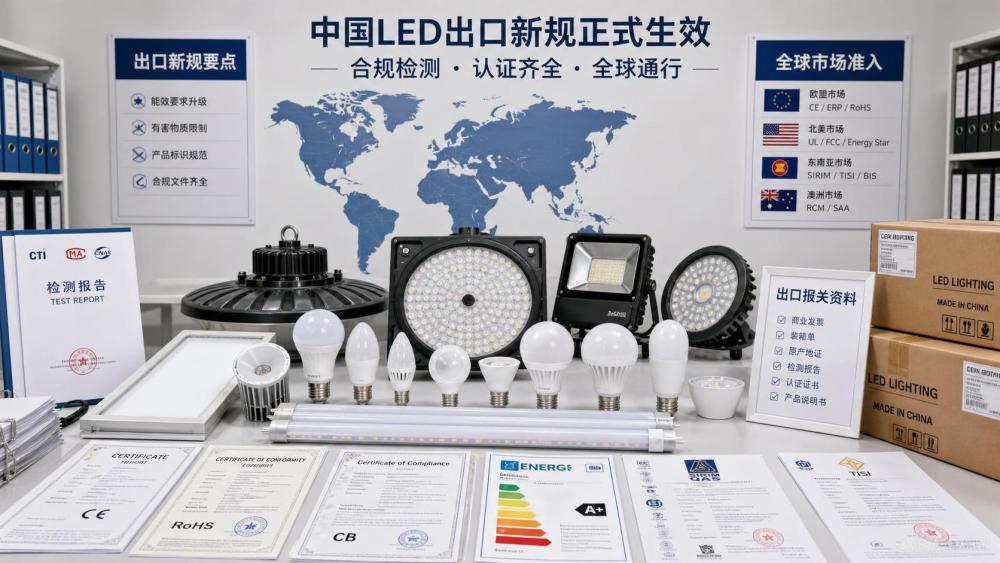
What the revised guide now includes
The confirmed facts are limited but clear. China’s Ministry of Commerce and the General Administration of Customs jointly released a revised version of the Technical Guide for Export Commodities: LED Lighting Products, and the revised guide became mandatory on August 3, 2026.
According to the provided event summary, the revised guide adds the latest EU CE-EMC revision, EN IEC 61000-3-2:2025, the US FCC Part 15 Subpart B fifth-edition compliance requirements, and mandatory energy-efficiency label grading rules for Southeast Asian markets.
The same summary states that the guide directly affects customs clearance compliance for global LED importers, the validity of third-party testing reports, and supplier certification pathways. It also places immediate constraints on purchasing decisions by distributors serving the European, US, and ASEAN markets.
Where the operational pressure is likely to appear first
Export transactions facing customs and entry compliance checks
From an industry perspective, exporters and trading companies are likely to feel the change first because the revised guide is already in force. The practical pressure point is whether shipment-related compliance materials, technical files, and supporting reports align with the updated EU, US, and Southeast Asian requirements referenced in the guide. For companies shipping LED lighting products into these markets, the issue is less about broad policy interpretation and more about whether existing export documentation remains usable in customs and downstream customer review.
Procurement and distributor screening of suppliers
Distributors, importers, and procurement teams may also face immediate adjustments. Analysis shows that once a guide becomes mandatory and explicitly references updated standards and labeling rules, buyers are more likely to revisit supplier screening, bid qualification, and document acceptance criteria. The impact is especially visible where purchasing decisions depend on whether suppliers can present compliance materials that match the newly cited requirements rather than earlier versions.
Testing and certification workflows under closer review
Testing service providers and certification-related firms are another affected group. The event summary specifically notes an effect on the validity of third-party testing reports and supplier certification pathways. Observably, this creates a practical checkpoint around report applicability, version alignment, and whether previously issued documents can still support current market access and customer approval needs under the revised guide.
Delivery planning across multiple destination markets
Manufacturers and supply chain service providers may need to pay closer attention to how destination-market requirements are separated in order processing and delivery planning. Because the revision simultaneously references EU EMC updates, US FCC requirements, and Southeast Asian energy-efficiency label grading rules, the compliance path may become more sensitive to the final destination of each shipment, the documentation package attached to the order, and the acceptance criteria set by the buyer.
Practical points companies should review now
Check whether existing reports still match the cited versions
Analysis shows that one immediate task is to review whether current third-party test reports and related technical documentation align with EN IEC 61000-3-2:2025, FCC Part 15 Subpart B fifth-edition requirements, and the mandatory graded energy-efficiency labeling rules referenced for Southeast Asian markets. The provided information does not define an official transition treatment for older documents, so this should be treated as a live compliance review point rather than an assumed conclusion.
Reconfirm supplier qualification and certification paths
What deserves closer attention is the supplier side of compliance. The summary expressly states that supplier certification pathways are affected, which suggests companies should recheck whether existing supplier approval files, qualification questionnaires, and certification records remain aligned with buyer expectations under the revised guide. For procurement teams, this is relevant not only to new sourcing but also to continuing orders already in pipeline review.
Watch bid files, customer specifications, and order documents
Observably, another practical area is document consistency across commercial and technical paperwork. Where tenders, purchase specifications, order confirmations, or product submission files still reference older standard versions or incomplete labeling requirements, companies may encounter avoidable friction in customer approval, shipment release, or customs-facing documentation checks. The current information does not confirm how any individual market participant will enforce the revision, so close document review is more appropriate than assumption.
Track follow-up wording and market-side execution signals
The available facts confirm the rule change and its immediate effect date, but they do not provide detailed enforcement language, transition arrangements, or acceptance criteria for legacy materials. For that reason, companies should continue monitoring official wording, customer notices, certification interpretations, and procurement-side document requirements tied to the revised guide. This is especially relevant for businesses serving the EU, US, and ASEAN channels at the same time.
Why this reads as an execution signal, not just a notice
Analysis shows that the most important feature of this update is its effective date and mandatory status. That makes it more appropriate to understand the event as an execution signal with immediate commercial relevance, rather than a distant policy discussion. At the same time, it should not be overstated as a fully settled enforcement picture, because the provided information does not include detailed implementation practice, treatment of previously issued reports, or market-by-market acceptance behavior.
From an industry perspective, the update matters because it ties together three areas that directly affect cross-border LED trade: technical compliance, market-entry documentation, and supplier selection. That combination tends to move the issue quickly from regulatory awareness into procurement control and shipment readiness.
How this update is best understood at this stage
At this stage, the revised guide is best understood as a rule change that has already taken effect and that immediately raises the importance of version-aligned testing, certification review, and destination-market documentation for LED lighting products. The confirmed facts support a cautious conclusion: companies involved in export, import, distribution, testing, and sourcing should treat the change as operationally relevant now, while still watching for further clarity in how the referenced requirements are applied in practice.
Basis of this article and what still needs verification
This article is generated on the basis of the user-provided news title, event date, and event summary. The core information used here is limited to the reported WTO notification, the August 3, 2026 effective date, and the stated content of the revised Technical Guide for Export Commodities: LED Lighting Products.
For events of this kind, relevant source types typically include official notices, releases from regulatory authorities, customs or trade administration information, industry association updates, standard-setting documents, and reporting by established professional media. No specific official source link was provided in the input, so the underlying official link remains to be verified.
Further observation is still needed on implementation details, certification interpretations, tender-document updates, customer-side acceptance criteria, industry feedback, and how companies adjust execution in response to the revised guide.
Weekly Insights
Stay ahead with our curated technology reports delivered every Monday.
Recommended News
 Supply ChainSep 22, 2026How heavy equipment lifecycle data can reduce unexpected downtime
 Supply ChainSep 21, 2026How export regulations affect logistics lead times and delivery risk
 Industry StandardsSep 20, 2026What evidence is needed to pass a carbon reporting audit?
 Industry StandardsSep 19, 2026When does manufacturing compliance consulting reduce audit risk?