
EU REACH Annex XVII Revision Takes Effect for Industrial Chemical Exports
On August 2, 2026, the European Commission formally issued Regulation (EU) 2026/1347, revising Annex XVII of REACH and setting new concentration limits for 12 SVHCs in B2B industrial products including sealants, industrial adhesives, and metal surface treatment agents. With mandatory enforcement starting on August 22, 2026, this is not just a regulatory update in text form; it is an immediate compliance issue for exporters, importers, procurement teams, and supply chain partners involved in chemical intermediates, functional additives, and related industrial consumables shipped to the EU.
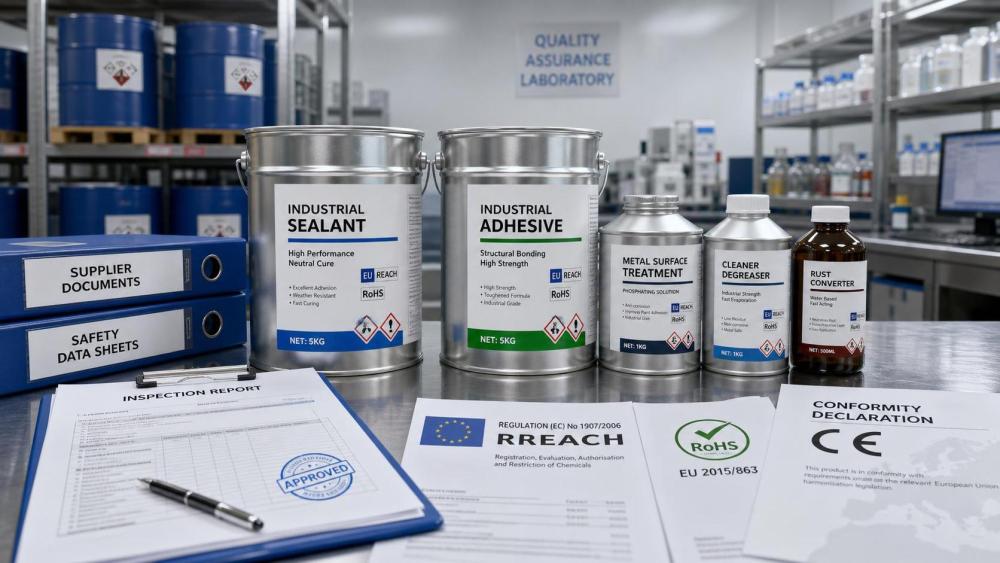
What the new restriction formally changes
The confirmed change is that Regulation (EU) 2026/1347, issued by the European Commission on August 2, 2026, revises Annex XVII of REACH. The revision adds concentration limits for 12 substances of very high concern (SVHCs) in several categories of B2B industrial products, including sealants, industrial adhesives, and metal surface treatment agents. The measure is stated to become mandatory from August 22, 2026.
The information provided also makes clear that the revision directly affects Chinese suppliers exporting chemical intermediates, functional additives, and supporting industrial consumables to the EU. Importers are required to immediately review supply chain compliance declarations and the status of SCIP notifications.
Where the pressure will show up first in the supply chain
Export-facing suppliers will face immediate document and formulation checks
From an industry perspective, suppliers selling into the EU market may be affected because the rule change is tied to product composition and market access at the same time. The first impact is likely to appear in product-level compliance review, internal formulation confirmation, and the readiness of supporting declarations used in export transactions. What deserves closer attention is whether existing product dossiers, technical statements, and downstream compliance communications still align with the revised Annex XVII requirements.
EU importers will need faster upstream verification
Importers are directly named in the event summary as parties that must review supply chain compliance declarations and SCIP notification status. Analysis shows that this shifts part of the urgency upstream: importers may need suppliers to confirm substance content, declaration completeness, and supporting records without delay. The practical pressure point is not only customs or entry risk, but also whether imported goods can continue to move through procurement and delivery processes without compliance gaps.
Procurement and industrial users may tighten supplier screening
For procurement teams and industrial buyers using sealants, adhesives, surface treatment agents, or related inputs, the change may influence supplier qualification and order release decisions. Observably, buyers may place more weight on current compliance statements, material disclosures, and traceable submission status where SCIP-related review is relevant. The issue is less about a broad market reaction and more about whether purchasing and delivery can continue under revised compliance conditions.
Testing and compliance support functions may see a higher review burden
Analysis shows that laboratories, compliance service providers, and internal regulatory affairs teams may experience additional demand for document verification and technical review. The event summary does not provide detailed enforcement practice, so it would be premature to treat this as a settled inspection pattern. Still, the combination of new concentration limits and a short implementation window suggests that supporting evidence and regulatory communication may become more time-sensitive across the transaction chain.
What companies should review now
Check whether affected product categories are already in active EU supply
Companies with EU-facing business should first identify whether sealants, industrial adhesives, metal surface treatment agents, chemical intermediates, functional additives, or related industrial consumables within their portfolio are part of current shipments, open orders, or near-term delivery plans. Analysis shows that this is the most basic screen before any further compliance action can be prioritized.
Reconfirm declarations and SCIP-related status
The provided information specifically points to immediate review of supply chain compliance declarations and SCIP notification status. What deserves closer attention is whether existing declarations remain usable after the Annex XVII revision takes effect, and whether internal and external records are consistent across supplier, importer, and customer-facing documentation.
Review technical files tied to delivery and customer approval
Observably, businesses should pay attention to technical documents that may affect shipment release, customer acceptance, or qualification continuity, such as compliance statements, test-related records, material disclosures, and product specification files. The input does not provide detailed documentary requirements, so this should be understood as a practical review priority rather than a confirmed checklist.
Monitor customer and market-side implementation signals
Because mandatory enforcement begins on August 22, 2026, companies should watch for changes in customer wording, importer requests, purchasing conditions, or bid and supply documents that reflect the revised restriction. It is more appropriate to understand this stage as one where execution signals may emerge quickly, even if detailed market practice is not yet fully visible from the information provided.
Why this looks more like an execution signal than a distant policy update
Analysis shows that the short interval between publication and mandatory enforcement is the most important practical signal in this event. This is not presented as a long-horizon regulatory discussion; it is a rule change with a defined enforcement date and explicit implications for product categories already moving through industrial supply chains.
At the same time, Observably, some parts of market implementation still require continued attention. The input does not provide detailed enforcement guidance, specific inspection methods, or downstream contracting responses. For that reason, the development is better understood as a landed compliance change with immediate operational consequences, while the exact market execution rhythm still needs to be tracked through follow-up practice.
How the market should read this development
The most balanced reading is that the REACH Annex XVII revision creates an immediate compliance checkpoint for industrial chemical exports connected to the EU market. Its significance lies in the combination of a formal rule change, product-specific concentration limits, and a near-term enforcement date. For affected suppliers and importers, the key issue is not abstract regulatory awareness but whether documents, declarations, and supply chain status can support continued shipment and procurement activity.
It is more appropriate to understand this as an implemented regulatory change that already demands operational review, while some execution details and market responses still merit close observation.
Basis of this article and points that still require verification
This article is generated based on the user-provided news title, event date, and event summary. For developments of this kind, commonly relevant source categories may include official announcements, regulatory authority publications, customs or trade authority information, industry association updates, standards-related documents, and reporting by authoritative media. A specific official source link was not provided in the input, so the exact official link still needs to be verified on an ongoing basis.
Further observation is still needed on detailed implementation language, compliance interpretation in practice, possible changes in tender or procurement documents, market feedback from importers and buyers, and how affected companies execute the required reviews in actual supply chains.
Have questions about this sector analysis, or seeking best practices specific to your niche? Drop us a line below and let the senior consultants at GTIIN assist you.
“We respect your privacy. Your information is strictly confidential.”
Weekly Insights
Stay ahead with our curated technology reports delivered every Monday.
Recommended News
 Supply ChainNov 10, 2026China Extends Pause on 24% Additional Tariff on US Goods by Two Months
 Industry StandardsNov 10, 2026Which imports are subject to EU carbon border compliance?
 Global SourcingNov 09, 2026USTR Extends 178 China Section 301 Tariff Exclusions to January 2027
 Supply ChainNov 09, 2026How can a tariff risk management dashboard track cost exposure?



