
Carbon Footprint Certification Standards: What to Check Before Supplier Approval
Before approving a supplier, procurement teams need more than a file marked “carbon certified.” They need to know what the certification actually covers, who verified it, which methodology was used, and whether the result can stand up to customer scrutiny, internal ESG review, or market-specific regulation. That question matters more now because carbon claims are moving out of sustainability reports and into tenders, contracts, border compliance, and product-level sourcing decisions.
In practice, carbon footprint certification standards are not interchangeable. Some focus on organizational greenhouse gas inventories. Others deal with product carbon footprints, life cycle accounting, or verification of emissions data rather than certification of low emissions performance. A supplier may present a legitimate certificate and still leave key procurement questions unanswered.
For buyers working across industrial categories and export markets, the hard part is rarely collecting documents. It is judging comparability. This is exactly where a trade intelligence approach becomes useful. GTIIN’s work across sourcing, supply chain resilience, export trends, and industry standards reflects a simple reality: environmental documents only become decision-ready when they are read in the context of product scope, production geography, logistics exposure, and destination-market requirements.
Start with the most basic question: what is being certified?
One of the most common procurement mistakes is treating all carbon-related certificates as proof of the same thing. They are not.
A supplier might show evidence aligned with ISO 14064-1, which is commonly used for quantifying and reporting organization-level greenhouse gas emissions. Useful, yes—but that does not automatically tell you the carbon footprint of the specific product you are buying. A different document may be based on ISO 14067, which is associated with product carbon footprint quantification. In another case, the relevant framework may come from the GHG Protocol, especially for corporate accounting or product life cycle work. Environmental Product Declarations, often developed under standards such as ISO 14025 and supported by product category rules, can also enter the conversation, particularly in construction and materials supply chains.
That distinction matters. If your procurement decision concerns steel coil, plastic resin, industrial equipment, components, packaging, or processed materials, you need to know whether the supplier’s document relates to the company, the site, the production batch, or the individual product model.
A supplier approved on the basis of a corporate inventory alone may still be unable to support downstream customer requests for product-level emissions data.
Check the accounting boundary before you check the number
A low carbon figure can look attractive until you discover that the system boundary is narrow. Procurement teams should ask how far the calculation goes: cradle-to-gate, gate-to-gate, cradle-to-grave, or another defined boundary.
For supplier approval, this is often more important than the headline emissions result. Two suppliers may report very different values simply because one includes upstream raw materials, energy use, transport, packaging, waste, and end-of-life assumptions, while the other covers only direct manufacturing activity. Without boundary alignment, comparison becomes misleading.
This issue becomes more visible in global trade. A component made in one country may rely on imported feedstock, a different electricity mix, and longer shipping routes than a similar component sourced regionally. GTIIN’s cross-border supply chain analysis often shows that carbon data cannot be separated from sourcing structure. The footprint is shaped not only by factory efficiency, but by fuel mix, material origin, process yield, packaging design, and transport mode.
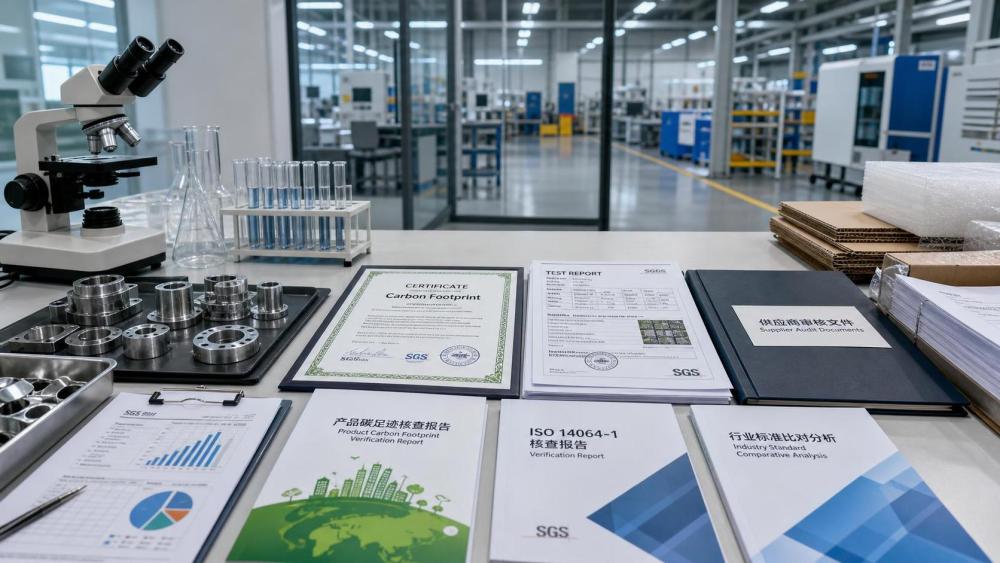
When reviewing a certificate or verification statement, ask for the declared scope and assumptions. If that information is missing, the document may still be formally valid, but it is not very useful for commercial comparison.
Verification credibility matters more than branding
Not every logo on a supplier presentation carries the same weight. Buyers should distinguish between self-declared claims, consultant-prepared calculations, third-party verification, and accredited certification schemes.
A practical review usually includes these questions:
- Was the footprint calculated internally, by a consultant, or independently verified?
- Is the verifier accredited for the relevant standard or scheme?
- Does the statement identify the exact site, entity, product, and reporting period?
- Are methodology references and exclusions disclosed?
- Is the certificate current, or already outside the reporting cycle used in sourcing approval?
This is where procurement teams need a healthy level of skepticism. Some suppliers are strong manufacturers but weak document managers. Others are the opposite: polished sustainability materials, limited operational transparency. A credible carbon footprint document should make it easier, not harder, to trace what was measured.
Look for methodology fit, not just standard names
There is no single universal standard that solves every category. Product type, market, and customer requirement all shape what is acceptable.
For example, basic materials, chemicals, construction inputs, and industrial components may face very different downstream reporting expectations. In some sectors, an EPD may be the most practical format because architects, contractors, or public buyers already understand it. In others, customer questionnaires may align more closely with GHG Protocol categories or with product-specific life cycle rules. Export-oriented suppliers selling into Europe may also face growing pressure to support carbon-related declarations tied to broader regulatory developments, including mechanisms that increase attention on embedded emissions. The exact requirement depends on product classification, destination market, and the current legal framework, so this point usually needs project-specific checking.
The takeaway is straightforward: a supplier’s certification standard should fit the transaction you are evaluating, not simply look familiar on paper.
Data quality is often the real risk
Even under a legitimate standard, carbon results depend heavily on data quality. Procurement teams rarely need to audit every emissions factor themselves, but they should probe whether the supplier uses primary operational data or generalized secondary data for major emissions sources.
Several warning signs deserve attention:
- energy consumption estimated broadly rather than measured at site level;
- material inputs allocated using generic assumptions without process detail;
- outdated emission factors not tied to the reporting year;
- no explanation of co-product allocation, scrap treatment, or waste accounting;
- heavy reliance on offsets when the buyer needs actual footprint intensity.
This becomes especially important in multi-site suppliers. One corporate name can cover plants with very different power mixes, process yields, and utility systems. If a certificate does not identify the production site that will fulfill your order, approval risk rises quickly.
Comparability across suppliers requires a common review frame
Procurement teams often ask a simple question: can we compare Supplier A and Supplier B directly? Usually, only if several conditions are aligned.
Without this alignment, comparing certified values is like comparing freight quotes that use different incoterms: technically possible, commercially dangerous.
Don’t ignore downstream usability
Supplier approval is not the end of the document journey. The carbon information may later be requested by customers, auditors, financiers, regulators, or internal reporting teams. A certificate that satisfies initial onboarding but cannot feed into later disclosure requirements creates rework.
That is why many procurement teams now look beyond mere possession of carbon footprint certification standards and focus on data usability. Can the supplier provide product-level emissions in a format that matches customer requests? Can they update the figure annually? Can they explain methodology changes from one reporting cycle to the next? If the answer is no, the supplier may still be operationally capable, but the relationship will carry more compliance friction.
Across GTIIN’s coverage of global industrial sourcing, this is becoming a recurring theme: the stronger suppliers are not always the ones with the most polished sustainability branding, but the ones able to connect technical documentation, manufacturing reality, and trade-facing compliance needs with minimal ambiguity.
A practical approval mindset
For procurement, the goal is not to become a carbon accounting specialist. It is to make approval decisions that remain defensible six months later, when a customer asks for embedded emissions data, a compliance team reviews supplier files, or a sourcing shift changes the carbon profile of a finished product.
So before approving a supplier, verify five things: the object of certification, the accounting boundary, the methodology fit, the credibility of verification, and the usability of the data after onboarding. If any one of those is unclear, the right next step is usually not rejection but clarification. Ask for the underlying statement, declared unit, reporting year, exclusions, and site coverage. Those details reveal far more than a certificate cover page ever will.
In a cross-border supply chain, carbon documentation is no longer a side file. It is becoming part of supplier qualification, risk control, and market access. That makes disciplined review less of a sustainability exercise and more of a procurement standard.
Weekly Insights
Stay ahead with our curated technology reports delivered every Monday.
Recommended News
 Supply ChainSep 22, 2026How heavy equipment lifecycle data can reduce unexpected downtime
 Supply ChainSep 21, 2026How export regulations affect logistics lead times and delivery risk
 Industry StandardsSep 20, 2026What evidence is needed to pass a carbon reporting audit?
 Industry StandardsSep 19, 2026When does manufacturing compliance consulting reduce audit risk?