
EU Tightens PFAS Rules for Imported Industrial Seals
From September 1, 2026, the EU rule framework for imported industrial sealing components changes from a general chemicals compliance issue into a specific market-entry requirement. The European Commission’s emergency revision to REACH Annex XVII introduces a 50 ppb migration limit for PFAS in industrial seals, gaskets, O-rings, and related elastomer components, while also requiring importers to complete PFAS substance declarations in the SCIP database 72 hours before goods arrive in the EU. For exporters, importers, procurement teams, compliance staff, and customs-facing supply chain operations, the issue is not only product content control but also whether documentation and filing can keep pace with shipment schedules under a no-transition arrangement.
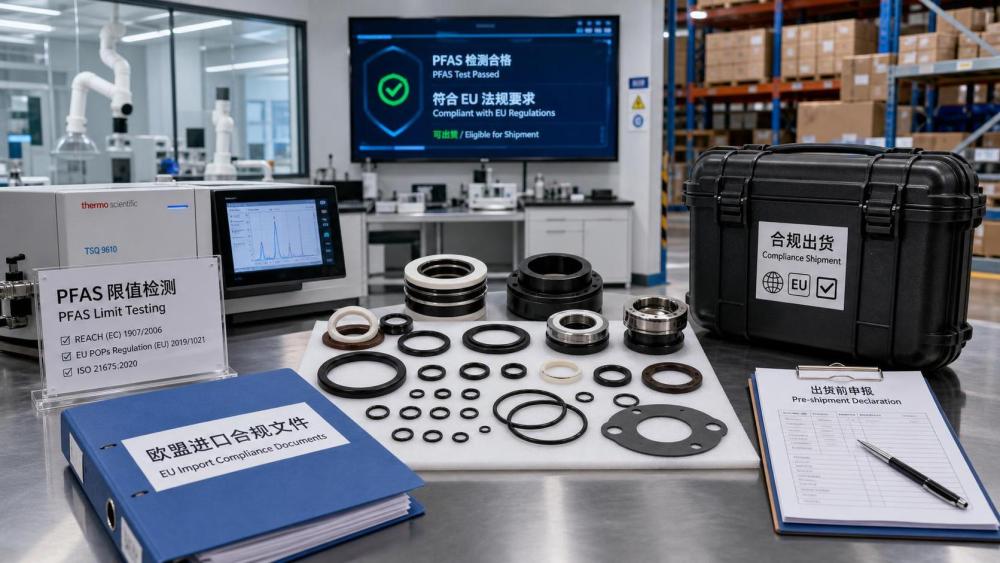
What the New REACH Revision Formally Changes
According to the provided event summary, the European Commission issued Regulation (EU) 2026/1421 on August 8, 2026, as an emergency revision to REACH Annex XVII. The rule sets, for the first time, a PFAS migration limit of 50 ppb for industrial sealing products including seals, gaskets, O-rings, and other elastomer-based components. It also requires all importers to complete PFAS composition declarations through the SCIP database at least 72 hours before the goods reach the EU.
The event date provided is September 1, 2026. The same summary states that the measure does not include a transition period. It further states that more than 3,200 Chinese sealing product exporters are directly affected, and that the rule is expected to raise compliance costs and increase customs clearance timing risks.
Where the Pressure Is Likely to Appear First
Export shipments now face both product and filing exposure
From an industry perspective, exporters of industrial sealing components are likely to be affected first because the rule combines a material threshold with a pre-arrival declaration obligation. That means shipment readiness may no longer depend only on production completion and commercial paperwork; it may also depend on whether PFAS-related information is available in a form that supports SCIP submission before the cargo reaches the EU.
Import-side coordination becomes a practical bottleneck
Importers are directly named in the filing requirement, so the operational burden is likely to concentrate on declaration timing, document completeness, and consistency between product data and shipment schedules. What deserves closer attention is that the 72-hour filing requirement may turn compliance preparation into a pre-clearance coordination issue rather than a post-arrival administrative step.
Procurement and supplier management may need tighter material verification
For procurement teams and supplier managers, the rule change may affect sourcing decisions for elastomer components that are used in larger industrial assemblies. Analysis shows that buyers may need clearer upstream material declarations, test-related support, and supplier responsiveness where sealing parts are purchased as standard items but now carry a direct compliance implication for EU-bound deliveries.
Testing, documentation, and delivery planning become more connected
Supply chain service providers, quality teams, and compliance support functions may feel the impact through document turnover, technical file preparation, and shipment timing control. The practical issue is not limited to whether a product can meet a PFAS migration limit, but whether evidence and declarations can be aligned with booking, dispatch, and arrival windows.
What Companies Should Watch in Immediate Practice
Check whether existing technical files support the new declaration path
Analysis shows that companies involved in EU-bound shipments should review whether current product specifications, composition records, and supporting compliance files are sufficient for SCIP-related declaration needs. The event summary confirms the filing obligation, but it does not provide detailed execution criteria, so this remains an area requiring close attention rather than assumptions.
Reassess delivery schedules against the 72-hour filing requirement
Observably, the new timing rule may affect dispatch planning, customs preparation, and importer-exporter coordination. Businesses should pay attention to whether delivery commitments, booking cutoffs, and internal approval timelines leave enough room for pre-arrival declaration without creating avoidable clearance risk.
Review affected product categories rather than treating seals as low-risk accessories
For manufacturers and traders, sealing parts such as gaskets, O-rings, and other elastomer components may require a more explicit compliance review than before. It is more appropriate to understand this as a rule change that can pull small or routine components into a higher-control trade process, especially where those parts were previously handled as standard consumables in procurement and export documentation.
Follow any emerging interpretation on enforcement and document expectations
The provided information confirms the legal change and its immediate application, but it does not define the full enforcement practice, document format expectations, or any market-specific interpretation beyond the stated filing and limit requirements. Companies should therefore watch for official wording, customer-side specification updates, tender document changes, and market feedback before treating any single operating approach as settled.
Why This Looks Like an Immediate Execution Signal
Analysis shows that this development is closer to an implemented compliance trigger than to a distant policy discussion. The absence of a transition period, combined with a defined migration limit and a pre-arrival declaration requirement, signals that affected market participants may need to respond in operational terms immediately. At the same time, observably, the market still lacks fully described execution detail in the information provided here, so the rule should also be read as an area where follow-up clarification may materially shape day-to-day compliance practice.
From an industry perspective, the most important point is not only that PFAS control is tightening, but that control is being attached directly to customs timing and importer filing responsibility. That combination can shift risk from laboratory or product design review alone into order management, documentation flow, and delivery reliability.
How This Update Is Best Understood Now
At this stage, the rule change is best understood as a live market-access requirement for affected industrial sealing products entering the EU, rather than as a policy signal with a long preparation window. The confirmed facts point to immediate compliance and shipment-planning consequences for exporters and importers. The broader commercial effect, however, still depends on how filing practice, customer requirements, and market implementation develop after the rule takes effect.
Basis of This Article and What Still Needs Verification
This article is generated on the basis of the user-provided news title, event date, and event summary. For developments of this kind, relevant source types usually include official regulatory notices, releases from supervisory authorities, customs or trade-administration information, industry association updates, standards-related documents, and reporting by authoritative trade media. A specific official source link was not provided in the input, so the exact source path still needs to be verified on an ongoing basis.
Further observation is still needed regarding implementation details, enforcement interpretation, certification and compliance expectations, tender document changes, market feedback, and how affected companies execute the new requirements in practice.
Weekly Insights
Stay ahead with our curated technology reports delivered every Monday.
Recommended News
 Supply ChainSep 23, 2026What drives cross-border logistics management pricing for importers?
 Supply ChainSep 22, 2026How heavy equipment lifecycle data can reduce unexpected downtime
 Supply ChainSep 21, 2026How export regulations affect logistics lead times and delivery risk
 Industry StandardsSep 20, 2026What evidence is needed to pass a carbon reporting audit?