What to check before starting industrial sourcing in the UAE
It often starts with a practical request: a plant needs replacement valves, packaging lines need motors, a project team wants steel sections, cables, chemicals, or control components sourced through the Gulf. Someone says the UAE should be a good place to begin because it is well connected, commercially active, and easier to access than some neighboring markets. Then the real work begins, and the first problem appears quickly: a supplier can look legitimate online, pricing can look competitive, but the actual sourcing risk is still unclear.
That uncertainty is expensive. A quote that seemed attractive can become less attractive once import paperwork, delivery terms, repacking requirements, local representation limits, or product conformity questions come into view. In many industrial categories, the issue is not whether the UAE is a viable sourcing base. It usually is. The issue is whether your team has checked the right things before placing time, budget, and credibility behind a supplier conversation. If you are planning industrial sourcing UAE activities, the strongest early move is not asking for the lowest price. It is building a verification path before negotiation gets too far ahead of reality.
Where sourcing efforts usually go off track
A common mistake is treating the UAE as a single, frictionless market. In practice, sourcing outcomes vary by product type, origin route, supplier role, and final destination. Some businesses in the UAE are manufacturers, some are stockists, some are regional traders, and some are procurement intermediaries that rely on third-country supply. None of those models is automatically wrong, but each changes how you should assess lead time, traceability, warranty responsibility, and landed cost.
Another problem is assuming that a polished catalog means stable supply capability. In industrial purchasing, a supplier may be strong in one category and weak in another. A company that reliably distributes fasteners may not be the right source for pressure-rated piping assemblies, instrument-grade components, or project-based fabricated items. The risk comes from category mismatch: the supplier is real, but the fit is poor.
This is why early screening matters more than many teams expect. Once internal stakeholders start relying on a quote for budgeting or scheduling, it becomes harder to slow down and ask basic questions. That is often when hidden issues surface: no batch traceability, unclear origin, changing Incoterms assumptions, incomplete technical files, or unsupported claims about standards compliance.
Start with the supplier’s actual role in the chain
Before comparing offers, pin down what the company actually does. Are they a manufacturer, authorized distributor, importer, trader, stockholder, project consolidator, or service agent? In the UAE, many firms serve as regional commercial hubs rather than full producers. That can still work very well, especially when you need mixed-product procurement or access to Gulf and wider MENA trade lanes. But it affects how you verify availability and accountability.
Ask for simple role-defining information first: product scope, warehouse handling capability, documentation they issue directly, whether they hold local inventory, and whether they source under their own commercial responsibility or through another entity. If answers stay vague, the sourcing risk rises immediately. You do not need to reject the supplier at once, but you do need to adjust expectations. A trading company may be fine for standard industrial consumables, while engineered or safety-critical items usually require a stricter documentation trail.
One useful habit is to separate “can quote” from “can supply reliably.” Many firms can obtain indicative pricing. Fewer can support consistent specifications, clear delivery commitments, and post-shipment issue handling.
Check whether the product is suitable for the destination market, not just available in the UAE
A frequent sourcing misunderstanding is assuming that if a product is stocked or sold in the UAE, it is automatically suitable for your import market or project standard. That is not always the case. Industrial goods can move through the UAE as a trading hub, but your compliance obligation remains tied to the country where the goods will ultimately be used.
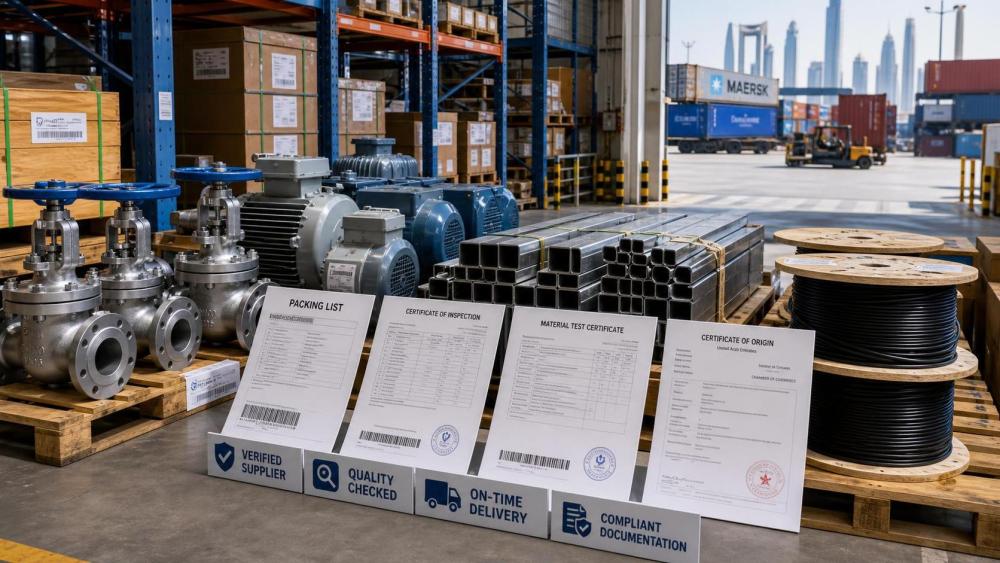
This matters in several ways. First, technical conformity: material grade, voltage, frequency, pressure class, coating specification, labeling language, and packing method may all need review. Second, documentation: commercial invoices and packing lists are only the starting point. Depending on the item, you may also need certificates of origin, test certificates, safety data, product declarations, or additional evidence linked to your own industry controls. Third, customs classification must be checked carefully. Misclassification can distort duty assumptions and create clearance delays.
For industrial sourcing UAE projects, this is where teams often save money in theory and lose it in practice. The unit price may be lower, but if the item needs re-documentation, re-testing, repacking, or onward corrective handling, the initial savings narrow fast. The right question is not “Can they supply it?” but “Can they supply it in a form that clears and performs where we need it?”
Look beyond ex-works pricing
Pricing conversations tend to become narrow too early. A quote can look favorable because it excludes packaging upgrades, local transport, export handling, documentation support, insurance assumptions, or downstream inspection costs. That does not mean the supplier is being misleading. It often means both sides are still speaking from different cost frames.
Instead of asking only for a best price, ask the supplier to break out the commercial basis clearly. Which Incoterm is being quoted? Is the packing suitable for sea freight, inland movement, or sensitive equipment protection? Are pallets fumigated if needed? Are dangerous goods rules relevant? Who pays for pre-shipment inspection if your company requires it? Is the lead time based on stock, incoming replenishment, or production from a third-country source?
The total landed cost view should include at least five layers: purchase price, export-side handling, freight and transit variability, import-side duties and clearance charges, and the internal cost of managing exceptions. If a supplier cannot support that discussion, you may still use them for low-risk buying, but not for time-sensitive or specification-sensitive categories.
Document control is not an admin issue
Procurement teams sometimes leave documentation checks until late because they feel secondary to commercial terms. In industrial trade, documentation is part of the product. If the paperwork is weak, the supply itself is weak.
Before moving ahead, confirm who prepares the shipping documents, whether technical certificates can be linked to the shipped batch, and how document revisions are controlled if specifications change. If you are buying machinery parts, fabricated items, electrical products, chemicals, or materials used in regulated production environments, that discipline matters even more. A missing or inconsistent certificate may not stop a shipment from leaving, but it can create problems during receiving, installation, audit review, or claims handling.
This is one area where outside trade intelligence can help. Neutral market research and sourcing guidance are useful not because they replace procurement judgment, but because they help teams frame the right questions before supplier discussions harden into commitments. When a category spans multiple exporting routes, standards regimes, or freight assumptions, broader supply chain analysis often reveals risks that a simple quote comparison misses.
Lead time needs to be tested, not accepted
Many sourcing delays come from optimistic lead times rather than outright supplier failure. In the UAE, the supply model may involve bonded stock, free zone handling, domestic transfer, regional consolidation, or import from another country after order confirmation. None of that is unusual. The issue is whether the stated lead time reflects the real route.
Ask the supplier to clarify whether the goods are physically in stock, allocated but not yet received, available through affiliate inventory, or subject to factory release. Those are four different lead-time profiles. It is also worth asking how often the item turns, whether substitutions are common, and whether serial or batch-controlled products are handled separately.
For urgent orders, request a practical shipping sequence rather than a single number of days. You want to know where the time sits: picking, export document preparation, customs processing, carrier booking, transshipment, destination clearance, or final inland delivery. A short lead time with no route logic behind it should be treated cautiously.
Evaluate supplier communication under pressure, not just at quote stage
One of the best predictors of sourcing performance is not the first quotation. It is the quality of follow-up when details become inconvenient. If specifications need clarification, if origin questions arise, if alternate brands are proposed, or if a delivery promise shifts, does the supplier respond clearly and in writing?
During early engagement, pay attention to small signals. Do they confirm revision numbers on technical documents? Do they separate confirmed stock from expected stock? Do they flag when a requested item is outside their strongest category? Do they explain exclusions in the quote instead of burying them? These habits often matter more than polished sales language.
This is especially relevant for industrial sourcing UAE because many transactions involve cross-border coordination, not just domestic purchase and delivery. A supplier who communicates well during uncertainty reduces operational friction for your team later.
When to treat a supplier as suitable, conditional, or high-risk
Not every supplier needs to be rejected or approved in absolute terms. It is more useful to classify them by purchase context.
A supplier may be suitable if they can define their role, provide category-relevant documentation, explain stock and lead-time status clearly, and quote on a transparent commercial basis.
A supplier may be conditional if they are credible but dependent on third-party sourcing, limited in technical documentation, or better suited for standard items than engineered packages. In that case, use them selectively and protect the order with tighter document and approval steps.
A supplier should be treated as high-risk if the company role is unclear, origin and traceability are weak, pricing assumptions keep shifting, or compliance questions are answered vaguely. The issue is not simply that something might go wrong. It is that if something does go wrong, recovery becomes difficult.
A practical way to prepare before the first serious RFQ round
If you are still at the market-entry stage, spend a little time tightening your own brief before asking the UAE market for offers. Internal ambiguity creates external noise. Define the product category, technical minimums, required documents, preferred Incoterms, destination country, and whether alternatives are allowed. Also decide which items are routine buying and which items need deeper qualification. Suppliers respond better when the procurement side is clear about risk tolerance.
It also helps to split your sourcing objective into two tracks. One is commercial discovery: who can quote, at what level, and under what terms. The other is supply verification: who can actually support your operational and compliance needs. These tracks should inform each other, but they should not be confused. A fast quote is useful. It is not yet a sourcing decision.
Where the market is fragmented or your team is entering an unfamiliar category, independent trade intelligence can reduce wasted cycles. Cross-border sourcing guides, export trend monitoring, and supply chain mapping are most helpful at the point where too many supplier options look similar on the surface. The value is in filtering risk before transaction pressure takes over.
Before you move from inquiry to order
The UAE can be a strong sourcing gateway, but only when the early checks are disciplined. Verify the supplier’s role. Confirm that the product, paperwork, and commercial terms fit your destination market. Test the lead time against the real route. Price the full movement, not just the item. Watch how the supplier handles inconvenient questions.
That approach may feel slower at the beginning, yet it usually prevents the bigger delays that happen later. In industrial procurement, the most avoidable problems are often the ones that looked small during supplier onboarding. If your next step in industrial sourcing UAE is an RFQ, make sure your verification questions go out with it. That is often where the quality of the eventual purchase is decided.
Weekly Insights
Stay ahead with our curated technology reports delivered every Monday.
Recommended News
 Supply ChainOct 15, 2026How to choose a supply chain strategy for unpredictable demand
 Supply ChainOct 14, 2026How to assess an industrial equipment supplier's spare parts support
 Supply ChainOct 14, 2026EU Updates CSDDD Guidance on Global Supply Chain Due Diligence
 Global SourcingOct 13, 2026How to assess industrial automation suppliers for legacy integration