When does a tariff exposure analysis tool justify the cost?
For business decision-makers navigating volatile trade policy, the real question is not whether tariffs matter, but when a tariff exposure analysis tool delivers measurable value. In many organizations, tariff cost is still tracked through spreadsheets, broker updates, and reactive conversations after a shipment is already committed. That may work when exposure is small, product portfolios are narrow, and sourcing patterns are stable. It breaks down quickly when procurement spans multiple countries, product classifications are complex, or pricing decisions need to be made before the next policy change lands.
A tool is worth paying for when tariff risk stops being a side calculation and starts influencing margin, supplier strategy, inventory posture, or customer pricing. That threshold arrives earlier than many executives expect.
The practical question is not “Do tariffs affect us?” Almost every importer, manufacturer, or cross-border procurement team can answer yes. The more useful question is: Are we losing money, time, or negotiating power because we do not see tariff exposure clearly enough or early enough?
When manual tariff tracking becomes too expensive to defend
There is a common moment inside growing companies. Finance believes tariffs are under control because landed cost reports exist. Procurement believes suppliers are being managed because quotes are compared. Sales believes pricing is protected because surcharges can be added later. Yet none of those views fully captures exposure if tariff rates shift, product origin changes, classifications are challenged, or alternate sourcing routes create different duty outcomes.
A tariff exposure analysis tool begins to justify its cost when manual tracking creates blind spots in any of these areas:
- Products sourced from several countries with different tariff treatment
- Frequent supplier changes or dual-sourcing strategies
- Large SKU counts with inconsistent HS code governance
- Compressed margins where even small duty changes alter profitability
- Long contract cycles that require forward-looking cost assumptions
- Executive pressure for scenario planning during geopolitical shifts
In other words, the cost of not having the tool is rarely just the tariff itself. It appears in slower decisions, overpayment, missed sourcing opportunities, pricing errors, and weaker supply chain resilience.
The clearest business case: when tariff exposure affects decisions before purchase orders are issued
The strongest justification for investing in a tool is not retrospective reporting. It is decision support.
If your team only calculates tariff impact after goods are purchased, then analysis arrives too late to influence supplier selection, volume allocation, stocking strategy, or sales pricing. At that point, the business is measuring damage rather than managing exposure.
For enterprise buyers and CPOs, useful tariff intelligence should shape questions such as:
- Should volume move from one country of origin to another?
- Would a slightly higher unit price from an alternate supplier produce a lower landed cost?
- Does a tariff-sensitive product need a different customer contract structure?
- Should inventory be brought forward ahead of a policy deadline?
- Are we too concentrated in a sourcing corridor vulnerable to sudden duty action?
Once tariff analysis becomes part of sourcing design rather than post-purchase accounting, the economics of a specialized tool improve dramatically.
Not every company needs one at the same level
That said, not every business needs a full-featured platform immediately. A tariff exposure analysis tool is easier to justify in some operating environments than others.
For a small importer with a limited number of products, stable origin, and low annual duty burden, disciplined internal processes may be enough. The same is true for companies whose suppliers are almost entirely domestic or whose contract structures naturally absorb duty shifts.
But the equation changes for firms operating across industrial sectors where sourcing and compliance details are tightly linked. GTIIN’s work across more than 50 manufacturing and industrial categories reflects a consistent pattern: the more physically complex the supply chain, the less useful generic tariff assumptions become. Material specifications, product configuration, trade route changes, customs latency, origin strategy, and regulatory shifts all interact. Executives need a view that is commercial, not just technical.
That is why many organizations outgrow static tariff checking long before they realize it. Complexity often rises quietly—in category expansions, contract diversification, localization efforts, or geopolitical hedging—until tariff exposure is no longer a narrow trade-compliance issue.
Five signs the tool is already cheaper than your current process
Decision-makers often ask for a hard threshold: annual import volume, duty spend, or number of suppliers. Those indicators matter, but they do not tell the full story. In practice, a tool justifies cost when it reduces uncertainty in high-value decisions. Here are five reliable signs.
1. Your teams argue over whose tariff number is correct
If procurement, finance, customs, and sales use different assumptions, your issue is not simply data accuracy. It is a governance problem. A centralized tariff exposure model can create one working version of landed cost logic across functions.
2. Pricing decisions are being made with outdated duty assumptions
Many companies still quote customers based on last quarter’s tariff picture. In sectors with low margin tolerance, even a modest shift in duty exposure can make a contract unattractive. If tariffs influence commercial viability, delayed analysis carries real cost.
3. Supplier negotiations ignore total landed cost
A supplier with the lowest ex-works price is not automatically the best choice. If duty, transit, compliance, and origin effects are not visible at the negotiation table, procurement is optimizing the wrong variable.
4. Scenario planning is slow when trade policy changes
When a new tariff action, exemption review, or geopolitical dispute emerges, executive teams need answers quickly. If your response still requires manual file gathering across departments, the hidden cost is not just labor. It is strategic delay.
5. The board or leadership team is asking for resilience, not just savings
Tariffs are rarely isolated from broader supply chain risk. Companies are increasingly expected to explain concentration exposure, route vulnerability, and cross-border dependency. A tariff exposure analysis tool becomes more valuable when resilience reporting matters as much as cost reporting.
What value should a good tariff exposure analysis tool actually produce?
Software should not be purchased because tariffs are “important.” It should be purchased because it improves decision quality in specific, observable ways.
For business leaders, the real outputs to evaluate include:
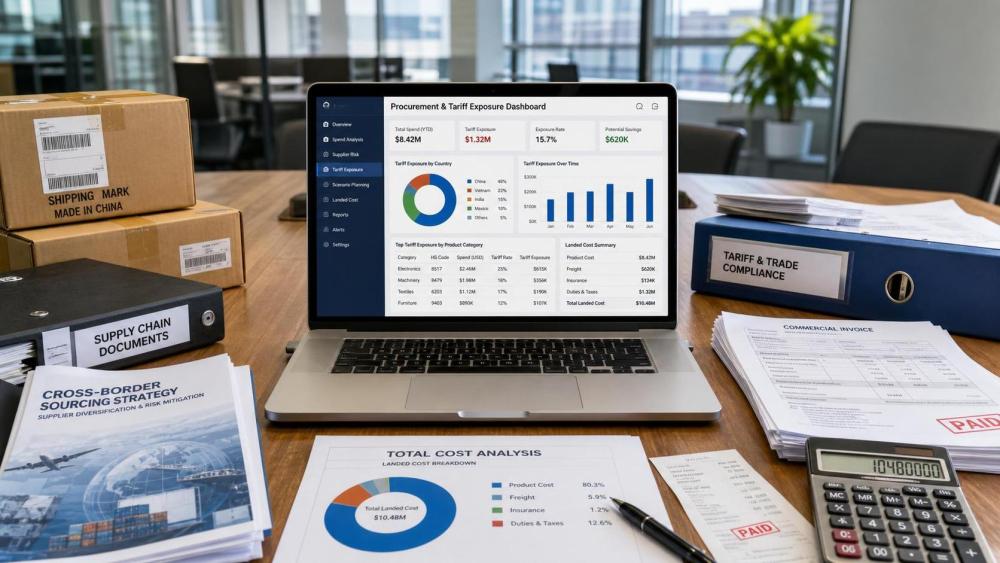
- Visibility: a clear map of where tariff cost sits by product, supplier, country, and customer segment
- Scenario modeling: the ability to test policy changes, sourcing shifts, or rerouting decisions before acting
- Landed cost accuracy: better cost-to-serve understanding across procurement and pricing teams
- Response speed: faster executive decision-making during trade disruptions
- Strategic alignment: better coordination between sourcing, commercial planning, and compliance functions
That final point is easy to underestimate. The value of a tariff tool is often organizational. It helps move trade intelligence out of a narrow specialist silo and into mainstream supply chain planning.
Where buyers make the wrong calculation
The most common mistake is to compare the tool’s subscription or implementation cost only against current tariff spend. That is too narrow.
If a company pays substantial duties but cannot alter suppliers, contracts, inventory timing, or customer pricing, then even excellent analysis may have limited near-term financial effect. On the other hand, a business with moderate tariff exposure may see strong returns if it frequently runs sourcing events, negotiates annual contracts, or manages volatile origin strategies.
In other words, the value lies not only in exposure size, but in decision leverage. The more choices your business can make based on better tariff insight, the more the tool is worth.
Another common error is assuming trade intelligence is interchangeable. Basic tariff lookup is not the same as exposure analysis. Decision-makers need context: supplier footprint, sector trends, regulatory developments, logistics realities, and medium-term industrial shifts. This is where a broader intelligence environment matters. Platforms like GTIIN are useful not because they present tariff friction in isolation, but because they connect tariffs to sourcing alternatives, export trends, supply chain resilience, and industrial market structure.
Questions to ask before approving the investment
If you are evaluating whether the tool belongs in next quarter’s budget, a few questions can sharpen the decision:
- How often do tariff changes force us to revisit sourcing or pricing assumptions?
- How many functions need tariff exposure data, and are they working from the same source?
- Can we model landed cost impact by supplier and country quickly enough to support negotiations?
- Are we managing tariff exposure at SKU level, category level, or only through broad estimates?
- What is the cost of delayed response when trade policy changes unexpectedly?
- Do we need this tool mainly for compliance reporting, or for commercial and supply chain strategy?
The answers often reveal whether the business needs a lightweight solution, a broader trade intelligence platform, or a more integrated procurement analytics capability.
Implementation matters more than feature lists
Even the best tool underperforms if ownership is unclear. Some companies place tariff analysis solely with customs or trade compliance, then wonder why procurement decisions do not improve. Others buy powerful software but fail to connect supplier data, product classification logic, and sourcing workflows.
The companies that extract the most value usually treat tariff exposure as a cross-functional planning input. Procurement, finance, trade compliance, and supply chain strategy each need different views of the same issue. A useful system supports that shared language.
For decision-makers, this means the buying decision should include more than software criteria. Consider internal readiness:
- Is product and supplier data clean enough to support meaningful analysis?
- Who owns HS code governance and origin assumptions?
- Will sourcing teams actually use scenario outputs in supplier decisions?
- Can insights feed into pricing, budgeting, and risk review processes?
If the answer is no across the board, the first need may be process discipline. But if the organization already feels the strain of fragmented tariff visibility, delaying the tool often means extending an expensive workaround.
So, when does a tariff exposure analysis tool justify the cost?
It justifies the cost when tariff complexity begins to influence business outcomes faster than your current process can interpret them. That may show up in margin leakage, slow sourcing decisions, pricing uncertainty, poor scenario planning, or weak resilience reporting. The trigger is not simply high duty spend. It is the point at which trade volatility becomes material to procurement and supply chain strategy.
For enterprise leaders, that point increasingly arrives before a crisis. Trade policy is more dynamic, supply chains are more geographically distributed, and cost pressure leaves less room for approximation. A tariff exposure analysis tool is not a purchase for curiosity. It is an investment in seeing landed-cost risk clearly enough to act on it.
And in cross-border procurement, clarity has a way of paying for itself long before spreadsheets admit it.
Weekly Insights
Stay ahead with our curated technology reports delivered every Monday.
Recommended News
 Supply ChainOct 15, 2026How to choose a supply chain strategy for unpredictable demand
 Supply ChainOct 14, 2026How to assess an industrial equipment supplier's spare parts support
 Supply ChainOct 14, 2026EU Updates CSDDD Guidance on Global Supply Chain Due Diligence
 Global SourcingOct 13, 2026How to assess industrial automation suppliers for legacy integration