Securing the Emulsion Supply Chain: Sourcing Strategies for Commercial Mayonnaise
In the highly industrialized global food service and ready-meal sectors, consistency is the bedrock of corporate profitability. For multinational fast-food franchises, industrial caterers, and frozen food manufacturers, a seemingly simple condiment often acts as the foundational building block for an entire menu. Among these, commercial emulsion sauces represent both a critical flavor profile and a profound logistical challenge.
Procuring these specialized ingredients on a massive international scale—where thousands of metric tons cross oceans and continents annually—requires significantly more expertise than standard commodity purchasing. Emulsions are not static, inert materials; they are highly volatile, temperature-sensitive thermodynamic systems. A single misstep in the global supply chain can result in catastrophic product separation, lipid oxidation, and millions of dollars in discarded inventory. This comprehensive supply chain intelligence report dissects the macro-procurement strategies necessary for safely, cost-effectively, and reliably sourcing commercial emulsion products in today's highly volatile global market.
The Thermodynamic Fragility of the Supply Chain
To successfully navigate the procurement of commercial sauces, supply chain directors must first understand the fundamental physical chemistry of the product they are purchasing. An emulsion is essentially a colloidal suspension where microscopic droplets of oil are violently dispersed into a water base, stabilized by an emulsifying agent (predominantly the lecithin found in egg yolks).
This physical state is thermodynamically unstable by nature. The oil and water constantly attempt to separate and return to their lower-energy, segregated states. In a controlled laboratory or a stable restaurant kitchen, a well-formulated emulsion remains perfectly homogenous. However, the global supply chain is a gauntlet of extreme thermodynamic stress.
When a 20-foot shipping container is loaded with totes of commercial sauce in Southeast Asia and shipped to Northern Europe, the cargo endures violent oceanic swells, high-frequency diesel engine vibrations from inland freight, and extreme climatic temperature swings. If the overseas manufacturer utilized inferior high-shear homogenizers or sub-standard emulsifiers, this kinetic and thermal stress will rapidly overcome the colloidal stability of the product. The result is "breaking" or phase separation—the oil rapidly pools at the top of the container, leaving a watery, useless sludge at the bottom, rendering the entire shipment commercially worthless upon arrival.
Vendor Auditing: Evaluating Homogenization Capabilities
Because of this inherent thermodynamic fragility, standard Vendor Quality Assurance (VQA) protocols are insufficient. When evaluating an international supplier for bulk emulsion products, procurement teams cannot rely solely on taste tests or basic microbiological certificates. They must conduct rigorous, engineering-focused factory audits.
The primary target of this audit is the vendor's homogenization infrastructure. The stability of an emulsion is mathematically correlated to the particle size of the dispersed oil droplets; smaller, more uniform droplets yield an exponentially more stable product. Auditors must verify that the overseas factory utilizes advanced, multi-stage, high-shear colloid mills or ultrasonic homogenizers capable of reducing oil droplets to the optimal sub-micron diameter.
Furthermore, sourcing directors must scrutinize the vendor's raw material intake, specifically their handling of egg-based emulsifiers and pasteurization protocols. Purchasing from a facility with outdated mixing technology guarantees a high incidence of product separation during transit. Investing capital to audit these physical capabilities before signing an irrevocable Letter of Credit (L/C) is the most critical risk-mitigation strategy a procurement team can execute.
Cold Chain Logistics and Temperature Excursion Risks
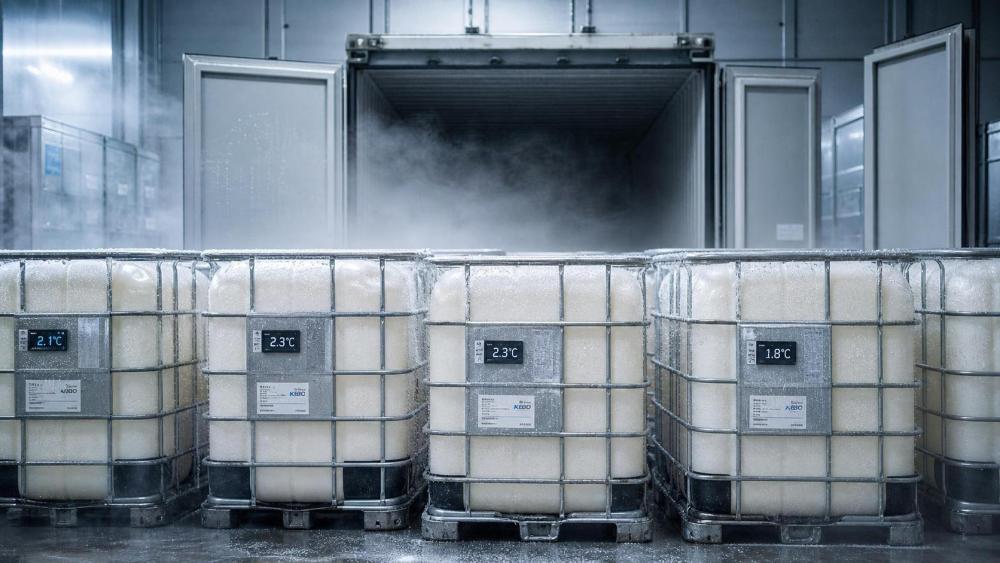
Once a highly stable product is manufactured, the survival of the cargo shifts entirely to the logistics network. Emulsion sauces operate within a remarkably narrow band of thermal tolerance. They are uniquely susceptible to both extreme heat and freezing temperatures, making them one of the most difficult food ingredients to transport globally.
If the product is exposed to prolonged heat (typically exceeding
Consequently, bulk sourcing requires strict adherence to temperature-controlled logistics, commonly known as a "reefer" (refrigerated) supply chain. Procurement directors must negotiate freight contracts that mandate the use of active refrigerated containers (usually set between 10
Formulation Economics and Commodity Oil Volatility
Beyond the physical logistics, Chief Financial Officers (CFOs) and procurement teams must manage the extreme financial volatility associated with the raw materials. The primary ingredient by volume in any commercial emulsion sauce is liquid vegetable oil—typically soybean, canola, or sunflower oil.
These oils are globally traded commodities, highly susceptible to geopolitical conflicts, extreme weather events (such as droughts in key agricultural basins), and shifting biofuel mandates. A 20% spike in the global commodity price of soybean oil will immediately and severely impact the Free On Board (FOB) price of the finished sauce.
When QA teams and procurement directors evaluate the differences between standard formulations and specialized blends, such as understanding how Mayonnaise behaves under various stress conditions compared to lower-oil salad dressings, they must also factor in the commodity risk. To mitigate this, sophisticated sourcing teams engage in strategic commodity hedging and negotiate long-term, indexed supply contracts. Instead of locking in a fixed price for a finished product over 12 months, the contract is mathematically tied to a recognized agricultural commodity index. This transparency ensures that the buyer is paying a fair market rate for the oil, while the manufacturer secures a guaranteed, stable profit margin for their processing and homogenization labor.
Navigating Import Compliance and Phytosanitary Regulations
The final, and often most paralyzing, hurdle in the global sourcing lifecycle is international customs compliance. Because premium commercial emulsions rely heavily on egg yolks as the primary emulsifying agent, they trigger the highest levels of scrutiny from global agricultural and customs authorities.
Global governments are hyper-vigilant regarding the cross-border transmission of highly pathogenic avian influenza (HPAI) and salmonella. Importing any product containing egg derivatives requires a flawless trail of phytosanitary documentation. The overseas manufacturer must provide authenticated health certificates issued by their national veterinary authority, proving that the egg yolks were sourced from disease-free avian zones and were subjected to mathematically verified thermal pasteurization protocols to eradicate all potential pathogens.
If a shipment arrives at the destination port with missing, incomplete, or incorrectly translated phytosanitary certificates, customs agents will immediately impound the cargo. Given the strict temperature requirements of the product, prolonged detention at a congested port facility significantly increases the risk of thermal degradation and accumulates astronomical demurrage fees. Sourcing directors must work in lockstep with licensed import brokers to pre-clear all veterinary documentation weeks before the maritime vessel ever reaches domestic waters.
Conclusion
Successfully sourcing heavy-volume, commercial-grade emulsion sauces on a global scale is a formidable supply chain achievement. It is a highly strategic, multi-disciplinary process that requires procurement teams to act simultaneously as food scientists, commodity traders, and logistics experts.
By proactively dismantling information asymmetry through rigorous high-shear homogenization audits, securing end-to-end refrigerated maritime transport with digital telemetry, intelligently hedging against volatile vegetable oil commodity markets, and flawlessly executing complex phytosanitary compliance, procurement directors can transform international sourcing from a high-risk gamble into a distinct corporate advantage. In the competitive arena of commercial food manufacturing, mastering these supply chain strategies ensures the consistent delivery of premium, stable flavors while protecting the fundamental profitability of the entire enterprise.
Tags
Weekly Insights
Stay ahead with our curated technology reports delivered every Monday.
Recommended News
 Supply ChainOct 15, 2026How to choose a supply chain strategy for unpredictable demand
 Supply ChainOct 14, 2026How to assess an industrial equipment supplier's spare parts support
 Supply ChainOct 14, 2026EU Updates CSDDD Guidance on Global Supply Chain Due Diligence
 Global SourcingOct 13, 2026How to assess industrial automation suppliers for legacy integration