FDA Tightens Traceability Checks on Chinese Industrial Inputs
On June 28, 2026, the U.S. Food and Drug Administration updated its Import Safety Verification Guidance for Industrial Inputs, adding a new requirement that takes effect immediately for certain industrial chemical imports from China. The change centers on products declared for non-food-contact use but containing organic solvents, plasticizers, or heavy metals, and it places new attention on batch-level composition verification and upstream raw-material traceability. For traders, manufacturers, importers, and supply chain service providers handling cleaners, release agents, and surface treatment chemicals, this is worth close attention because the operational consequence is not abstract: shipments that do not meet the documentation standard may face port detention and added testing costs.
What the FDA Changed
According to the information provided, the FDA updated the guidance on June 28, 2026, by adding Section 4.7 to the Import Safety Verification Guidance for Industrial Inputs. The new provision applies to Chinese industrial chemicals declared as “non-food-contact use” when those products contain organic solvents, plasticizers, or heavy metals.
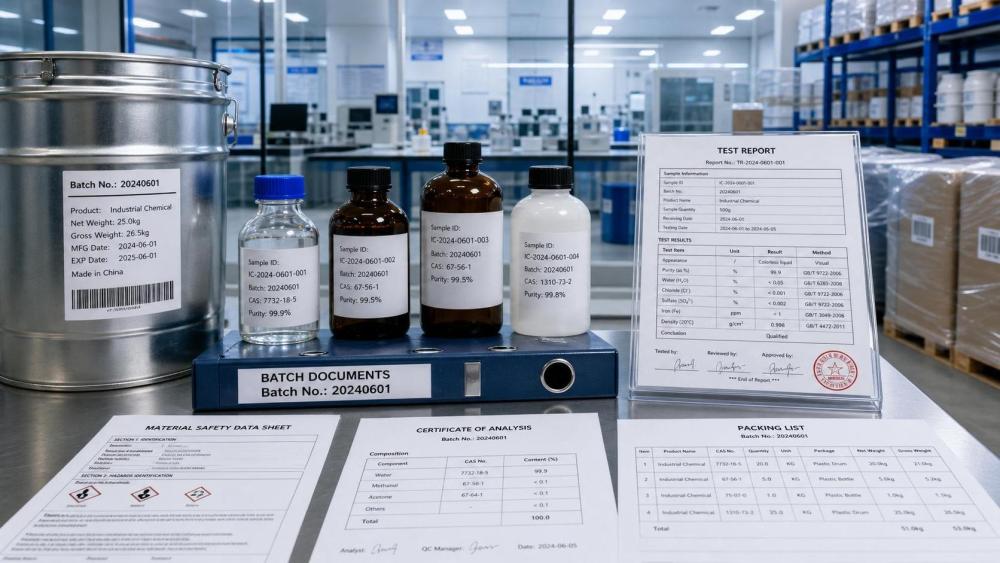
The requirement is effective immediately. Covered goods must provide a verifiable batch-level substance composition profile, specifically including GC-MS and ICP-MS reports, along with proof of the upstream raw-material traceability chain. Examples mentioned in the event summary include cleaning agents, release agents, and surface treatment agents.
The stated enforcement consequence is also clear in the provided information: goods that fail to meet the requirement may be detained at the port of entry and may incur additional testing costs.
Where the Pressure May Appear First
Documentation risk for direct trading parties
From an industry perspective, direct trading companies and import-export operators may be the first to feel the impact because the rule is tied to import declaration and supporting records. The immediate pressure point is whether shipment files can match the FDA's new expectation for verifiable batch-level composition data and upstream traceability proof, rather than relying only on conventional product-level documents.
Higher coordination demands on manufacturers and formulators
Manufacturers of affected industrial chemicals may face the operational burden of preparing composition evidence at the batch level and aligning it with export documentation. Analysis shows that the issue is not only laboratory reporting, but also whether internal production, quality, and supplier records can be connected in a way that is credible during review.
Upstream procurement now matters more in compliance delivery
For raw-material procurement teams, the update may shift attention upstream. If a finished product must be supported by traceability chain evidence, then sourcing records, supplier identity, and material handoff documentation become more relevant to shipment release. What deserves closer attention is that the compliance question may now extend beyond the finished product file to the raw-material trail behind it.
Logistics and customs service providers may see added execution complexity
Customs brokers, logistics coordinators, and other supply chain service providers may also be affected because shipment timing and clearance planning could become more sensitive to documentation completeness. The practical exposure here lies in port handling, inspection response time, and the possibility of extra testing if supporting records are judged insufficient.
What Companies Should Watch Now
Confirm whether a product falls within the described scope
Companies should first focus on whether their exported products match the stated conditions in the update: declared as non-food-contact use, originating from China, and containing organic solvents, plasticizers, or heavy metals. That threshold matters because it determines whether the added documentation burden is likely to apply.
Review whether batch-level reports are actually verifiable
The new requirement is not framed only as a need to provide reports, but as a need to provide verifiable batch-level substance profiles. Observably, businesses should pay attention to whether GC-MS and ICP-MS materials can be matched to specific batches in shipping and internal records, rather than treated as generic reference documents.
Check the continuity of upstream traceability records
Another practical focus is the upstream raw-material traceability chain. Companies involved in procurement, formulation, and export documentation should examine whether supplier records and material-origin documentation are continuous enough to support a traceability claim if questioned during import review.
Prepare for customer and delivery-cycle implications
Because the event summary states that non-compliant goods may face detention and extra testing costs, affected businesses should closely monitor delivery scheduling, contract communication, and customer expectations. The distinction worth tracking is between the publication of a rule update and the day-to-day execution burden that appears once shipments begin moving under the revised standard.
Why This Looks Like More Than a Routine Paperwork Update
Analysis shows that this development is best read as a compliance signal with immediate operational consequences, not merely as a formal wording change. The FDA update connects product declaration, analytical verification, and upstream traceability into one review logic. That matters because it raises the standard for showing what a product contains and where its inputs came from, even when the goods are declared for non-food-contact use.
At the same time, it is more appropriate to understand this as an active regulatory development that still requires continued observation, rather than as a fully settled long-term outcome for every product category. The confirmed facts establish the new requirement and the immediate enforcement risk, but the industry will still need to watch how consistently this standard is applied in practice across shipments and documentation scenarios.
How the Industry May Need to Read This Signal
In practical terms, this update points to a narrower but more demanding compliance environment for certain Chinese industrial chemical exports entering the United States. The immediate issue is not broad market change in the abstract, but whether companies can produce documentation that is specific, batch-linked, and traceable upstream.
A balanced reading is that this is both a short-term operational change and a longer-term signal worth monitoring. It should not be overstated beyond the facts provided, but it also should not be treated as a minor administrative adjustment given the stated risks of port detention and extra testing costs.
Basis of This Article and What Still Needs Verification
This article is based on the user-provided event title, event date, and event summary concerning the FDA's June 28, 2026 update to the Import Safety Verification Guidance for Industrial Inputs. No additional unverified facts, company examples, market figures, or external links have been added.
For this type of industry development, source types that are usually relevant include official regulatory notices, agency guidance documents, company compliance communications, industry association updates, and reporting from authoritative trade or business media. The specific official source link was not provided in the input, so continued verification remains necessary. What deserves closer attention going forward is whether further official wording, implementation clarification, or related compliance interpretation emerges after the guidance update.
Tags
Weekly Insights
Stay ahead with our curated technology reports delivered every Monday.
Recommended News
 Supply ChainOct 15, 2026How to choose a supply chain strategy for unpredictable demand
 Supply ChainOct 14, 2026How to assess an industrial equipment supplier's spare parts support
 Supply ChainOct 14, 2026EU Updates CSDDD Guidance on Global Supply Chain Due Diligence
 Global SourcingOct 13, 2026How to assess industrial automation suppliers for legacy integration