
Export Documentation Mistakes That Delay Shipments
Export Documentation Mistakes That Delay Shipments
Export documentation errors remain one of the most common yet preventable causes of shipment delays, compliance issues, and unexpected costs.
Even a small mismatch can stop cargo at customs, trigger inspections, or create disputes between sellers, buyers, and logistics partners.
In practice, export documentation is not just paperwork. It is the operating language of cross-border execution, compliance, and payment control.
For companies reviewing supplier reliability or shipment readiness, these mistakes often reveal deeper process gaps.
This guide explains the export documentation mistakes that delay shipments and shows how to reduce risk before cargo moves.
Why export documentation delays happen so often
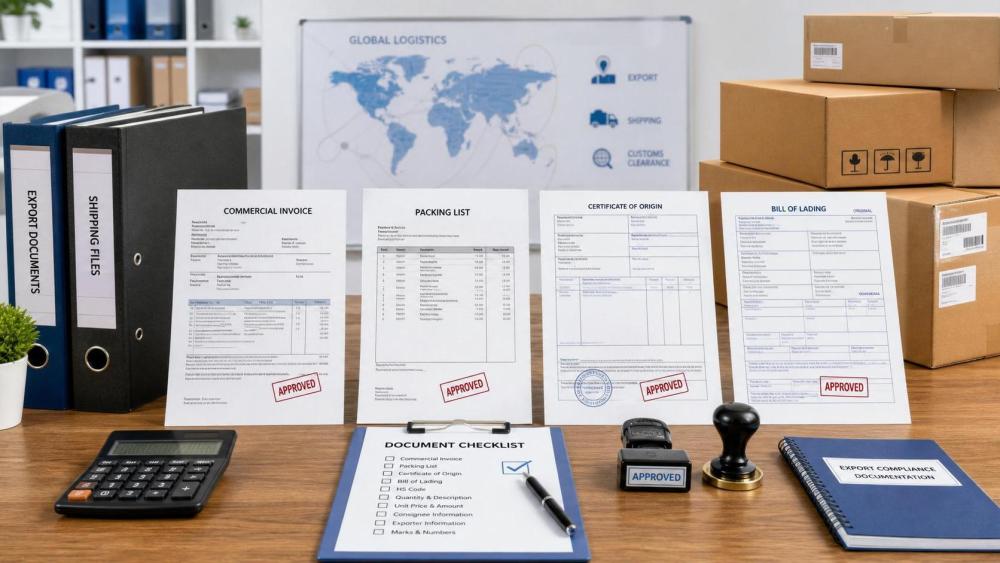
Most shipment delays do not begin at the port. They begin earlier, when commercial data is entered inconsistently across documents.
A sales team may issue one description. A warehouse team may pack another quantity. A broker may file customs data using older records.
That gap creates friction across the invoice, packing list, certificate of origin, bill of lading, and export declaration.
From a control perspective, export documentation reflects process maturity. When it is weak, shipment performance becomes harder to trust.
That is why document accuracy matters not only for customs clearance, but also for supplier evaluation and supply chain resilience.
The most common export documentation mistakes
Some mistakes look minor on paper. In real operations, they can add days, extra fees, or even cargo holds.
1. Inconsistent product descriptions
A vague or mismatched product description is one of the most frequent export documentation failures.
For example, the invoice may say “industrial parts,” while the packing list shows specific valve models and material grades.
Customs teams often flag these differences because they affect classification, duty treatment, and inspection decisions.
2. Wrong HS codes or tariff classification
Incorrect HS codes are a direct export documentation risk. They can lead to customs queries, reclassification, penalties, or duty corrections.
This issue becomes more serious when products have technical specifications, mixed materials, or dual-use compliance concerns.
3. Quantity, weight, or unit mismatches
If the commercial invoice, packing list, and transport document do not match, shipment delays become likely.
Differences in carton count, net weight, gross weight, or unit of measure often trigger manual review.
4. Missing certificates or outdated forms
Many markets require supporting export documentation such as certificates of origin, phytosanitary certificates, test reports, or compliance declarations.
When forms are missing, expired, unsigned, or issued by the wrong body, customs release can stall immediately.
Where these mistakes create the biggest business impact
The cost of weak export documentation is rarely limited to one delay. The bigger damage usually spreads across operations and supplier trust.
- Port storage and demurrage charges rise while documents are corrected.
- Production plans slip when inbound materials miss planned delivery windows.
- Customer confidence weakens when promised dates change without clear cause.
- Internal teams spend time on rework instead of sourcing, planning, or negotiation.
- Trade finance or letter of credit processing may fail if export documentation does not comply exactly.
This is especially important in bulk commodities, industrial equipment, components, and regulated cross-border procurement.
In those sectors, documentation quality often signals whether a supplier can scale reliably under pressure.
How to spot export documentation risk early
The best time to catch export documentation mistakes is before booking, not after cargo reaches the terminal.
A practical review process should focus on consistency, document ownership, and market-specific requirements.
Check the data fields that fail most often
- Legal exporter and consignee names
- Product descriptions and model numbers
- HS codes and country of origin
- Quantities, values, weights, and packaging details
- Incoterms, payment terms, and transport references
Review the handoff points
Most export documentation errors appear where information passes between teams.
Typical risk points include sales to operations, warehouse to forwarder, and exporter to customs broker.
If ownership is unclear, correction cycles become slow and expensive.
A practical framework to prevent shipment delays
Reducing export documentation mistakes does not always require complex software first. It usually starts with disciplined process design.
- Create a single product master for descriptions, HS codes, and origin data.
- Standardize invoice and packing list templates across business units.
- Assign one document owner before every shipment is booked.
- Use a pre-shipment export documentation checklist for market-specific certificates.
- Run a final cross-check between commercial, logistics, and customs data.
This approach works well because it targets root causes, not just last-minute corrections.
It also supports better supplier comparisons when documentation quality becomes part of performance review.
What strong export documentation says about supplier capability
Reliable export documentation is often a leading indicator of broader execution strength.
A supplier that controls documentation well usually manages specifications, packaging, traceability, and compliance more consistently.
That matters in global sourcing environments where delays come from both physical flow and information quality.
From recent market shifts, the clearer signal is this: documentation discipline is now part of supply chain competitiveness.
As regulatory scrutiny grows, weak export documentation becomes harder to hide and more costly to ignore.
Final takeaway
Shipment delays linked to export documentation are common, but they are rarely random.
They usually point to poor data control, unclear ownership, or weak coordination across export processes.
Companies that treat export documentation as a strategic control point move faster and manage cross-border risk more confidently.
For stronger shipment execution, start by auditing the documents that fail most often, then tighten the process behind them.
That simple shift can reduce delays, lower avoidable costs, and improve trust across the full international supply chain.
Weekly Insights
Stay ahead with our curated technology reports delivered every Monday.
Recommended News
 Supply ChainOct 15, 2026How to choose a supply chain strategy for unpredictable demand
 Supply ChainOct 14, 2026How to assess an industrial equipment supplier's spare parts support
 Supply ChainOct 14, 2026EU Updates CSDDD Guidance on Global Supply Chain Due Diligence
 Global SourcingOct 13, 2026How to assess industrial automation suppliers for legacy integration