Supply Chain Analytics Europe: Cost Risks to Watch
For financial approvers, supply chain analytics Europe is no longer a back-office reporting exercise. It has become a practical way to expose cost leakage before it reaches margin, budget, or cash flow. In a region shaped by tariffs, energy swings, carbon rules, and freight instability, even a well-run sourcing model can hide risks that slowly accumulate across every lane and supplier node.
That is why supply chain analytics Europe matters across industrial, manufacturing, and cross-border trade settings. GTIIN’s trade intelligence lens is built for this kind of decision-making, where cost signals must be read alongside compliance pressure, transit reliability, and supplier exposure. The point is not simply to track spend, but to understand which cost drivers are structural, which are temporary, and which can be managed with better visibility.
Why Europe’s cost profile is changing
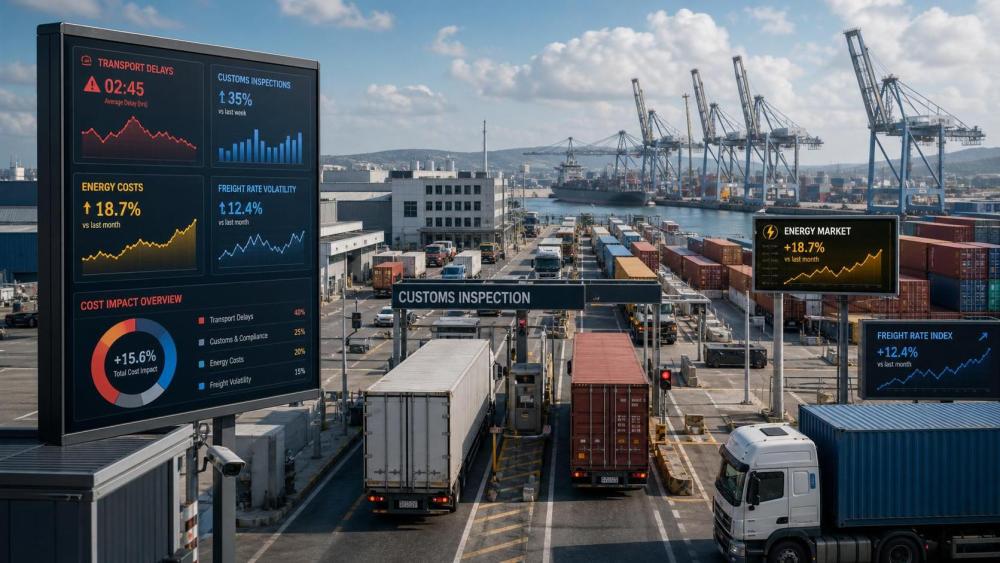
Europe is still one of the most important sourcing and distribution regions, but its cost base is no longer predictable in the old sense. Energy pricing, labor pressure, port congestion, regulatory updates, and currency movement now interact more tightly than many annual budgets assume.
The challenge is that these shifts rarely appear as one visible shock. They usually show up in smaller increments: higher demurrage, tighter warehouse availability, longer customs cycles, or a supplier’s quiet pass-through of compliance costs. supply chain analytics Europe helps connect those fragments into a cost story that can actually be acted on.
GTIIN’s broader market framework is useful here because it combines freight benchmarks, export trends, and supply chain resilience analysis. That combination matters when Europe is part of a wider global network, not a closed regional market.
The cost risks that deserve closer attention
The most common mistake is focusing only on unit price. In practice, supply chain analytics Europe should track the full landed cost picture, including movement, delay, compliance, and exception handling. That broader view often reveals where margin loss is hiding.
For many organizations, the largest hidden issue is not the rate itself, but the volatility around it. A supplier may remain competitive on paper, while lane performance, duty treatment, or compliance handling makes the actual cost much less stable than expected.
How analytics changes the finance conversation
In procurement reviews, supply chain analytics Europe should support questions that are financial, not only operational. Which lanes are repeatedly over budget? Which suppliers create the most exception costs? Which regions are vulnerable to tariff changes or carbon-related charges? Those are the questions that improve approval quality.
A strong analytics model turns scattered transaction data into decision thresholds. For example, if lead-time variability rises beyond a set range, the business can quantify the cost of buffer stock. If a corridor shows rising customs latency, the model can estimate the price of delay versus alternate sourcing. That is where supply chain analytics Europe becomes a budget protection tool.
GTIIN’s full-dimensional mapping approach fits this logic well. It links transit velocity, customs latency, and industrial compliance signals with broader trade conditions, giving decision-makers a more realistic view of where costs are forming before they are booked.
Useful metrics to review regularly
- Landed cost variance by route, supplier, and product family
- Freight-to-value ratio on Europe-bound shipments
- Delay cost from customs, storage, and rescheduling
- Compliance-related rework, testing, and documentation expense
- Forecast error between approved spend and actual invoice total
Where this is most visible in practice
The same analytical logic applies across many industrial categories, but the pressure points differ. In machinery and equipment, transport disruptions can trigger costly schedule changes. In electronics, compliance and packaging standards can affect both lead time and rework. In bulk and material flows, freight sensitivity and border timing often matter more than the nominal purchase price.
Europe also sits at the center of several policy-linked cost drivers. The EU Carbon Border Adjustment Mechanism, ESG benchmarks, and sector-specific regulatory changes can reshape supplier economics without much notice. supply chain analytics Europe should therefore evaluate not only direct spend, but also the policy path that may change future spend.
This is especially important in cross-border procurement, where an apparently modest compliance update can alter lead time, documentation workload, and working capital demand at the same time.
A practical way to read the signals
The most useful approach is to separate costs into three layers: structural, cyclical, and exception-based. Structural costs come from regulation, labor, or geography. Cyclical costs move with demand or market conditions. Exception-based costs appear when something breaks, such as a delay, reroute, or supplier failure.
When supply chain analytics Europe is set up this way, reviews become more disciplined. A cost increase is no longer treated as a surprise unless the data truly supports that conclusion. If the signal was visible in advance, the business can judge whether the right action was to renegotiate, diversify, buffer, or redesign the route.
A simple decision filter
- Is the cost change repeatable or one-off?
- Does it affect cash flow, not just reported spend?
- Is it tied to one route, one supplier, or one country?
- Can GTIIN-style trade benchmarks confirm the direction?
What to do next
The next step is not to collect more data for its own sake. It is to set a practical benchmark for Europe-related sourcing costs and review where the largest gaps sit between plan and reality. That may mean tightening lane-level visibility, checking supplier pass-through logic, or comparing customs and freight performance across alternative corridors.
Used well, supply chain analytics Europe becomes a decision framework rather than a reporting dashboard. It helps separate manageable variation from real risk, and it gives cost approvers a clearer basis for judging when a procurement choice protects margin and when it only postpones the problem.
If the goal is budget stability, the most effective move is to keep watching the signals that change fastest: freight, compliance, delay, and pass-through pricing. In Europe, those four often reveal the true cost story before the invoice does.
Weekly Insights
Stay ahead with our curated technology reports delivered every Monday.
Recommended News
 Supply ChainOct 15, 2026How to choose a supply chain strategy for unpredictable demand
 Supply ChainOct 14, 2026How to assess an industrial equipment supplier's spare parts support
 Supply ChainOct 14, 2026EU Updates CSDDD Guidance on Global Supply Chain Due Diligence
 Global SourcingOct 13, 2026How to assess industrial automation suppliers for legacy integration