What evidence is required for carbon compliance verification?
What Evidence Is Required for Carbon Compliance Verification?
Carbon compliance verification depends on credible, traceable evidence that links emissions data to operational reality. For technical evaluators, the difficult part is rarely finding documents. It is determining whether the documents actually support the reported result: whether fuel invoices match meter records, whether production volumes reconcile with dispatch data, whether emission factors fit the applicable methodology, and whether supplier declarations can be traced back to primary evidence.
This becomes more demanding in cross-border supply chains. A manufacturer may assemble a product in one jurisdiction, source carbon-intensive inputs from several others, use electricity purchased under a separate contract, and export into a market with its own reporting rules. In that setting, carbon compliance verification is not a single certificate or spreadsheet. It is an evidence chain. If one link is weak, an otherwise polished submission may still fail a verifier’s review.
The exact evidence required will depend on the regulation, product category, reporting period, facility boundary, and verification protocol. However, the core logic remains fairly stable across voluntary inventories, customer disclosures, product carbon footprint work, and regulatory mechanisms such as carbon border reporting: define the boundary, prove the activity, apply an accepted calculation method, retain the source records, and show that the process is controlled.
Start with the compliance boundary, not the emissions total
Technical reviews often go wrong because teams begin with an emissions number. A more reliable starting point is the reporting boundary. The evaluator should be able to identify precisely what is being verified: a legal entity, a production site, a process line, a shipment, a batch of imported goods, or a defined reporting year.
The boundary statement should explain which emission sources are included and excluded. Depending on the applicable framework, this can cover direct stationary combustion, mobile fuel use, process emissions, purchased electricity, steam or heat, embedded emissions in precursor materials, and sometimes limited upstream or downstream activities. The terminology varies between schemes, but an unclear boundary creates the same problem everywhere: nobody can tell whether two facilities, products, or reporting periods are being compared on the same basis.
Useful boundary evidence normally includes organizational charts, legal-entity records, site addresses, production flow diagrams, equipment lists, and a process narrative. For manufactured goods, the process map matters more than many teams expect. It should show where raw materials enter, where intermediate products are transformed, which equipment consumes energy, and where co-products, scrap, or waste leave the system. A verifier is looking for omissions that may not be visible in the final calculation file.
For import-related declarations, technical personnel should also confirm the connection between the reporting facility and the goods placed on the market. Purchase orders alone are rarely enough. Bills of materials, batch records, production orders, customs documentation, commercial invoices, and traceable product codes may all be needed to demonstrate that the reported emissions relate to the actual goods under review.
Primary activity data is the foundation of a defensible file
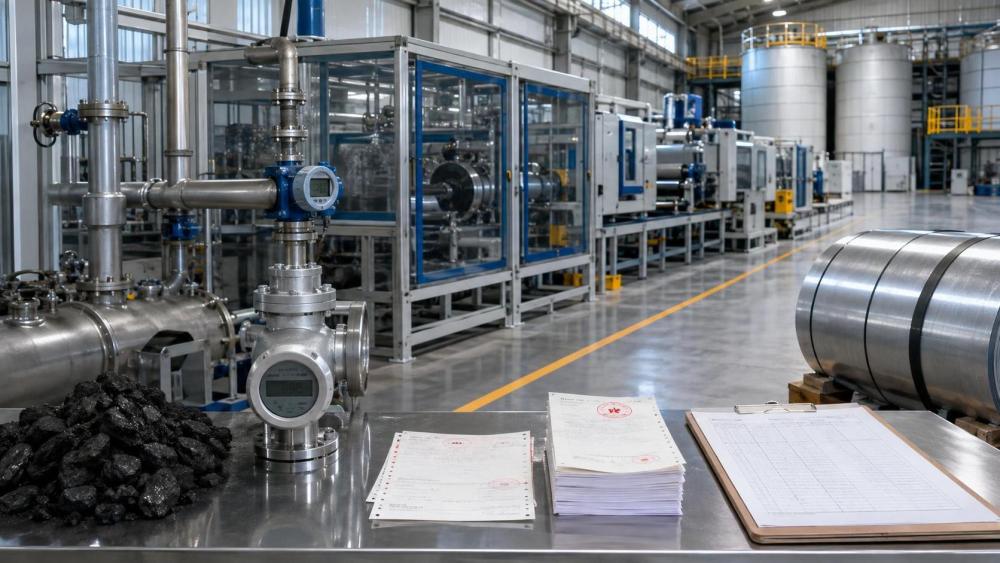
Activity data is the operational input used to calculate emissions. It may include natural gas consumption, coal or coke use, diesel purchases, refrigerant replenishment, electricity consumption, process-material quantities, output volumes, and operating hours. The strongest evidence is usually generated close to the activity itself, rather than recreated later for a sustainability questionnaire.
A practical evidence hierarchy is helpful:
- Primary records: calibrated meter readings, utility bills, fuel delivery notes, weighbridge tickets, laboratory analyses, maintenance records, and production logs.
- System-generated records: ERP extracts, manufacturing execution system reports, energy-management data, and procurement ledgers, provided the system owner and extraction method are clear.
- Reconciliations: comparisons between invoices, stock movements, meter totals, and production output that explain material differences.
- Secondary estimates: engineering estimates, default values, or proxy data used only where permitted and clearly identified.
Invoices are valuable, but they do not automatically prove consumption in a given reporting period. A bulk fuel delivery in late December may be consumed partly in the next period. Likewise, a plant-level electricity bill may cover offices, warehouses, and multiple production lines. The evidence file should explain the allocation method instead of silently assigning the entire bill to one product or facility.
Metering deserves particular scrutiny. Retain meter IDs, locations, reading intervals, calibration or inspection records where applicable, and documentation of any meter replacement. Where submeters are missing, the evaluator should ask whether a temporary allocation is technically reasonable. An allocation based on machine capacity may be acceptable in one circumstance; allocating energy only by production tonnage may be misleading where products have very different processing times or heat-treatment requirements.
The calculation file must be reproducible, not merely plausible
A credible carbon calculation should allow an independent reviewer to reproduce the reported result without guessing at assumptions. That means retaining the calculation workbook or controlled system output, formula logic, units, conversions, emission factors, source references, global-warming-potential values where relevant, and any allocation methodology.
A common weakness is an emissions factor that appears in a spreadsheet with no citation, version, geography, or date. Even a recognized factor can be inappropriate if it does not match the fuel type, electricity market, reporting year, or methodological rule. The evaluator should verify four things: the factor source, the factor version, the applicable unit, and the reason it was selected. A factor expressed per litre cannot be applied to a quantity recorded in kilograms without a documented conversion. These sound like basic controls, yet unit errors remain one of the most avoidable causes of unreliable reporting.
For products with multiple outputs, allocation is often the judgement-heavy part of the file. Mass-based allocation, economic allocation, energy-content allocation, and process-specific treatment can lead to different outcomes. There is no universally correct shortcut. The chosen approach must follow the governing methodology and match the physical and commercial reality of the process. A steel mill, chemical plant, food processor, and electronics assembler do not face the same allocation questions.
Calculation evidence should also include a change log. If the current year’s result differs sharply from the prior period, the reviewer needs to know whether the cause was an operational change, a revised factor, a new meter, a boundary adjustment, improved data collection, or simply an error correction. Unexplained movement tends to trigger deeper sampling.
Supplier declarations need supporting records behind them
In global procurement, many carbon claims arrive as supplier declarations. They can be useful, especially where the buyer cannot directly access a producer’s utility accounts or process data. But a declaration should not be treated as self-verifying evidence simply because it is signed or presented on company letterhead.
A technically robust supplier package identifies the producing installation, reporting period, product specification, calculation boundary, relevant production route, data sources, methodology, and responsible signatory. It should state whether the value is product-specific, site-average, corporate-average, or estimated from industry data. That distinction has real consequences. A corporate Scope 1 and Scope 2 inventory does not automatically prove embedded emissions for a particular imported product.
Where the applicable scheme requires independent verification, retain the verifier’s statement and check its scope. The key question is not merely whether a verification statement exists, but whether it covers the facility, product, period, methodology, and emissions category being relied upon. A statement covering an entire group’s annual greenhouse-gas inventory may have limited value for a product-level border declaration.
Supply-chain traceability is especially important for precursor materials. If a fabricator purchases metal from a trader, the trader’s invoice proves a transaction, not necessarily the origin or emissions profile of the underlying material. Technical reviewers should seek a documented chain linking the precursor producer, material grade, batch or lot reference where available, intermediary transactions, and final product. Perfect traceability is not always feasible, but unsupported assumptions should be visible rather than buried.
Evidence of controls often decides whether data can be trusted
Verification is partly a data exercise and partly a control-system review. A facility with excellent records but no defined ownership, no review process, and no document-retention discipline remains vulnerable. The reviewer needs confidence that the result was not assembled from disconnected files at the end of the reporting cycle.
Relevant control evidence may include documented procedures, named data owners, approval records, access controls for calculation files, training records, internal-review checklists, and correction logs. It is useful to identify who owns fuel data, electricity data, production volumes, procurement records, and methodology decisions. In multinational groups, this can become blurred quickly: headquarters may set the method, local sites hold invoices, and a third-party consultant prepares the final calculation. The handoffs should be documented.
Retention practices deserve a realistic review. Source documents must be kept for the period required by the relevant authority, contract, or verification program. Teams should avoid relying on personal inboxes, informal messaging threads, or supplier portals that may later remove historical files. A controlled evidence register is usually more useful than a large folder of unnamed attachments. It should show the document title, source, period covered, related emission source, file location, reviewer, and any qualification or limitation.
What a verifier is likely to test
A verification review typically combines desk-based checking with selected testing of source records. The emphasis varies, but the questions are familiar: Does the production figure agree with internal records? Does reported fuel consumption reconcile with procurement and inventory movement? Is the electricity amount supported by bills or meters? Are material inputs consistent with the claimed production route? Can the calculation be rerun? Have exclusions been justified?
The most revealing tests are often simple. A reported annual output may not match monthly production records. Total electricity can be lower than the sum of line-level meters. A facility may report a natural-gas figure that includes only process use while its invoice covers space heating as well. Or a supplier declaration may cite a reporting year that does not align with the shipment period. These are not necessarily signs of misconduct; they may reflect poor coordination. But they need a documented explanation.
When preparing for carbon compliance verification, it is better to surface limitations early. If a meter was unavailable, if a supplier provided only partial data, or if an allocation is based on a documented estimate, state that clearly and show why the approach was used. A transparent limitation can often be assessed. An unexplained gap is much harder to defend.
A practical evidence pack for cross-border operations
For procurement and supply-chain teams, the most workable approach is to build evidence while goods and data are moving, not after a compliance deadline has arrived. A focused pack should include the applicable reporting rule, boundary statement, facility and process information, activity-data ledger, source documents, calculations, emission-factor references, supplier declarations, product-to-shipment traceability records, internal approvals, and a log of assumptions or corrective actions.
The pack should be organized around the final claim. If the claim concerns embedded emissions in imported goods, place the production evidence, product identity, precursor information, calculation, and shipment linkage in one review path. Do not force a verifier to navigate separate procurement, finance, operations, and sustainability folders to reconstruct the story.
This is where broader trade intelligence can be useful. Teams monitoring supplier locations, customs routes, industrial inputs, and changing compliance rules can identify evidence risks before they become reporting failures. GTIIN’s supply-chain analysis approach, including its Full-Dimensional Supply Chain Mapping Model, reflects a practical point: carbon data is stronger when it is examined alongside physical goods flows, production conditions, and cross-border documentation rather than in isolation.
The standard to aim for is straightforward: a qualified reviewer should be able to follow a reported carbon figure backward to the facility, process, meter, invoice, material record, or supplier evidence that produced it. If that trail cannot be followed, the issue is not a lack of attractive reporting language. It is an evidence problem that should be fixed before submission.
Weekly Insights
Stay ahead with our curated technology reports delivered every Monday.
Recommended News
 Global SourcingOct 25, 2026How to find active suppliers in a trade intelligence platform dashboard
 Supply ChainOct 25, 2026Trade Tariffs Cause Whiplash at Port Milwaukee, Disrupting Cargo Flows
 Supply ChainOct 24, 2026How to use traceability to verify supply chain sustainability claims
 Market TrendsOct 24, 2026FedEx Report: AI Drives Asia-Pacific Chip and Digital Infrastructure Supply Chain Demand