Product Conformity Europe: Key Rules and Risk Checks
Product Conformity Europe: Key Rules and Risk Checks
For many companies, “product conformity Europe” sounds like a label exercise: apply CE marking, collect a few test reports, clear customs, and move on. That reading is too shallow. In practice, conformity is Europe’s way of asking a harder question: can the economic operator prove, with the right evidence and at the right time, that a product meets the legal requirements placed on it before and after it enters the market?
That distinction matters because the European framework is not built around one single approval. It is built around a network of product laws, harmonised standards, documentation duties, traceability rules, and post-market responsibilities. A product may be technically sound and still fail a market entry review because the declaration is incomplete, the importer is misidentified, the instructions are not in the required language, or the applicable legislation was mapped incorrectly from the start.
For business leaders, the issue is less about paperwork volume and more about exposure. Conformity failures can interrupt launch timing, create stock holds at distribution level, trigger corrective action with distributors, and in more serious cases lead to market surveillance intervention, withdrawals, or recalls. The commercial damage often starts before any formal penalty appears.
What “product conformity” really covers in Europe
The European market does not regulate all products in the same way. Some products fall under sector-specific legislation with CE marking, such as machinery, low-voltage electrical equipment, electromagnetic compatibility, toys, medical devices, pressure equipment, or construction products. Others are governed by different safety, chemical, environmental, or consumer protection rules that do not necessarily use CE marking at all. That is why the first technical question is never “Do we need CE?” but “Which EU acts apply to this product, in this configuration, for this intended use?”
This is where companies often compress legal classification into a sourcing checklist. A simple industrial assembly may trigger multiple layers of compliance at once: electrical safety, EMC, hazardous substance restrictions, eco-design considerations in some categories, packaging obligations, battery rules if energy storage is involved, and separate obligations under the General Product Safety framework for products outside CE sectors. The conformity task is therefore a scoping exercise before it becomes a testing exercise.
The broader market trend is also moving toward more accountable supply chains. Importers, manufacturers, authorised representatives, and in some sectors fulfilment service providers are being asked to carry clearer responsibilities. Europe increasingly expects traceability not only at the finished-product level but across documentation, labeling, and operator identity.
Why CE marking is important, but not enough
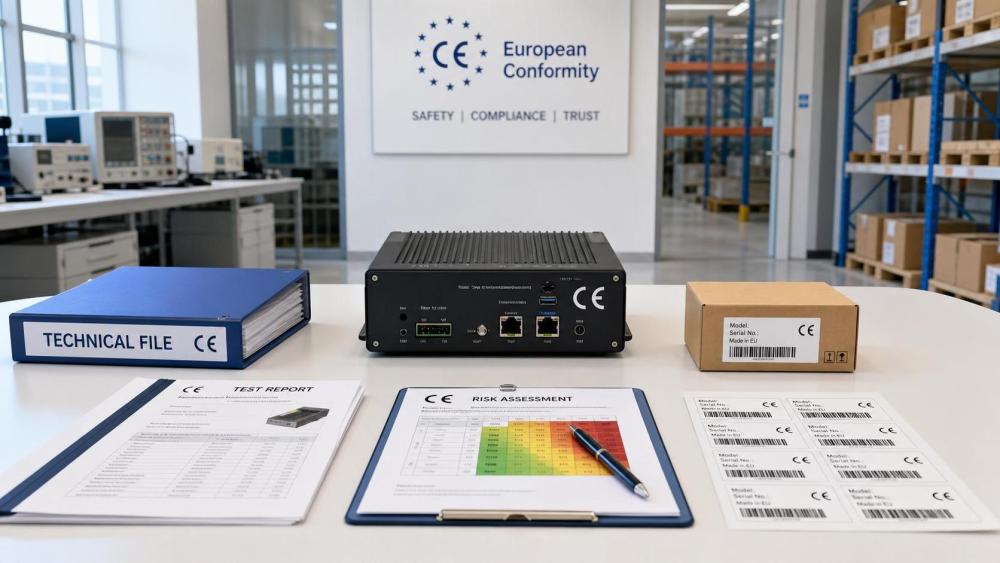
CE marking is the most visible conformity signal, which is why it is often overestimated. It is not a quality seal and not a customs passport by itself. It is a manufacturer’s declaration that the product complies with the relevant EU legislation requiring that marking. If the underlying conformity assessment is weak, the mark does not fix the problem.
In practical terms, the mark only has meaning when supported by a defensible compliance file. That usually includes the EU Declaration of Conformity, technical documentation, risk assessment where required, applicable test evidence, product identification details, labeling, and user instructions. For higher-risk categories, involvement of a notified body may also be mandatory, but that depends on the product and the legal route chosen. Assuming third-party certification is always required is just as mistaken as assuming self-declaration is always sufficient.
A useful management test is this: if a market surveillance authority asks for the basis of conformity tomorrow, can your team provide the complete technical and legal rationale quickly, in a coherent set, and in the language or format expected? Many organizations discover too late that they only have fragments from labs, suppliers, and contract manufacturers rather than a controlled conformity position.
The risk checks that deserve board-level attention
The highest-value checks usually happen before volume purchasing or shipment booking. Once tooling is fixed, packaging is printed, and inventory is on the water, the cost of a conformity mistake rises sharply.
Two of these deserve special emphasis. The first is regulatory scope. Product teams tend to classify by commercial naming, while regulators classify by function, risk, and intended use. A “controller,” “module,” or “industrial unit” may sit in different legal buckets depending on voltage, wireless capability, moving parts, safety function, or whether it is sold standalone or integrated into a larger assembly.
The second is change management. Many conformity files look valid at prototype stage and drift out of sync during sourcing optimization. Component substitutions caused by shortages, firmware changes pushed to improve performance, or labeling revisions made for private-label distribution can all affect the basis of compliance. This is one of the least glamorous parts of European market entry, and one of the most expensive to ignore.
Where procurement and supply chain teams get drawn in
Conformity is often treated as a legal or engineering matter until a shipment is blocked or a distributor asks for evidence. In reality, procurement has direct influence over compliance resilience. Supplier onboarding decisions shape whether documentation is recoverable, whether materials remain stable across production lots, and whether there is any disciplined process for notifying design changes.
This is especially relevant in cross-border sourcing. A supplier may present test reports that are genuine but misaligned with the shipped configuration, the target EU legislation, or the final branding structure. Another common problem is overreliance on old reports based on withdrawn harmonised standards or product variants that no longer match the bill of materials. These are not always signs of bad faith; sometimes they reflect a supplier’s limited understanding of how European conformity is evaluated downstream. But the commercial result is the same if the importer cannot defend the file.
A more mature sourcing process asks for document logic, not just document existence. Which standards were used, and why those? Do the product photos in the report match the current model? Does the declaration identify the correct legal entity? Is the instruction manual aligned with the actual hazards and intended use? Can the supplier explain what triggers reassessment after a design change? Those questions are more revealing than a folder full of certificates with no context.
Common misunderstandings that distort decision-making
One persistent misunderstanding is that customs clearance confirms conformity. It does not. Customs and market surveillance are related but distinct functions. A product can enter the territory and still face later scrutiny from authorities or commercial partners.
Another is that a laboratory report equals legal compliance. Test evidence is important, but conformity is a legal conclusion built on product scope, applicable law, standards use, documentation integrity, and operator obligations. The report is one piece of that structure.
There is also a recurring belief that compliance responsibility can be pushed entirely back to the factory. That is rarely how the European framework works. The manufacturer carries primary design responsibility, but importers and distributors have their own duties, including verification, traceability, and response obligations. Commercial contracts can allocate tasks, but they do not erase statutory roles.
Finally, companies sometimes assume conformity is finished once the first batch ships. Europe does not treat it as a one-time event. Post-market monitoring, complaint handling, incident response, record retention, and corrective action all sit within the broader compliance lifecycle. For products in fast-changing supply chains, this lifecycle view is more realistic than the old “test once, sell forever” mindset.
How experienced teams make the concept operational
The companies that handle product conformity Europe well do not necessarily have the largest compliance departments. They tend to do three things consistently. They classify products early, before commercial commitments harden. They keep a controlled conformity file rather than scattered supplier attachments. And they connect engineering change control with compliance review instead of treating those as separate workflows.
That operating model is particularly useful for diversified industrial portfolios, where the risk is not one catastrophic error but repeated smaller mismatches across SKUs, labels, and local market variants. If your organization sources across multiple jurisdictions, private-labels equipment, or bundles products into integrated solutions, a portfolio view becomes essential. Conformity should be mapped at product-family level, but verified at the exact variant level being sold.
A sound internal question is not “Do we have the certificate?” but “Can we explain, evidence, and maintain compliance for the exact product we are placing on the EU market?” That wording is less convenient, but it is much closer to how European regulators and sophisticated customers will look at the issue.
For decision-makers, the practical takeaway is straightforward. Treat conformity as an upstream risk filter tied to sourcing, design control, documentation governance, and market access planning. When viewed that way, it stops being an administrative afterthought and becomes what it already is in European trade: a disciplined check on whether the product, the paperwork, and the supply chain story actually match.
Weekly Insights
Stay ahead with our curated technology reports delivered every Monday.
Recommended News
 Supply ChainSep 22, 2026How heavy equipment lifecycle data can reduce unexpected downtime
 Supply ChainSep 21, 2026How export regulations affect logistics lead times and delivery risk
 Industry StandardsSep 20, 2026What evidence is needed to pass a carbon reporting audit?
 Industry StandardsSep 19, 2026When does manufacturing compliance consulting reduce audit risk?