How to verify whether a conformity assessment certification is valid
Before relying on a supplier, product, or market entry document, it is essential to confirm whether a conformity assessment certification is authentic, current, and recognized by the relevant authority. This guide explains how to verify a conformity assessment certification efficiently, helping researchers and sourcing professionals reduce compliance risks, avoid fraudulent claims, and make better-informed cross-border trade decisions.
Why certification verification matters before you trust a supplier or product
When people search for how to verify whether a conformity assessment certification is valid, they usually want a practical answer, not a definition. The real concern is simple: can this certificate be trusted for sourcing, market access, or compliance review?
For information researchers and cross-border procurement teams, a certificate is never just a document. It can affect customs clearance, supplier approval, regulatory exposure, product safety confidence, insurance claims, and even contract liability if something later proves non-compliant.
That is why verification should be treated as a decision checkpoint, not a paperwork formality. A certificate may look professional, carry familiar logos, and still be expired, altered, issued by an unrecognized body, or unrelated to the actual product being sold.
In practical terms, a valid conformity assessment certification should pass three tests. It must be authentic, currently effective, and relevant to the exact product, model, standard, market, and legal scope claimed by the supplier.
If any one of those elements fails, the certificate may have little compliance value. Many sourcing mistakes happen because buyers confirm the existence of a document but do not verify its status, scope, and issuer legitimacy.
What a valid conformity assessment certification actually means
Before checking a certificate, it helps to understand what “valid” means in an operational sense. Validity does not only refer to whether a file exists. It refers to whether the certification still stands and applies correctly.
A conformity assessment certification is generally issued after a product, system, process, or management practice has been assessed against specific standards or regulatory requirements. Depending on the market, this may involve testing, inspection, factory audits, or ongoing surveillance.
Validity normally includes several dimensions: the certificate number is real, the issuing body exists, the certificate has not expired, the scope matches the goods, and the certification scheme is accepted by the destination market.
This distinction matters because many fraudulent or misleading documents are partly true. A certificate number may be genuine, but linked to another company. The issuing body may exist, but lack accreditation for that technical field.
In other cases, the certificate is technically valid but commercially misleading. For example, it may cover one product family, while the supplier uses it to support a broader range of unrelated products in quotations or catalogs.
How to verify a conformity assessment certification step by step
The most efficient way to verify a conformity assessment certification is to follow a structured sequence. This reduces confusion and helps researchers separate document review from actual compliance verification.
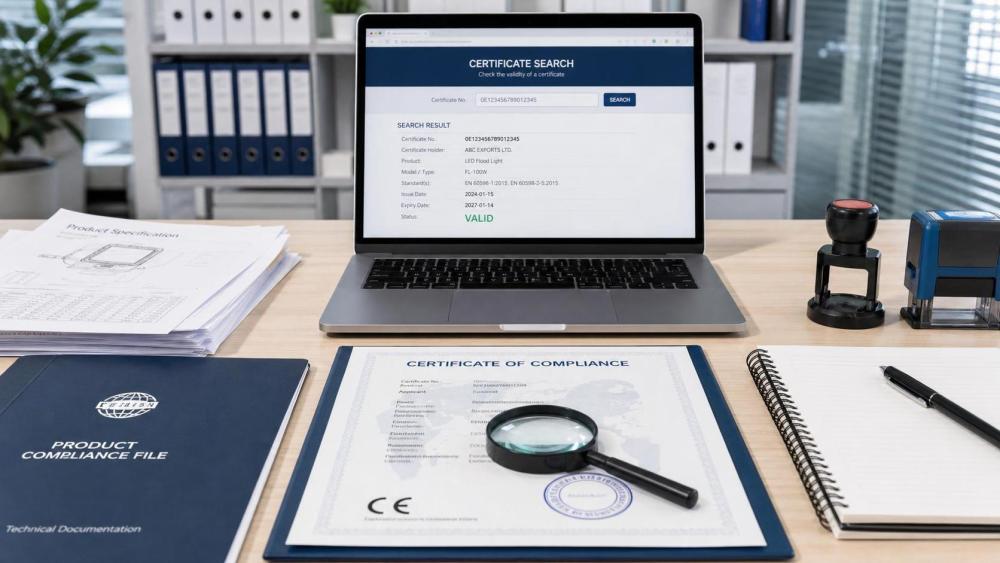
First, inspect the basic certificate details. Check the certificate number, issue date, expiry date, company name, registered address, factory location, product description, applicable standards, and signature or seal information.
Second, compare those details with the supplier’s quotation, product specification sheet, packaging, website, and legal entity records. Small inconsistencies often reveal larger problems, especially when company names, model numbers, or addresses do not align.
Third, search the issuing certification body’s official database. Many recognized bodies provide certificate lookup tools online. Use the certificate number and company name together when possible, because single-field searches can produce incomplete matches.
Fourth, confirm the accreditation status of the issuer. If the certification body claims accredited status, check the relevant national accreditation body or international recognition network to confirm that the issuer is authorized in that area.
Fifth, review the certification scope carefully. This is where many buyers make mistakes. The scope should match the exact product category, technical standard, and sometimes even the manufacturing site involved in the transaction.
Sixth, check whether surveillance, renewal, or follow-up audit requirements apply. Some certifications remain valid only if periodic inspections or monitoring activities are completed. A certificate may show an end date yet still be suspended in practice.
Seventh, contact the issuer directly if the public database is unclear. Use official contact details from the certification body’s own website, not phone numbers or email addresses printed only on the supplier-provided document.
This process may take more effort than simply collecting a PDF, but it gives a much stronger basis for supplier screening and market entry decisions. In regulated trade, that difference can prevent expensive downstream disruption.
Which warning signs suggest the certificate may be fake, misused, or unreliable
Researchers often need to identify risk quickly, especially during early-stage supplier screening. Several warning signs deserve closer attention because they frequently appear in invalid or misleading conformity assessment certification claims.
One common issue is poor alignment between the certificate and the seller’s business identity. If the exporter name on the invoice differs from the certified legal entity, ask whether the relationship is contractual, licensed, or unrelated.
Another warning sign is vague product scope. Certificates that describe goods only in broad terms such as “electrical products” or “industrial equipment” may not be sufficient when the transaction concerns a precise regulated product type.
Formatting anomalies also matter, though they are not decisive on their own. Missing page numbers, inconsistent logos, unusual language quality, absent accreditation marks, or low-resolution seals can indicate document tampering or unofficial reproduction.
A further risk appears when a certificate is used across markets without considering local recognition. A supplier may present a certificate valid in one jurisdiction, while implying that it automatically satisfies another country’s import requirements.
Be cautious when a supplier resists independent verification, delays responses from the issuing body, or insists that the document is confidential. Legitimate certification records usually allow at least basic status confirmation through authorized channels.
Finally, watch for timing issues. Expired certificates, recently changed legal entities, relocated factories, or modified product designs can all weaken the practical value of an otherwise legitimate certification record.
How to confirm that the issuing body is recognized and relevant
Even if a certificate looks authentic, the issuing body must also be credible. This is a critical step because conformity assessment certification only carries weight when the issuer is recognized within the relevant regulatory or commercial framework.
Start by identifying what kind of body issued the document. It may be a testing laboratory, inspection body, certification body, notified body, or another specialized conformity assessment organization depending on the sector and market.
Next, verify whether that organization is accredited or officially designated for the relevant activity. Accreditation bodies, government registries, and international recognition arrangements can help confirm whether the issuer has formal standing.
The important point is relevance, not just existence. A company may be a legitimate certification body in one technical domain but have no authority or accreditation for the category of product listed on the certificate under review.
Researchers should also distinguish between private commercial certificates and legally meaningful ones. Some supplier documents reflect internal quality claims or voluntary assessments, which may be useful commercially but insufficient for regulatory clearance.
Where higher risk is involved, such as industrial machinery, electrical goods, medical products, or construction materials, recognition should be checked against the destination market’s legal framework rather than assumed from branding alone.
What documents and databases are most useful during verification
Efficient verification depends on using the right supporting records. Relying on the certificate alone is rarely enough, especially when the purpose is supplier qualification or pre-shipment compliance review.
The first supporting document is the product specification sheet. It helps confirm whether the model, configuration, technical rating, and intended use align with the certified scope. Product mismatches are a common source of hidden compliance gaps.
The second is the supplier’s legal registration information. This helps confirm whether the certified entity actually controls the factory or trading operation involved. It also reveals whether a trader is presenting a manufacturer’s certificate without clear authorization.
The third is the issuing body’s official certificate directory, if available. This is often the fastest route to confirming live status, issue dates, scope wording, and whether the certificate has been withdrawn or suspended.
The fourth is the accreditation body database. These records help determine whether the issuer holds recognized competence in the relevant technical area. They are especially useful when the certification body is unfamiliar or regionally based.
The fifth is the applicable regulatory framework for the destination market. Customs authorities, product regulators, and industry regulators often publish lists of accepted schemes, technical regulations, or notified entities that support more reliable validation.
In higher-value transactions, it is also worth reviewing test reports, factory audit summaries, declaration documents, and change history records. These materials can reveal whether the certificate remains aligned with the current production reality.
How verification supports better sourcing and market entry decisions
For GTIIN’s target audience, certificate verification is not only a compliance exercise. It is part of a broader decision framework for reducing supply chain friction and improving cross-border sourcing confidence.
When researchers verify a conformity assessment certification properly, they gain more than a yes-or-no answer. They also learn how disciplined the supplier is, how transparent the documentation chain is, and how prepared the company is for regulated export.
That insight has direct business value. It helps teams avoid onboarding weak suppliers, reduce delays linked to document rejection, improve internal approval workflows, and build stronger evidence trails for procurement, legal, and quality functions.
Verification also supports negotiation quality. If a certificate covers only limited models or locations, buyers can request clarification before contract finalization rather than discovering the problem after order placement or customs intervention.
In fast-moving international trade, this discipline creates resilience. A sourcing team that checks certification status early is better positioned to compare suppliers objectively, identify hidden compliance costs, and protect delivery continuity.
Common mistakes to avoid when checking certification validity
One frequent mistake is treating any certificate as proof of full compliance. In reality, a certificate may address only one standard, one product line, or one stage of assessment. It should be read in context.
Another mistake is assuming that a well-known logo guarantees authenticity. Fraudulent documents often imitate familiar certification marks. The database record and issuer confirmation matter more than graphic appearance.
Teams also make errors when they review documents too late. If certification checks happen only before shipment, there may be little time left to replace suppliers, correct scope gaps, or handle retesting requirements.
A further problem is failing to distinguish between manufacturer certification and exporter documentation. In global trade, the selling entity and producing entity are often different, and certification relevance must be traced carefully.
Finally, some organizations do not document their verification process. That creates risk later when audits, disputes, or internal reviews require evidence showing who checked the certificate, when it was checked, and what was confirmed.
Conclusion: valid certification is about evidence, scope, and recognition
To verify whether a conformity assessment certification is valid, focus on three questions. Is the document authentic, is it currently in force, and does it apply to the exact product and market involved?
That approach is more reliable than trusting appearance, supplier assurances, or broad claims of compliance. Strong verification means checking the issuer, the accreditation path, the certificate scope, and the live status in official records.
For information researchers, procurement teams, and cross-border trade decision makers, this process is a practical risk-control tool. It helps prevent fraudulent claims, avoid compliance misunderstandings, and support more defensible sourcing decisions.
In global industrial trade, certification should never be treated as a box-ticking exercise. Its real value lies in verified evidence that the product, supplier, and assessment pathway are genuinely fit for the market you intend to serve.
Weekly Insights
Stay ahead with our curated technology reports delivered every Monday.
Recommended News
 Supply ChainOct 15, 2026How to choose a supply chain strategy for unpredictable demand
 Supply ChainOct 14, 2026How to assess an industrial equipment supplier's spare parts support
 Supply ChainOct 14, 2026EU Updates CSDDD Guidance on Global Supply Chain Due Diligence
 Global SourcingOct 13, 2026How to assess industrial automation suppliers for legacy integration