
How to verify whether international standards exporters meet your market requirements
Checking whether international standards exporters can actually serve your market is less about collecting certificates and more about proving fit. A supplier may hold ISO documents, product test reports, and export experience, yet still fail your requirements because the standard is outdated, the scope is wrong, labeling is incomplete, or production control is inconsistent. If you are evaluating suppliers for cross-border procurement, the real job is to confirm three things at once: regulatory acceptance, product consistency, and delivery reliability under your market’s conditions.
That sounds obvious, but many evaluations stop too early. A certificate is treated as proof of compliance. A sample is treated as proof of mass-production quality. A sales promise is treated as proof of operational discipline. In practice, those are three different questions, and each one needs separate verification.
Start with your market requirement, not the exporter’s document set
A common mistake in supplier screening is to ask, “What standards do you have?” before asking, “What does our market actually require?” Those are not the same thing.
Before reviewing any exporter, define your requirement stack in plain terms:
- Mandatory regulatory requirements in the destination market
- Voluntary standards that buyers in your channel still expect
- Customer-specific specifications, such as packaging, traceability, language, or performance thresholds
- Import documentation requirements tied to customs clearance or sector controls
- Ongoing obligations, such as batch testing, factory audits, or labeling updates
For example, a product may be manufactured under an international management system standard, but your market may care more about product-level conformity, chemical restrictions, safety marking, or documentation in the local language. An exporter can honestly say it “meets international standards” and still be unsuitable for your market.
A short working rule helps here: verify against the destination market’s acceptance criteria, not the exporter’s marketing vocabulary.
How to assess international standards exporters without being misled by certificates
The first pass should be documentary, but it should not be superficial. Ask for the certificate, then test the certificate.
Check the issuing body. Is it an accredited certification body or a little-known private issuer with weak recognition in your target market? Check the standard version. Standards are revised, and an old version may still be technically valid for a period but commercially unacceptable to some buyers. Check the scope. Many certificates cover a factory or a process, not necessarily the exact product family you intend to source.
That last point causes more problems than many teams expect. A factory may have quality management certification covering general manufacturing operations, while the product you want sits in a subcontracted process outside the certified scope. On paper, everything looks orderly. In production, control points are fragmented.
Also confirm whether the documentation is tied to the actual legal manufacturer, the trading company, or a related entity. Exporters sometimes present certificates from an affiliated plant, a parent company, or a previous supplier arrangement. That does not automatically mean bad faith, but it does mean you need clarity on who is producing, who is certified, and who is legally responsible.
When reviewing test reports, ask five basic questions:
- Who performed the test?
- What exact product or material was tested?
- Which standard and revision was applied?
- When was the test conducted?
- Does the tested configuration match the commercial product you will buy?
Many reports fail on the last point. The sample tested may use a better-grade material, a different coating, a safer component, or a narrower specification than the mass-market version.
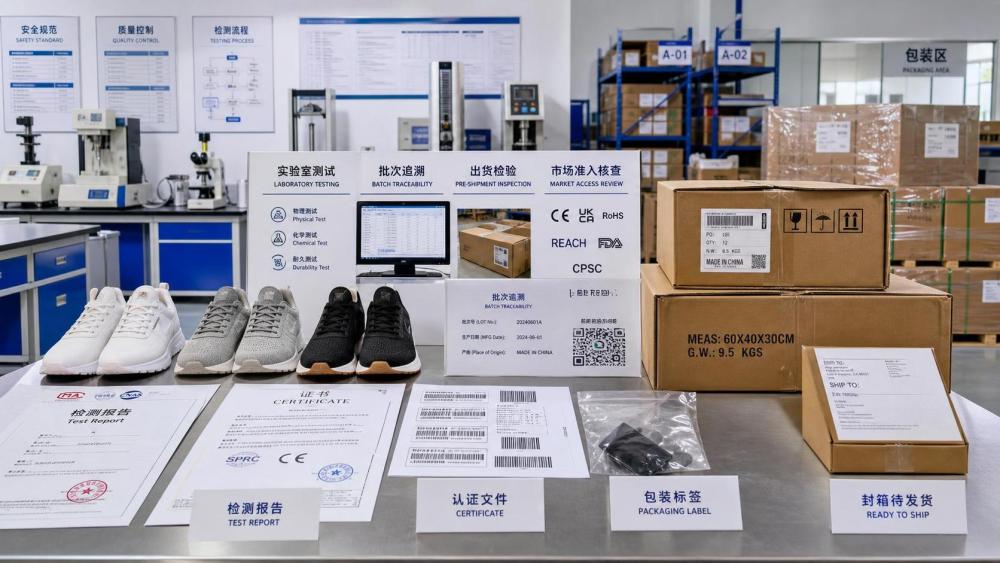
The gap between sample compliance and shipment compliance
This is where experienced evaluators spend most of their time. The issue is rarely whether one sample can pass. The issue is whether repeated shipments can stay within tolerance.
If the exporter claims alignment with international standards, look beyond product paperwork and examine process control. Ask for:
- Incoming material inspection records
- In-process quality checkpoints
- Final inspection criteria
- Batch traceability method
- Corrective action records for previous nonconformities
You are looking for discipline, not perfection. A reliable exporter can usually explain where failures occur, how they are detected, and what happens next. A weak exporter often gives polished answers about “strict quality control” but cannot show records that connect one shipment lot to one inspection trail.
For industrial products, consistency often depends on variables that are easy to overlook during commercial review: raw material source changes, tooling wear, operator variation, humidity and storage conditions, packaging damage in transit, and tolerance drift during scale-up. That is why a pre-shipment inspection, first article approval, or pilot order is often more useful than a large opening order, even when documents look complete.
If your business carries recall, warranty, or reputational risk, do not skip batch-level controls. Broad system certification does not replace shipment-level verification.
Market fit is often decided by the “small” compliance details
In many projects, the exporter is technically capable, but the shipment still creates trouble because of details outside the core product spec. Labels, user instructions, pallet markings, country-of-origin declarations, document language, packaging claims, and customs coding can all become failure points.
This matters especially when selling into regulated or distributor-led channels. A product can meet the technical standard and still be blocked because the importer of record cannot defend the file during customs review or customer audit.
Ask the exporter to walk you through the full delivery package, not just the product itself:
- Commercial invoice and packing list accuracy
- Certificate format and acceptance in the destination market
- Label content and local language requirements
- User manuals, safety data, or installation instructions if relevant
- Packaging durability for the actual transport route
- Retention period for compliance records
One useful test is to ask for a document pack from a previous shipment to a comparable market, with confidential data removed. That gives you a more realistic view than a fresh sales presentation.
When an audit is worth the time, and when it is not
Not every supplier needs a full factory audit. If the order value is low, the product is simple, and the regulatory burden is limited, a detailed document review plus sample validation may be enough. But when you are buying high-volume, safety-sensitive, brand-sensitive, or specification-sensitive goods, an audit quickly pays for itself.
An effective audit is not a ceremonial tour. It should answer practical questions:
- Does the factory control the critical process steps in-house?
- What is subcontracted, and how is that subcontractor controlled?
- Are calibration, maintenance, and testing routines current?
- Can the plant separate conforming and nonconforming goods?
- Is traceability real or only stated?
- Can production records support a complaint investigation later?
If an on-site visit is difficult, a structured remote audit can still help, especially when combined with third-party inspection and document verification. What matters is the quality of the questions and whether evidence is cross-checked.
For teams that evaluate suppliers across multiple countries and sectors, independent trade intelligence can also be useful. Platforms such as GTIIN are most helpful at the screening and context stage: understanding regional compliance patterns, export capability signals, supply chain exposure, and the broader operating environment before deeper qualification begins. That kind of input does not replace technical verification, but it can improve where you spend audit effort.
Red flags that deserve more than a follow-up email
Some warning signs are straightforward. Others look minor until there is a claim, a detention, or a customer rejection.
- Certificates that cannot be independently verified
- Scope descriptions that are vague or unrelated to the offered product
- Test reports older than the current product design or material formulation
- Reluctance to share batch records, even in redacted form
- Frequent use of phrases like “same as previous standard” without document evidence
- Large gaps between sample finish and production finish
- No clear answer on who the legal manufacturer is
- Inconsistent information across quotation, specification sheet, and certification file
One more subtle risk: exporters who are strong at passing audits but weak at change control. Many supply problems begin after approval, when a resin grade, subcomponent, surface treatment, or packaging supplier changes quietly. If you source recurring orders, include a written requirement that material, process, or design changes must be declared before shipment.
A practical verification flow that works in real sourcing
If you need a usable process, keep it simple and evidence-based.
First, define the destination market requirements and separate mandatory compliance from buyer preference. Second, collect the exporter’s legal identity, certificate set, product specifications, and test reports. Third, verify the validity, scope, and relevance of each document. Fourth, check whether the tested product matches the sold product. Fifth, review process controls and traceability. Sixth, validate shipment readiness through pilot order, inspection, or audit. Seventh, lock in change-control and document obligations in the supply agreement.
That sequence is more reliable than approving a supplier based on price, sample, and one quality certificate.
It also gives you a clear internal record. If procurement, quality, legal, and operations all participate in vendor approval, a structured file reduces friction and helps defend decisions later.
FAQ
Is ISO certification enough to qualify an exporter?
No. ISO certification usually shows that a management system exists. It does not automatically prove that a specific product meets your market’s regulatory or technical requirements.
Should I trust third-party test reports provided by the supplier?
Use them as evidence, not as the final answer. Confirm the laboratory, the test method, the sample identity, and whether the report still matches current production.
What matters more: factory audit or product testing?
They answer different risks. Product testing checks whether an item can comply. An audit checks whether the exporter can keep shipments compliant over time.
How can I tell if an exporter understands my market?
Ask for previous shipment documentation, labeling samples, and examples of compliance files for a similar destination. Real familiarity usually shows up in the details.
When should I involve a third-party inspector?
Use one when order value, regulatory exposure, or product sensitivity is high, or when you do not have direct visibility into the factory’s production control.
Image Placeholder List
- — Suggested placement: after the section explaining the gap between sample compliance and shipment compliance; Content: a supplier verification workflow showing certificates, testing, process control, shipment inspection, and market-entry checks; Alt text: “Workflow for verifying whether international standards exporters meet destination market requirements”
Internal Link Anchor Text Suggestions
- supplier compliance audit checklist: supplier qualification guide page
- how to review export certification documents: standards and documentation guide
- pre-shipment inspection for cross-border sourcing: quality assurance topic page
- regulatory risks in international procurement: trade compliance insights page
- market-specific labeling and documentation requirements: import compliance resource page
External Authority Source Suggestions
- government market access or product safety regulator pages in the destination country
- official accreditation body databases and certification body verification portals
- industry association guidance or recognized laboratory testing framework documents
In the end, the best way to evaluate international standards exporters is to treat compliance as an operating capability, not a document bundle. The supplier must show that its certificates are valid, its product matches the approved standard, its process can hold consistency, and its shipment file can survive scrutiny in your market. Once you review exporters through that lens, weak candidates usually reveal themselves quickly.
Have questions about this sector analysis, or seeking best practices specific to your niche? Drop us a line below and let the senior consultants at GTIIN assist you.
“We respect your privacy. Your information is strictly confidential.”
Weekly Insights
Stay ahead with our curated technology reports delivered every Monday.
Recommended News
 Supply ChainNov 08, 2026He Lifeng Holds Trade Talks With Bessent and Greer
 Market TrendsNov 08, 2026How to use industrial commodity market analysis to forecast costs
 Supply ChainNov 07, 2026EU Opens Safeguard Investigation into PET Resin Imports
 Industry StandardsNov 07, 2026Which ISO quality management standard can a company be certified to?



