
How to prepare for an industrial safety regulations audit
An industrial safety audit rarely fails because a site has no documents at all. It fails because the written system, the conditions on the floor, and the evidence available to prove control do not match. A safety manager may have a current policy manual, while an auditor finds an unguarded machine, an expired inspection tag, or an operator who cannot explain the emergency shutdown procedure. For quality and safety teams, these disconnects can lead to corrective-action requests, interrupted operations, customer concerns, and preventable exposure to injury.
The practical way to prepare for an industrial safety regulations audit is to treat it as a verification exercise rather than a paperwork exercise. First identify which legal, contractual, and site-specific requirements apply. Then test whether each requirement is implemented, understood by relevant workers, documented with traceable evidence, and maintained in day-to-day operations. Starting this work early gives the team time to correct real weaknesses instead of trying to assemble an audit file at the last minute.
Start by defining the audit scope and evidence standard
Before reviewing records, clarify what the auditor is expected to examine. The scope may cover a whole facility or a defined activity such as machinery operation, chemical handling, warehouse traffic, contractor control, electrical safety, pressure systems, lifting equipment, fire protection, or emergency response. It may also combine statutory requirements with customer specifications, internal procedures, insurance conditions, or certification-related controls.
Create a requirement register that translates broad obligations into verifiable site controls. A regulation may require safe operation of work equipment, for example, but the audit evidence will usually be more specific: documented risk assessment, approved operating procedure, training and authorization records, inspection history, maintenance work orders, machine guarding checks, and evidence that defects are corrected.
A requirement register also prevents a common preparation error: collecting documents that look relevant but do not demonstrate compliance. A signed training attendance sheet, for instance, does not prove that the trainee was assessed as competent or that the training addressed the actual hazards of the assigned task.
Walk the site before reviewing the folders
Physical conditions should guide the document review, not the other way around. Conduct a structured walk-through using the same routes and work areas an auditor is likely to inspect: entrances, production lines, maintenance zones, utility rooms, loading bays, warehouses, chemical storage, waste areas, and emergency exits. Include different shifts where possible, because safety controls that look sound during normal daytime operation may be bypassed during cleaning, changeovers, maintenance, or peak dispatch periods.
Look for visible signs that the documented system may not be working. These include blocked exits, missing or faded labels, damaged cables, unsecured cylinders, leaking containers, poor segregation of pedestrians and vehicles, improvised tools, bypassed guards, incomplete lockout devices, and fire equipment that is inaccessible or overdue for inspection. Do not limit the review to obvious hazards. An auditor may also notice whether instructions are legible at the point of use, whether safety signs match the current layout, and whether workers wear the required protective equipment consistently.
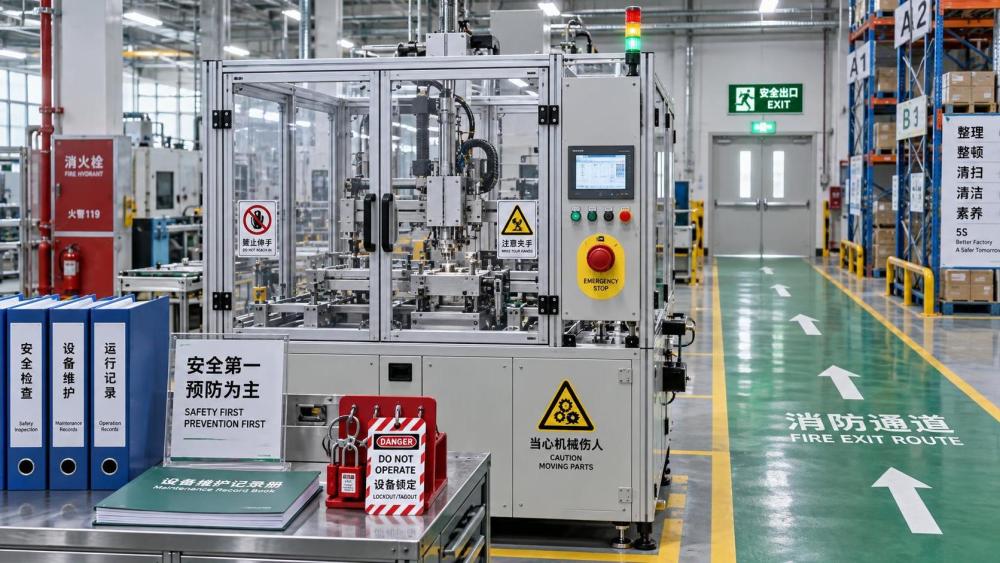
During the walk-through, ask supervisors and operators practical questions instead of testing them on policy language. Ask how they stop equipment safely before clearing a jam, where they report a near miss, what they would do after a chemical splash, or how they know a lifting accessory is approved for use. Their answers reveal whether procedures have been communicated in a usable form. A person who knows where the procedure is stored but cannot describe the critical control may need further instruction or task observation.
Separate immediate hazards from audit-readiness gaps
Some findings require immediate control regardless of the audit timetable. A damaged guard, unprotected live electrical component, obstructed evacuation route, or unsafe lifting condition should be isolated, repaired, or otherwise controlled without waiting for a formal review. Other issues may be less urgent but still material to audit readiness, such as a missing revision date on a procedure or an incomplete training record.
Record both categories in one action log, but assign different response expectations. Immediate hazards need a named owner, temporary control, permanent correction, and confirmation that affected workers were informed. Documentation gaps need a clear due date and a check that the replacement record is accurate, not simply completed for appearance.
Test whether risk assessments reflect actual work
Risk assessments are often among the first documents requested, yet their real value is tested on the floor. An assessment becomes unreliable when it describes an ideal process rather than the work people actually perform. Changes in equipment, materials, staffing, production volume, packaging, work layout, cleaning methods, contractors, or shift patterns can introduce hazards that are absent from older assessments.
Review assessments against current operations one task at a time. Compare the stated steps with observed practice and ask whether the existing controls remain effective. A machine risk assessment may identify entanglement hazards but fail to address how operators clean rollers, remove waste, or troubleshoot faults. A chemical assessment may specify ventilation and gloves but omit transfer operations, spill response, incompatible storage, or disposal of contaminated materials.
Pay particular attention to non-routine work. Maintenance shutdowns, confined-space entry, work at height, electrical isolation, hot work, line changes, and contractor activities often involve a higher concentration of serious risks because normal safeguards may be removed or altered. Confirm that permit systems, isolation methods, supervision arrangements, and authorization requirements are defined and used in practice.
- Check whether each assessment has an identifiable owner and review date.
- Confirm that control measures follow a sensible hierarchy: elimination or substitution where feasible, engineering controls, administrative controls, then personal protective equipment.
- Verify that residual risks have been communicated to the people performing the task.
- Link significant assessment actions to completed work orders, revised procedures, training, or physical improvements.
A risk assessment should not be marked complete merely because actions are listed. Auditors may ask how the organization determined that a corrective measure worked. Evidence could include a post-installation inspection, a supervisor observation, a revised maintenance plan, or a documented review after workers began using the new control.
Bring training, authorization, and supervision into alignment
Training records often create false confidence. A full matrix can still conceal important gaps: temporary workers may be omitted, refresher intervals may have lapsed, job roles may have changed, or the record may show course completion without confirming practical capability. Review the matrix against the current roster, including supervisors, maintenance personnel, cleaners, warehouse staff, contractors, and workers who cover multiple roles.
For safety-critical tasks, distinguish awareness training from authorization. General instruction about forklift risks is not the same as authorization to operate a specific vehicle in a particular work environment. The same distinction applies to electrical work, lifting operations, isolation procedures, confined spaces, respiratory protection, and emergency response roles.
Evidence is stronger when it connects the worker, task, trainer, date, competence method, and any restrictions. Where language or literacy barriers are relevant, confirm that instructions were delivered in a form employees could understand. A signed sheet is weak evidence if the procedure is complex and no one can demonstrate comprehension.
Do not overlook supervisory controls
Auditors often assess whether managers and supervisors actively monitor safety rather than simply assign training. Review records of safety observations, pre-shift briefings, toolbox talks, workplace inspections, and follow-up actions. These records should show a meaningful connection to the site’s hazards. Repeating generic reminders while recurring issues remain unresolved suggests that the monitoring process is not effective.
Validate equipment inspection and maintenance records
Industrial operations rely on numerous safety-critical items, from fixed machine guards and emergency stops to lifting accessories, pressure equipment, fire systems, extraction units, portable electrical tools, and emergency eyewash stations. The appropriate inspection interval and record format depend on local requirements, manufacturer instructions, equipment type, risk level, and site procedures. Preparation should therefore focus on traceability rather than assuming one schedule fits every asset.
Build or review an asset register that identifies the equipment, location, responsible owner, inspection requirement, last completed check, next due date, and defect status. During the audit preparation walk, select a sample of equipment and trace it both ways: from the register to the physical asset, and from the physical asset back to the register. Missing asset identification, inconsistent serial numbers, or records that do not match the installed equipment are warning signs.
Defect management deserves separate scrutiny. A record showing that a problem was identified is not enough. Confirm that defective equipment was removed from service or controlled where necessary, that repairs were carried out by suitable personnel, and that the item was verified before return to use. This is especially important where a temporary repair has remained in place longer than intended.
Review emergency arrangements under realistic conditions
Emergency documentation should reflect the present facility, not an old layout. Check evacuation maps, assembly arrangements, contact details, first-aid provisions, spill kits, firefighting equipment, rescue resources, and communication methods. Renovations, stock changes, new machinery, and altered traffic routes can make a previously adequate plan inaccurate.
Examine drill records for more than attendance. They should show the scenario, date, participants, observations, issues identified, assigned actions, and evidence of follow-up. A drill that repeatedly identifies the same delayed response, unclear assembly point, or communication failure without corrective action may draw auditor attention.
Also verify that emergency equipment is inspected and accessible. Eye wash units cannot be obstructed by stored material; spill response supplies must suit the substances present; emergency exits must open and lead to a usable escape route. These details are easy to miss during document-based preparation and easy for an auditor to observe.
Use corrective actions to demonstrate control, not just closure
Incident reports, near-miss records, inspection findings, and internal audit results are valuable because they show how the safety system responds to problems. However, they can also expose weak follow-through. Review open and recently closed actions before the audit. Look for vague root causes such as “operator error,” actions without owners, overdue tasks with no escalation, and repeated events that were closed without addressing the underlying condition.
A credible corrective-action record explains what happened, what immediate control was applied, why the failure occurred, what permanent measures were selected, who owns them, and how effectiveness was checked. The best corrective action is not necessarily the largest or most expensive one. It is the one that addresses the actual cause and can be sustained by the operating team.
Where an action cannot be fully completed before the audit, do not hide it. Document the risk evaluation, interim safeguards, responsible person, target date, and management oversight. An auditor is more likely to view a controlled open item positively than an issue that appears ignored or artificially closed.
Prepare the audit room, but expect the audit to move beyond it
Organize records so they can be retrieved quickly: applicable requirements, policies, risk assessments, procedures, training evidence, inspection logs, maintenance history, permits, incident files, emergency drill records, and action registers. Use a logical index and ensure document versions are controlled. Remove obsolete forms from active folders, shared drives, and workstations where they could be mistaken for current instructions.
Assign a coordinator who can manage document requests and identify the appropriate technical owner for each area. Brief supervisors on the audit schedule, but do not script employee responses. The goal is for personnel to explain normal practice honestly and consistently. Trying to coach answers often creates contradictions when auditors compare statements with site conditions and records.
The final review should ask one simple question for every significant safety control: can the organization show that it is required, implemented, maintained, and checked for effectiveness? When the answer is supported by both credible evidence and visible workplace conditions, audit preparation becomes part of safer daily operations rather than a short-term administrative exercise.
Weekly Insights
Stay ahead with our curated technology reports delivered every Monday.
Recommended News
 Supply ChainSep 22, 2026How heavy equipment lifecycle data can reduce unexpected downtime
 Supply ChainSep 21, 2026How export regulations affect logistics lead times and delivery risk
 Industry StandardsSep 20, 2026What evidence is needed to pass a carbon reporting audit?
 Industry StandardsSep 19, 2026When does manufacturing compliance consulting reduce audit risk?