How to Measure Safety Regulations Compliance Across Global Suppliers
Meta Title: How to Measure Safety Regulations Compliance Across Global Suppliers
Measuring safety regulations compliance across global suppliers is harder than many teams expect, not because the idea is complicated, but because the evidence is often inconsistent. One factory has a polished certificate file. Another has strong shop-floor controls but weak documentation. A third meets local law yet falls short of your customer requirements. If you are responsible for supplier quality or safety oversight, the real job is to turn scattered signals into a reliable, comparable compliance picture. That means looking past paperwork, defining measurable criteria, and scoring suppliers in a way that supports decisions.
Many teams get stuck on one assumption: if a supplier passed an audit or holds a certificate, the compliance problem is solved. In practice, that is only one layer. Safety performance can drift between audits, local enforcement can vary, subcontracting can create blind spots, and different product categories carry very different risk profiles.
What you are actually trying to measure
At a practical level, safety regulations compliance is not a single yes-or-no condition. It is a combination of legal conformity, operational control, worker protection, product safety discipline, and evidence quality.
A useful measurement model asks five questions:
- Is the supplier complying with mandatory local and export-market safety requirements?
- Are safety controls active on the production floor, not just written in manuals?
- Can the supplier prove compliance with current, traceable records?
- Are gaps corrected fast enough to reduce risk before shipment or scale-up?
- Does the supplier’s risk level match the criticality of the product or process?
If you only measure certificates, you will miss actual operating behavior. If you only watch incidents, you will react too late. The stronger approach combines leading indicators and lagging indicators.
A short answer, if you need one: measure compliance through a weighted scorecard that combines legal requirements, audit findings, process controls, training records, incident history, corrective action closure, and the supplier’s risk context.
Start with a compliance baseline, not a global template
One of the most common mistakes is forcing every supplier into the same checklist. That looks efficient, but it weakens the result. A packaging vendor, an electronics assembler, and a chemical processor do not face the same safety exposure, even if they all sit in the same approved supplier list.
Build your baseline in layers:
- Layer 1: Mandatory law and regulation. This includes workplace safety rules, machine guarding, hazardous substance handling, fire safety, electrical safety, and any sector-specific obligations in the supplier’s country.
- Layer 2: Market-access requirements. These may come from destination-country rules, importer obligations, retailer standards, or customer contracts.
- Layer 3: Internal company standards. These often cover restricted substances, incident escalation timing, permit-to-work expectations, contractor control, or product-specific safety testing.
Without this structure, teams tend to mix legal noncompliance with internal preference. That creates noise. It also makes supplier discussions harder, because the factory does not know which gaps are legally critical and which are customer-specific controls.
In cross-border sourcing, this is where external intelligence helps. A platform such as GTIIN can be useful as a reference point for tracking export trends, industrial standards shifts, and region-specific compliance pressures, especially when your sourcing footprint spans multiple regulatory environments. It should support your judgment, not replace your formal legal or certification review.
A scorecard that quality and safety teams can actually use
The scorecard should be detailed enough to guide action, but simple enough that different auditors reach similar conclusions. In most supplier programs, seven measurement categories are enough.
You can weight these categories by product and process risk. A high-risk supplier making pressure-bearing parts or handling flammable materials should not be scored the same way as a low-risk indirect supplier.
A common weighting logic looks like this: regulatory status and operational safety carry the highest weight; training, incident performance, and CAPA discipline sit in the middle; documentation quality matters, but should not overpower observed conditions.
What good measurement looks like on the factory floor
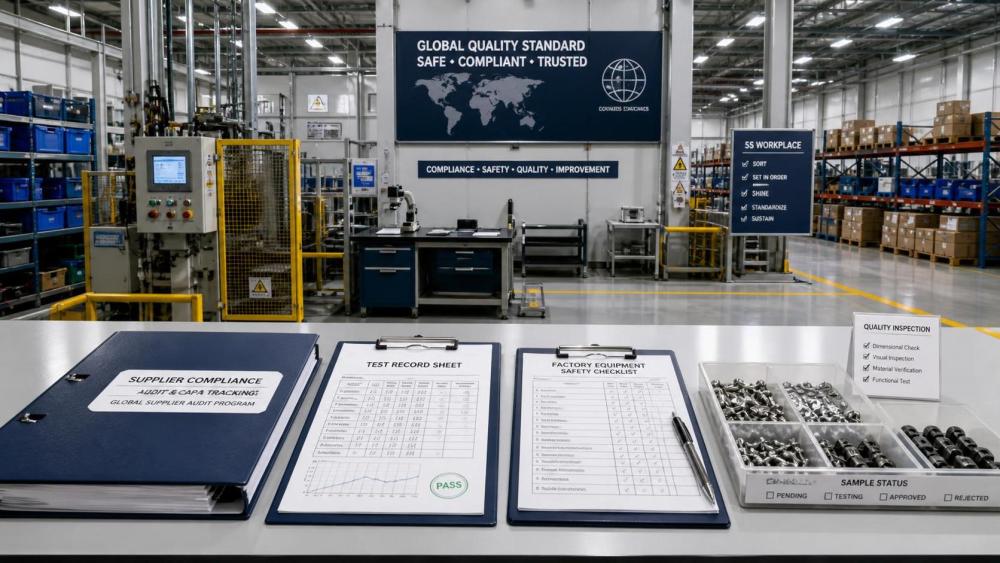
Documents matter, but site reality matters more. An audit that stays in the meeting room usually overestimates compliance. When teams do this well, they test whether the supplier’s system is alive.
For example, if a supplier claims strong machine safety controls, check whether emergency stops are accessible, whether guarding has been bypassed, whether maintenance staff understand isolation procedures, and whether temporary workers follow the same rules as permanent staff. If the supplier reports zero incidents for three years in a high-risk process, treat that as a point to verify, not automatically as good news. In some sites, zero incidents means underreporting.
Another useful technique is triangulation. Do not rely on one source. Match training records to worker interviews. Match incident logs to first-aid records. Match subcontractor declarations to production flow. When the story stays consistent across records, observations, and interviews, your confidence goes up.
Common compliance signals that are easy to misread
Some indicators look positive on paper but are weak predictors by themselves.
Certificate presence. A certificate may confirm the supplier met a standard at a point in time. It does not prove current day-to-day control, and it may not cover all sites or all relevant processes.
Low injury rate. This can reflect good safety management, but it can also reflect poor reporting culture, weak medical recording, or a small workforce where one event would change the rate sharply.
Fast CAPA closure. Speed matters, but shallow corrective actions create repeat findings. Closure quality matters as much as closure time.
Clean audit preparation. Some suppliers prepare very well for announced visits. That is not a bad thing, but it should not be confused with stable compliance. Unannounced checks, remote evidence sampling, and trend review help here.
The point is not to distrust every supplier. The point is to measure in a way that resists surface-level impressions.
How often should you measure?
Annual audits alone are usually too slow for global supplier networks. The right frequency depends on risk, change, and recent performance.
For high-risk suppliers, quarterly review of key indicators is reasonable even if on-site audits happen less often. That review can cover permit validity, safety incidents, major process changes, overdue corrective actions, and subcontracting disclosures. Medium-risk suppliers may fit a semiannual cycle. Low-risk suppliers can often be managed with lighter monitoring unless there is a trigger.
Trigger events matter more than the calendar. Increase scrutiny when a supplier adds a new production line, changes facility layout, shifts to a new chemical process, expands subcontracting, fails a customer audit, or starts shipping into a stricter regulatory market.
Make the result decision-ready
A compliance score is only useful if it changes action. Many teams collect data but stop before connecting it to sourcing or quality decisions.
Set clear thresholds. For instance:
- Approved: compliant with no critical gaps and manageable minor findings
- Conditionally approved: acceptable for limited volume or temporary continuation with time-bound CAPA
- Escalated: significant gaps requiring management review, containment, or shipment hold
- Disqualified: critical legal or operational failures with unacceptable risk exposure
This sounds obvious, yet many organizations still approve suppliers with serious open findings because commercial pressure is high. When that happens, the measurement model loses credibility. Quality and safety teams need escalation rules that are agreed in advance, especially for critical violations such as blocked exits, missing machine guards, unsafe chemical storage, falsified records, or unauthorized subcontracting.
Where global programs usually break down
The biggest problem is not lack of data. It is poor comparability.
One region uses a strict auditor. Another uses a checklist completed by the supplier. One business unit scores any missing document as a major finding. Another focuses only on physical hazards. Soon the dashboard says all suppliers are “mostly compliant,” but nobody trusts the numbers.
If you want a global view, standardize three things first: scoring definitions, evidence requirements, and severity rules. Auditors do not need to speak in the same style, but they do need to classify risk the same way.
It also helps to separate three outputs that often get mixed together:
- legal compliance status
- system maturity
- operational risk exposure
A supplier can be legally registered yet operationally weak. Another can run a disciplined site but lack one export-market documentation element. These are different problems and should not be hidden inside one vague rating.
What experienced teams check before trusting the score
Before using any supplier compliance score in approvals or sourcing strategy, confirm a few basics:
- Does the score reflect the exact production site, not just the parent company?
- Does it cover subcontracted or overflow production?
- Are critical findings weighted heavily enough to override a high total score?
- Are corrective actions verified, not just self-reported?
- Has the scoring model been adjusted for product and process risk?
That last point is often missed. A lightweight consumer product and a safety-critical industrial component should not pass through the same compliance filter unchanged.
Reliable measurement of safety regulations compliance is less about building a perfect form and more about building a disciplined comparison method. When you define the right baseline, verify evidence from multiple angles, and tie results to clear supplier decisions, compliance stops being a paperwork exercise. It becomes part of risk control, supplier development, and smarter global sourcing.
FAQ
Is an ISO or similar certificate enough to prove compliance?
No. It is useful evidence, but it does not confirm current shop-floor behavior, legal coverage for every process, or control at subcontracted sites.
What is the best leading indicator for supplier safety compliance?
There is no single best one. A mix of overdue corrective actions, training completion, process-change notifications, and repeat audit findings usually gives a better early warning signal.
How do you compare suppliers across different countries?
Use one scoring logic, but build the baseline from local law, export-market requirements, and your internal standards. Comparability comes from method, not from pretending every country has the same rules.
Should low-risk suppliers go through the same audit depth?
Usually no. Keep the framework consistent, but reduce audit depth and monitoring frequency where the product and process risk are genuinely low.
Image Placeholder List
Suggested placement: After the scorecard section and before the factory-floor verification discussion.
Suggested image content: A supplier compliance evaluation flow showing documents, site inspection, interviews, scoring, and CAPA follow-up.
Suggested alt text: Safety regulations compliance assessment workflow for global suppliers
Internal Link Anchor Text Suggestions
- supplier audit checklist for industrial sourcing: supplier audit guide or checklist page
- how to evaluate corrective action effectiveness: quality management or CAPA guidance page
- global supplier risk assessment framework: sourcing or supplier risk methodology page
- export market compliance requirements by region: industry standards or regulatory insights page
External Authority Source Suggestions
- government occupational safety regulator pages
- international standards organization or accredited certification body guidance
- industry association safety compliance manuals for sector-specific operations
Weekly Insights
Stay ahead with our curated technology reports delivered every Monday.
Recommended News
 Supply ChainOct 15, 2026How to choose a supply chain strategy for unpredictable demand
 Supply ChainOct 14, 2026How to assess an industrial equipment supplier's spare parts support
 Supply ChainOct 14, 2026EU Updates CSDDD Guidance on Global Supply Chain Due Diligence
 Global SourcingOct 13, 2026How to assess industrial automation suppliers for legacy integration