EU Sets 2027 DPP Rule for Imported Packaging
On 3 July 2026, the European Commission formally adopted a revised EU packaging Extended Producer Responsibility framework that will require digital product passports for imported packaged goods from 1 January 2027. The scope explicitly includes imported packaging tied to industrial components, machinery consumables, and bulk commodity containers. For exporters, importers, packaging teams, compliance functions, and supply chain operators, the development matters because non-compliant shipments may face customs detention or re-export, turning packaging data and traceability into an immediate trade-readiness issue rather than a back-office compliance topic.
What the adopted rule now confirms
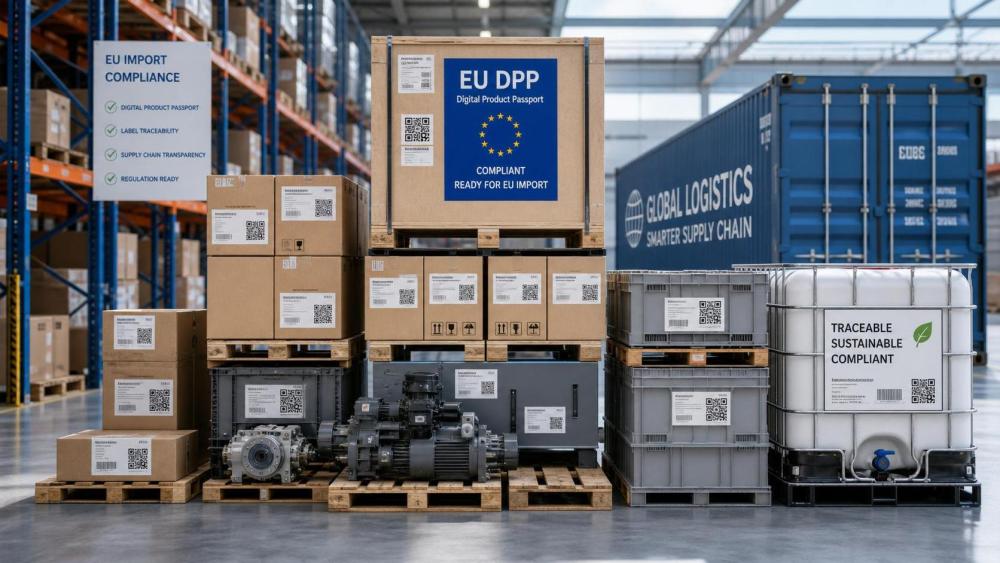
The confirmed change is that the EU has adopted new packaging EPR rules covering imported packaged goods, with mandatory digital product passports becoming effective on 1 January 2027. The requirement applies across a broad imported-goods base rather than only to consumer retail packaging, and the summary provided specifically includes industrial components, machinery consumables, and bulk commodity containers within scope.
The compliance consequence also appears clear at a high level: imports that do not meet the requirement may be detained by customs or ordered for re-export. The information provided further confirms that the rule directly affects export readiness, labeling systems, and traceability infrastructure for global suppliers.
Where pressure is likely to show up across the trade chain
Export-facing manufacturers will need packaging data that can travel with the shipment
From an industry perspective, manufacturers and packers serving the EU market may be affected first because the new obligation is attached to imported packaged goods. The pressure point is not only the physical packaging itself, but whether the shipment can be supported by compliant digital product passport information and traceable labeling at the time of export.
Importers and distributors face a border-risk problem, not only a documentation problem
For importers, distributors, and channel operators, the stated risk of customs detention or re-export means the issue extends beyond routine filing work. What deserves closer attention is the operational exposure at customs clearance, delivery scheduling, and customer commitments if packaging-linked compliance information is incomplete or inconsistent.
Supply chain and service providers may be pulled into execution
Analysis shows that logistics providers, labeling service partners, and traceability-related vendors may also be affected because the summary directly points to labeling systems and traceability infrastructure. Their role may become more visible wherever shipment data, package identification, or compliance handoff must be coordinated across multiple parties.
Industrial and bulk goods suppliers are not outside the scope
The inclusion of industrial components, machinery consumables, and bulk commodity containers is notable because it signals that the requirement is relevant beyond conventional consumer-goods packaging discussions. For suppliers in these categories, the key change is that packaging compliance may now need to be reviewed as part of export preparation and contract execution for EU-bound business.
What companies should be watching now
Separate the adopted requirement from later implementation detail
Analysis shows that companies should distinguish between what is already confirmed and what may still require further clarification in official materials. The adoption of the framework and the 1 January 2027 effective date are the immediate facts to work from; any finer operational interpretation still needs continued verification against future official wording.
Identify which shipped packaging formats are exposed
What deserves closer attention is product and packaging mapping. Businesses exporting to the EU should review where packaged industrial parts, consumables, or bulk containers are used in actual shipments, because the commercial risk will likely sit in the intersection between packaging format, shipment documentation, and border handling.
Review labeling and traceability as one workflow
Observably, the summary links compliance directly to labeling systems and traceability infrastructure. That means companies should not treat DPP preparation as a standalone data exercise. A more practical focus is whether internal packaging records, shipment labels, and traceability processes can support EU-bound consignments in a consistent way.
Prepare supplier and customer communication early
For procurement teams, sales teams, and account managers, the practical issue may be coordination. Exporters may need to confirm what packaging-related information upstream suppliers can provide, while importers and customers may ask for clearer readiness signals before the rule takes effect. Lead times, document completeness, and responsibility allocation are likely areas requiring early discussion.
Why this looks like more than a short-term compliance notice
This section is an editorial observation. It is more appropriate to understand this development as a concrete regulatory signal with near-term operational consequences, rather than as a speculative policy discussion. The reason is straightforward: the framework has been formally adopted, a start date has been set, and the stated enforcement risk reaches customs treatment of imports.
At the same time, it should not be overstated as a fully settled end state for every workflow detail. Observably, the current information confirms direction, scope, timing, and headline risk, while leaving room for market participants to keep monitoring how implementation language and business practices develop in practice.
How the market may need to read this update
In practical terms, this update suggests that packaging compliance for EU imports is moving closer to the center of export execution. The immediate industry meaning is less about broad market prediction and more about readiness: whether companies that ship into the EU can connect packaging, labeling, and traceability into a usable compliance process before January 2027.
Current observation suggests this is best understood as an actionable regulatory development with longer-term signaling value. It already creates a clear preparation window, while also indicating that digital compliance expectations around imported packaging are becoming more operationally relevant across cross-border supply chains.
About the basis of this article
This article is based on the user-provided news title, event date, and event summary concerning the EU's adoption of new EPR rules for imported packaging and the mandatory use of digital product passports from 1 January 2027. No additional unverified facts, market figures, company cases, policy numbers, or source links have been added.
For developments of this type, commonly relevant source categories may include official announcements, regulator publications, industry association updates, company compliance notices, authoritative media coverage, and standards-related documents. A specific official source link was not provided in the input, so continued verification remains necessary. Follow-up attention should focus on any further official wording, practical implementation guidance, and how customs, labeling, and traceability expectations are expressed in subsequent materials.
Weekly Insights
Stay ahead with our curated technology reports delivered every Monday.
Recommended News
 Supply ChainOct 15, 2026How to choose a supply chain strategy for unpredictable demand
 Supply ChainOct 14, 2026How to assess an industrial equipment supplier's spare parts support
 Supply ChainOct 14, 2026EU Updates CSDDD Guidance on Global Supply Chain Due Diligence
 Global SourcingOct 13, 2026How to assess industrial automation suppliers for legacy integration