Export Controls Compliance Platform: Key Features to Compare in 2026
Choosing an export controls compliance platform in 2026 is no longer a narrow software decision. It sits at the intersection of trade law, supply chain continuity, product classification, and data governance.
Basic denied party screening and license tracking still matter. The harder question is whether a platform can keep pace with shifting jurisdictions, fragmented supplier data, and increasingly technical goods.
That matters across industrial trade, from semiconductors and automation equipment to chemicals, metals, energy systems, and precision components. Compliance failures now affect sourcing choices, shipment timing, customer onboarding, and audit exposure.
For organizations that depend on cross-border procurement and export visibility, the right comparison standard is operational, not cosmetic. An export controls compliance platform should help reduce risk while improving decision speed across global trade workflows.
Why platform selection is getting harder
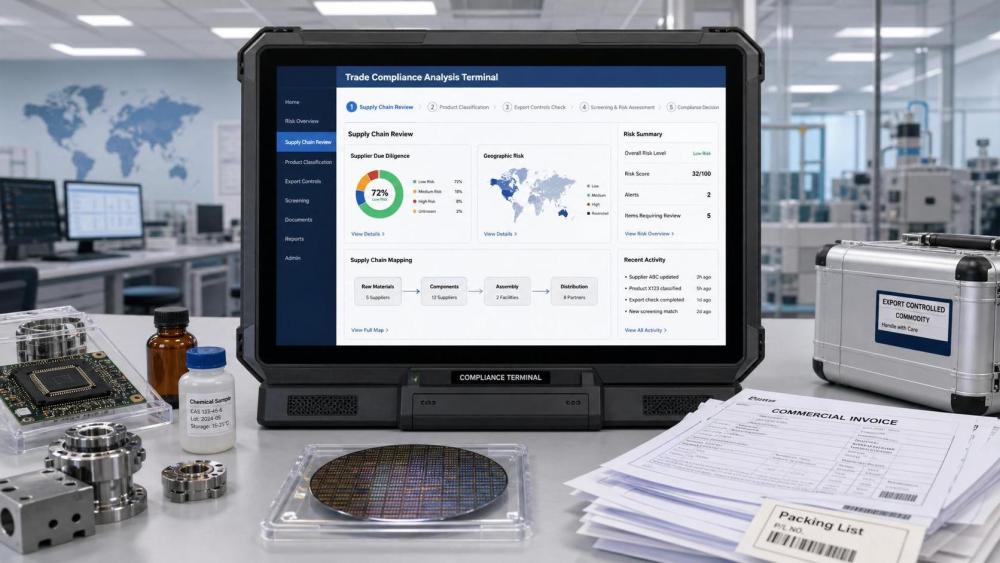
Trade controls are becoming more dynamic, more political, and more technical. Rules now change faster than many internal review cycles.
A shipment may trigger U.S. controls, EU dual-use rules, local customs declarations, and end-use concerns at the same time. The compliance layer can no longer operate as a standalone legal checkpoint.
This is also why market intelligence matters. Platforms are judged not only by regulatory content, but by how well they connect controls data to sourcing routes, supplier geography, logistics timing, and sector-specific risk signals.
In broader industry analysis, including the kind of cross-border mapping emphasized by GTIIN, export compliance has become part of resilience planning. It influences who can buy, who can ship, and how quickly an industrial network can adapt.
What an export controls compliance platform should actually do
At a minimum, an export controls compliance platform should centralize restricted party screening, product classification support, licensing workflows, and transaction recordkeeping.
In practice, the stronger platforms go further. They create a decision system that links item data, customer data, shipment context, and jurisdictional rules inside one controlled process.
That distinction is important. A tool that only flags names on lists may still leave teams exposed if item attributes are incomplete, end-use indicators are weak, or review logic cannot be audited later.
An effective export controls compliance platform should support three layers at once: regulatory interpretation, transactional execution, and operational traceability.
The comparison points that matter most in 2026
Data quality and update discipline
Regulatory content is only useful when updates are timely, structured, and traceable. Compare how vendors handle list refreshes, rule revisions, historical versions, and source citations.
Look for evidence that product and party data can be normalized before screening. False positives often come from weak data hygiene rather than weak rules.
Jurisdictional breadth with usable depth
Coverage should go beyond a long country list. The key issue is whether the platform supports meaningful rule logic for the jurisdictions that affect actual trade lanes.
This includes dual-use classifications, embargo screening, military end-use controls, entity restrictions, and license exceptions where relevant.
Workflow automation without hidden rigidity
Automation is valuable when it reduces repetitive review work. It becomes risky when the rules engine is difficult to adjust or impossible to explain during an audit.
The better export controls compliance platform allows configurable review paths, exception handling, escalation logic, and documented overrides.
Audit readiness and evidence capture
Every compliance decision should leave a clean trail. That means decision timestamps, rule sources, reviewer actions, attached documents, and final disposition logs.
Teams often discover too late that a platform can screen transactions but cannot reconstruct why a shipment was approved six months earlier.
Integration with enterprise systems
A compliance tool becomes more useful when it connects to ERP, PLM, CRM, TMS, supplier databases, and customs documentation systems.
Without integration, classification data and party reviews remain siloed. That creates duplicate effort and raises the chance of inconsistent shipment decisions.
How these features play out in real operations
Different sectors stress an export controls compliance platform in different ways. The platform should match operational complexity, not just compliance theory.
This is where broader trade intelligence becomes useful. GTIIN’s emphasis on industrial sourcing, export trends, and supply chain mapping reflects a practical truth: compliance data gains value when it is read alongside market and logistics signals.
Questions that expose platform maturity
Many product demos look similar at first glance. The differences appear when evaluation moves from interface features to operating conditions.
- How are restricted party lists sourced, updated, and versioned?
- Can the platform explain each screening result with rule-level transparency?
- How does it handle multilingual entity names and incomplete supplier records?
- Can product classification data be inherited from PLM or engineering systems?
- What happens when a shipment spans several jurisdictions with conflicting review logic?
- Are audit exports usable for internal controls, external review, and regulator response?
- How much configuration can be done without a long vendor services cycle?
A mature export controls compliance platform should answer these questions with process detail, not marketing language.
Common evaluation mistakes
One mistake is treating compliance as a legal add-on instead of an operational control. That usually leads to shallow integration and limited adoption.
Another is overvaluing feature count. A long module list does not guarantee usable workflows, clean master data, or reliable exception management.
A third mistake is ignoring regional trade context. A platform may be strong in one regulatory sphere but weak in the routes, sectors, and sourcing patterns that actually matter.
That is why comparison should include live transaction samples, product records, supplier structures, and realistic edge cases. Static demos rarely reveal operational friction.
A practical way to move from shortlist to decision
Start with a narrow scoring framework tied to risk exposure. Focus on jurisdictions, product classes, transaction volume, integration dependencies, and audit requirements.
Then test each export controls compliance platform against actual workflows. Include supplier onboarding, quote review, order release, shipment approval, and post-shipment traceability.
Where possible, compare platform output with external trade intelligence. Signals from sourcing trends, customs patterns, and sector regulation changes can reveal whether a tool is built for current conditions or older assumptions.
In 2026, the strongest choice will usually be the platform that connects compliance accuracy with cross-border execution. A useful next step is to build a side-by-side matrix using live data, then rank vendors by traceability, adaptability, and operational fit rather than headline features alone.
Have questions about this sector analysis, or seeking best practices specific to your niche? Drop us a line below and let the senior consultants at GTIIN assist you.
“We respect your privacy. Your information is strictly confidential.”
Weekly Insights
Stay ahead with our curated technology reports delivered every Monday.
Recommended News
 Supply ChainNov 10, 2026China Extends Pause on 24% Additional Tariff on US Goods by Two Months
 Industry StandardsNov 10, 2026Which imports are subject to EU carbon border compliance?
 Global SourcingNov 09, 2026USTR Extends 178 China Section 301 Tariff Exclusions to January 2027
 Supply ChainNov 09, 2026How can a tariff risk management dashboard track cost exposure?