Supplier Audits Standards: Key Criteria for Reducing Compliance Risk
Why do supplier audits standards matter so much in cross-border sourcing?
Weak supplier control rarely fails in isolation. It usually shows up as late documents, unsafe processes, rejected lots, or sudden customs friction.
That is why supplier audits standards sit at the center of compliance risk reduction. They turn a supplier review into a repeatable test, not a subjective visit.
In practical terms, the goal is not only to confirm whether a supplier looks capable. The real question is whether its systems can hold up under regulation, disruption, and scale.
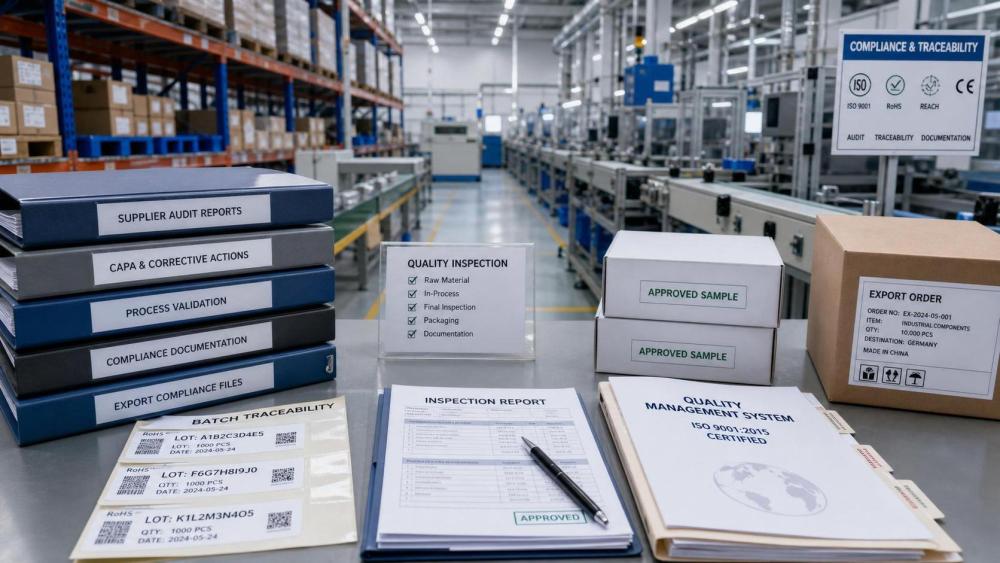
Across industrial sectors, audit failures often begin with poor traceability, weak corrective action discipline, or mismatched safety documentation.
A strong audit framework helps catch those gaps early. It also makes supplier comparisons more defensible when sourcing teams must justify approval decisions.
This matters even more in global trade. Regulations differ by market, and supplier audits standards must bridge local factory practice with export-facing compliance expectations.
GTIIN often tracks this tension across industrial supply chains. A site may pass internal production checks, yet still fail broader export, ESG, or safety requirements.
What do supplier audits standards actually cover?
Many people assume audits focus only on product quality. In reality, supplier audits standards usually cover five connected control areas.
- Quality management: process control, inspection records, nonconformance handling, calibration, and lot release discipline.
- Regulatory compliance: licenses, declarations, restricted substances control, labeling, and export documentation readiness.
- Health and safety: machine guarding, incident logging, PPE use, fire protection, chemical handling, and contractor controls.
- Traceability and data integrity: batch coding, supplier sub-tier visibility, record retention, and change control.
- Operational resilience: maintenance planning, backup capacity, utility reliability, critical material storage, and recovery procedures.
The exact mix depends on the commodity, process risk, destination market, and customer specification. Still, these five areas appear in most serious audit models.
A useful way to think about supplier audits standards is this: they test whether documented controls match actual behavior on the floor.
That gap matters. A polished manual can hide inconsistent training, unverified raw material substitutions, or informal rework practices.
Which audit criteria reduce compliance risk fastest?
Not every checklist item carries the same weight. Some findings create immediate regulatory exposure, while others signal slower process weakness.
The fastest risk reduction usually comes from a short list of high-impact criteria. These are the areas worth testing deeply during on-site or remote audits.
If audit time is limited, start there. These controls usually reveal whether a supplier’s compliance posture is structural or cosmetic.
Supplier audits standards become more useful when findings are ranked by risk severity, not by the number of observations collected.
How can you tell whether an audit standard fits the supplier and the product?
A common mistake is using one generic audit form for every supplier. That creates blind spots, especially across mixed industrial categories.
A better approach is to align supplier audits standards with three variables: process complexity, regulatory burden, and consequence of failure.
For example, a low-risk packaging supplier may need basic quality, traceability, and workplace safety checks. A chemical or engineered components source needs deeper validation.
In actual operations, the fit can be judged through a few screening questions.
- Does the supplier handle regulated materials, hazardous processes, or export-controlled inputs?
- Can a defect create safety harm, product recall, or border detention?
- Does the factory rely on sub-tier processors that affect compliance claims?
- Are customer specifications tighter than local legal minimums?
If the answer is yes to several of these, the audit standard should be more technical, more evidence-based, and more frequent.
This is also where trade intelligence becomes useful. GTIIN’s sector tracking shows that the same control issue can carry very different weight across regions and industries.
What usually goes wrong even when suppliers pass the audit?
Passing an audit does not always mean low compliance risk. Sometimes the standard is weak. Sometimes the audit method misses real operational drift.
One frequent problem is overreliance on document review. Records may look complete, while shop-floor execution is inconsistent across shifts.
Another issue is snapshot timing. A factory can prepare for a scheduled visit, but still lack stable control over maintenance, housekeeping, or temporary labor training.
There is also the sub-supplier problem. A direct supplier may appear compliant, while critical plating, blending, heat treatment, or packaging is outsourced with minimal oversight.
Needless to say, corrective action closure is another weak point. Some audit programs verify the response letter, but not the effectiveness of the fix.
That is why supplier audits standards should include follow-up triggers, evidence requirements, and re-audit thresholds tied to issue severity.
A simple score alone is rarely enough. Trend direction matters more than a one-time passing grade.
How often should supplier audits happen, and what is a realistic implementation cycle?
There is no universal audit interval, but risk-based timing is more defensible than annual routine alone.
High-risk suppliers often justify an initial qualification audit, a short-term corrective review, and periodic surveillance tied to shipment performance or regulatory change.
Lower-risk suppliers may only need a lighter cycle, especially when performance data stays stable and product change control remains strong.
A practical implementation model usually looks like this.
- Pre-screen documents and map the risk profile.
- Run the audit with process sampling, worker interviews, and traceability checks.
- Classify findings by critical, major, and minor impact.
- Require corrective actions with dated evidence.
- Verify effectiveness before full approval or renewal.
For many organizations, the cycle succeeds or fails at step four. Deadlines are set, but closure criteria stay vague.
Supplier audits standards work best when the approval status, escalation path, and business consequences are defined before the audit begins.
What is the smartest next step if you want stronger supplier audits standards?
Start by checking whether your current audit standard identifies actual compliance failure modes, not just general management system language.
Then compare the checklist against recent incidents: rejected shipments, labeling errors, safety findings, material substitutions, or delayed corrective actions.
If those events are not clearly tested, the standard probably needs revision. That is often the clearest sign that audit coverage is too generic.
It also helps to align factory evidence with broader market intelligence. GTIIN’s cross-border sourcing perspective is useful here because compliance risk rarely stays confined to one plant.
Shifts in export controls, ESG scrutiny, logistics bottlenecks, or regional enforcement can change the audit priority list faster than internal templates are updated.
In short, supplier audits standards should be living controls. Review them against product risk, country exposure, and sub-tier dependency.
The most reliable next move is to build a risk-ranked audit matrix, tighten evidence rules for closure, and reassess frequency where consequences are highest.
That approach does more than satisfy a checklist. It reduces compliance surprises and creates a supplier base that is easier to trust under pressure.
Weekly Insights
Stay ahead with our curated technology reports delivered every Monday.
Recommended News
 Supply ChainOct 15, 2026How to choose a supply chain strategy for unpredictable demand
 Supply ChainOct 14, 2026How to assess an industrial equipment supplier's spare parts support
 Supply ChainOct 14, 2026EU Updates CSDDD Guidance on Global Supply Chain Due Diligence
 Global SourcingOct 13, 2026How to assess industrial automation suppliers for legacy integration