EU CBAM Update Extends to All Industrial Intermediates
On July 1, 2026, the EU’s updated transitional guidance for the Carbon Border Adjustment Mechanism (CBAM) takes a wider practical reach by covering all industrial intermediate goods exported to the EU. For exporters of metal semi-finished products, chemical precursors, mechanical components, and related industrial goods, the immediate issue is no longer only product scope but also the need to file embedded carbon emissions data verified by an accredited third party. For Chinese industrial exporters and the service providers around them, this deserves attention because it changes compliance timing, documentation preparation, and transaction-related costs within existing export workflows.
What the revised guidance confirms
The confirmed timeline in the provided information is that the European Commission issued a revised version of the CBAM transitional implementation guidance on June 29, 2026, with the updated requirement taking effect on July 1, 2026.
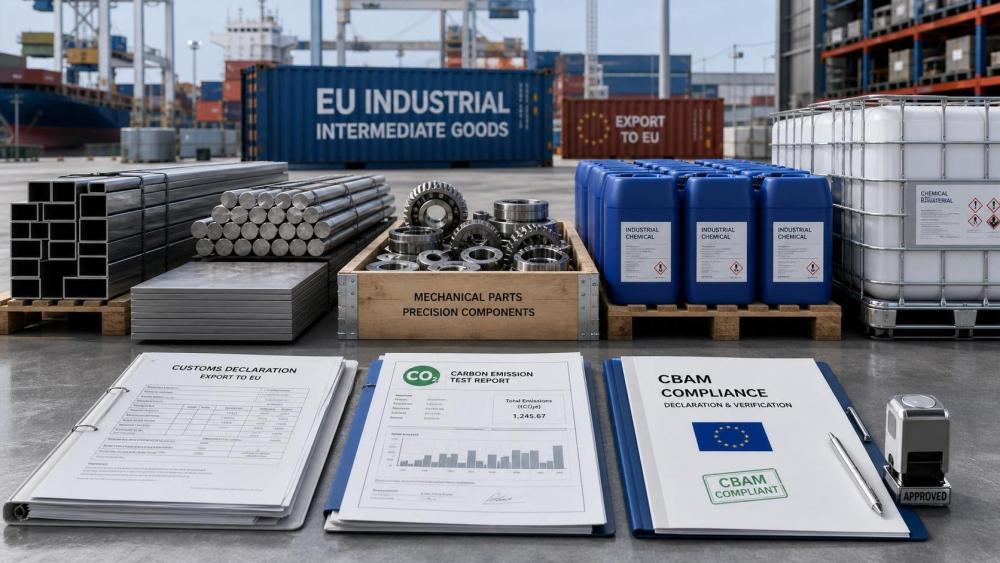
According to the provided summary, the revised guidance expands CBAM coverage to all industrial intermediate products exported to the EU. The examples expressly mentioned include metal semi-finished products, chemical precursors, and mechanical parts.
The same update also makes clear that exporters must submit embedded carbon emissions data at the time of declaration, and that this data must be verified by an accredited third party. The provided information further states that this adjustment directly affects the compliance preparation schedule and documentation costs of Chinese companies exporting industrial goods to Europe.
Where the pressure is likely to appear first
Export-facing manufacturers will feel it in filing and product-level preparation
From an industry perspective, companies shipping industrial intermediates directly to EU buyers are likely to face the earliest operational impact because the new requirement sits at the declaration stage. The main pressure points are likely to be product categorization, emissions data readiness, and coordination of third-party verification within shipment schedules.
Upstream suppliers may face tighter data requests
Analysis shows that suppliers feeding into export products may also be affected, even when they are not the declarant themselves. If exporters must provide verified embedded emissions information, upstream material and component suppliers may see more requests for production-related data, technical specifications, and supporting records that can be used in verification and document assembly.
Trade, logistics, and documentation service providers may see process complexity rise
For customs, trade compliance, and supply chain service providers, the likely impact is procedural rather than product-based. What deserves closer attention is whether export documentation flows, verification timing, and customer communication processes can keep pace with the new requirement, especially where declarations depend on multiple suppliers or multiple intermediate goods in one shipment.
EU-facing buyers and procurement teams may push for earlier compliance clarity
Observably, procurement teams and downstream buyers connected to EU delivery may focus more closely on whether exporters can provide complete and verified emissions information on time. The practical concern for these market participants is continuity of supply, especially where industrial intermediates are embedded in larger manufacturing or assembly schedules.
What companies should watch now
Separate confirmed rules from operational assumptions
The confirmed point in the provided information is the widened product coverage and the requirement for accredited third-party verification of embedded emissions data. Companies should distinguish that from any internal assumption about how quickly supporting processes can be built, because the policy text and the day-to-day ability to comply are not the same issue.
Identify exposed product lines and declaration pathways
What deserves closer attention is which exported product lines fall within industrial intermediate categories relevant to the company’s EU business. For many exporters, the immediate task is less about broad policy interpretation and more about identifying which declarations, customers, and recurring shipments now require verified emissions documentation.
Check supplier records and verification readiness
Analysis shows that compliance risk may build upstream if required emissions inputs are incomplete or inconsistent. Companies should pay close attention to supplier documentation quality, the availability of records needed for third-party verification, and whether those materials can be assembled within normal delivery cycles.
Prepare for cost and timing changes in customer communication
The provided information already notes an effect on compliance preparation pace and documentation cost. In practical terms, exporters and account teams should watch for changes in lead times, supporting document workloads, and the need to explain compliance status to EU customers earlier in the order and shipment process.
Why this reads as more than a routine clarification
Analysis shows that this update is not just a technical wording change for companies that sell industrial intermediates into the EU. It points to a more demanding transitional phase in which product coverage and documentary proof move closer together. That said, it is more appropriate to understand this as a concrete compliance development rather than a finished picture of long-term market outcomes, because the provided information confirms the rule adjustment but does not establish how implementation will vary across sectors or transactions.
Observably, the most important near-term signal is that emissions reporting is becoming harder to separate from ordinary export execution. The practical burden appears likely to sit in data collection, verification coordination, and declaration timing rather than in a single headline policy change alone.
How this update is best understood at this stage
At this stage, the update is best read as an immediate operational change with broader strategic implications still unfolding. The confirmed facts already show a wider scope for CBAM during the transitional period and a stricter requirement around verified embedded emissions data. For affected industrial exporters, the issue is not only regulatory awareness but whether internal and supplier-side documentation processes can support EU-bound trade without delay. A cautious reading is appropriate: this is a real compliance shift now, and also a signal that further practical interpretation remains worth monitoring.
Basis of this article
This article is based on the user-provided news title, event date, and event summary. The summary states that the European Commission released a revised CBAM transitional implementation guide on June 29, 2026, and that from July 1, 2026 the mechanism extends to all industrial intermediate goods exported to the EU, with embedded carbon emissions data requiring accredited third-party verification.
For this type of development, source categories commonly worth checking include official announcements, company disclosures, industry association updates, authoritative media coverage, and standards or compliance-related documents. No specific official source link was provided in the input, so the exact source document link remains to be verified on an ongoing basis. Areas that still warrant follow-up include any later official wording updates, implementation clarifications, and practical filing expectations affecting export documentation and verification workflows.
Weekly Insights
Stay ahead with our curated technology reports delivered every Monday.
Recommended News
 Supply ChainOct 15, 2026How to choose a supply chain strategy for unpredictable demand
 Supply ChainOct 14, 2026How to assess an industrial equipment supplier's spare parts support
 Supply ChainOct 14, 2026EU Updates CSDDD Guidance on Global Supply Chain Due Diligence
 Global SourcingOct 13, 2026How to assess industrial automation suppliers for legacy integration