EU Adds 12 SVHCs to REACH Annex XVII
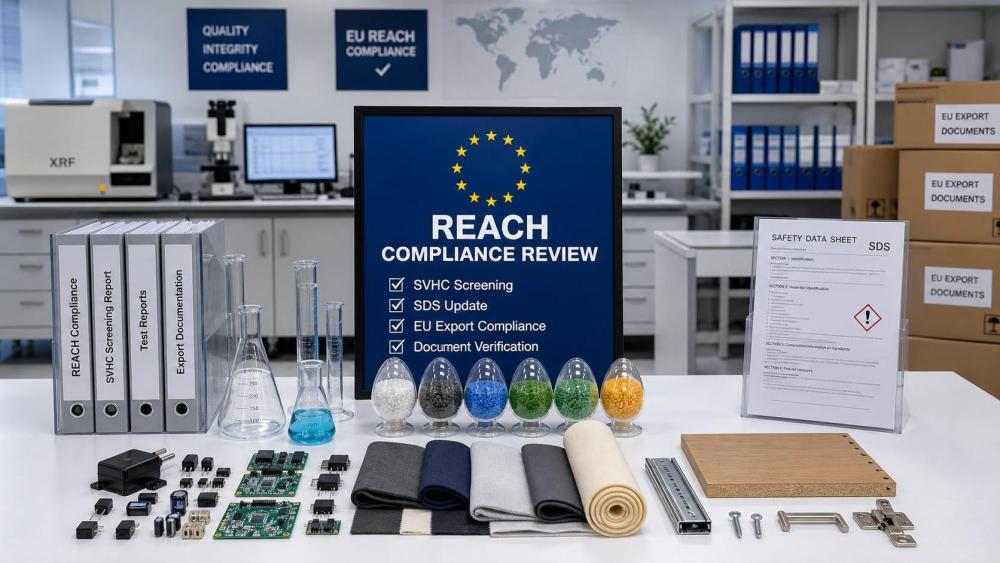
On July 24, 2026, the European Commission published Regulation (EU) 2026/1389 in the Official Journal, adding 12 newly identified substances of very high concern (SVHCs) to REACH Annex XVII. The change covers certain flame retardants, plasticizers, and metal complexes, and from October 1, 2026, imported articles containing more than 0.1% (w/w) of any of these added SVHCs must be notified to ECHA, with SDS and supply-chain communication statements updated accordingly. For exporters shipping into the EU, especially in electrical and electronic products, textiles, plastic goods, furniture, and industrial components, this is a compliance development that directly affects documentation, material screening, and customer communication.
What the new rule formally changes
The confirmed facts are limited but clear. According to the provided information, the European Commission issued Regulation (EU) 2026/1389 on July 24, 2026, and brought 12 newly identified SVHCs into REACH Annex XVII. The substances mentioned in the summary include certain flame retardants, plasticizers, and metal complexes. The requirement takes effect on October 1, 2026, and applies to imported articles that contain more than 0.1% (w/w) of any one of the newly added SVHCs.
The operational consequence stated in the input is also specific: affected imported articles must be notified to ECHA, and the related SDS and supply-chain communication statements must be updated. The summary further states that the adjustment directly affects compliance pathways for a broad range of products exported from China to the EU, including electrical and electronic products, textiles, plastic products, furniture, and industrial parts.
Where the compliance pressure is likely to appear first
Export-facing product suppliers will face immediate material review pressure
From an industry perspective, exporters selling finished goods into the EU are likely to feel the earliest impact because the new obligation is tied to imported articles and a defined concentration threshold. For these companies, the main pressure point is not only substance presence itself, but whether existing bill-of-materials data, declarations, and technical files are detailed enough to identify any of the 12 added SVHCs above 0.1% (w/w).
Manufacturers and processors may need tighter upstream substance visibility
Analysis shows that processing and manufacturing businesses in categories such as electronics, textiles, plastics, furniture, and industrial components may be affected through raw material selection, formulation control, and component sourcing. Where certain flame retardants, plasticizers, or metal complexes are used in subcomponents or treated materials, the impact is likely to show up in internal verification, supplier declaration requests, and document updates tied to delivery into the EU market.
Supply-chain coordinators and documentation teams will carry more of the execution burden
What deserves closer attention is that this change is not limited to laboratory or product engineering functions. Teams responsible for SDS maintenance, regulatory communication, and customer-facing compliance statements are also likely to be affected. For distributors, trading companies, and supply-chain service providers handling EU-bound goods, the practical issue is whether product information can move through the chain in a timely and consistent way once the October 2026 requirement starts to apply.
What companies should be checking now
Check which product lines map to the named substance groups
Companies with EU-bound shipments should first identify whether their products or components are associated with the substance groups mentioned in the provided summary: certain flame retardants, plasticizers, and metal complexes. The practical focus is on product categories already flagged in the input, including electrical and electronic products, textiles, plastic goods, furniture, and industrial components.
Review whether current declarations are usable for the new notification threshold
Observably, the 0.1% (w/w) threshold makes document quality a business issue, not just a regulatory one. Firms should examine whether supplier declarations, internal material records, and article-level compliance files are sufficient to support ECHA notification where required. This is distinct from a general compliance check; the issue here is whether current records can support the specific notification and communication duties referenced in the summary.
Prepare for document updates across SDS and supply-chain statements
The provided information explicitly links the new requirement to SDS updates and revised supply-chain communication statements. That means companies should pay attention to document version control, customer communication timing, and consistency between technical, commercial, and logistics teams. Where multiple suppliers or subcontractors are involved, the main risk is fragmented or delayed information rather than a single technical decision.
Watch for any further official clarification before implementation
Analysis shows that the headline rule is already clear enough to require preparation, but day-to-day execution often depends on official wording, interpretive notes, or customer-specific compliance requests. Businesses should therefore distinguish between the confirmed legal trigger in the provided information and any later clarifications that may shape how notification and supply-chain disclosures are handled in practice.
Why this reads as more than a short-term filing task
This section is analysis rather than confirmed fact. It is more appropriate to understand this development as both an immediate compliance change and a longer-term signal about substance transparency expectations in EU-bound trade. The short-term element is obvious: from October 1, 2026, affected imported articles face a mandatory notification trigger and related document updates. The longer-term signal is that exporters and their supply chains may need more reliable substance-level visibility across product categories that are often managed through complex supplier networks.
Observably, the importance of this update is not limited to whether a company currently uses one of the 12 added SVHCs. It also tests how quickly a business can trace material content, validate supplier inputs, and translate regulatory change into shipment-ready documentation. That is why the update deserves attention from regulatory, sourcing, product, and account management functions at the same time.
How the market should read this update today
At this stage, the most balanced reading is that the rule change is already concrete enough to affect compliance planning, but its full commercial impact will depend on how exposed individual product lines are to the newly added SVHCs. It should not be treated as a generic policy headline or as a settled indicator of wider market outcomes. Instead, it is better understood as a targeted regulatory development with direct implications for EU import compliance, especially for China-to-EU product flows in the categories named in the provided summary.
From an editorial perspective, the key takeaway is practical: this is a documentation and substance-tracing issue as much as a legal one. Companies that rely on layered supply chains or broad product portfolios are likely to need closer internal coordination before the October 2026 effective date.
Basis of this report and points that still require verification
This article is based on the user-provided news title, event date, and event summary concerning Regulation (EU) 2026/1389, the addition of 12 SVHCs to REACH Annex XVII, the October 1, 2026 notification trigger, and the stated impact on multiple export product categories. For this type of development, relevant source types typically include official government or regulator notices, company compliance disclosures, industry association updates, authoritative media coverage, and standard or regulatory documentation.
No specific official source link was provided in the input, so the precise official link still needs to be verified on an ongoing basis. The next points to watch are any further official wording, implementation detail, or market-side clarification affecting ECHA notification practice, SDS updates, and supply-chain communication expectations for affected imported articles.
Tags
Weekly Insights
Stay ahead with our curated technology reports delivered every Monday.
Recommended News
 Global SourcingOct 25, 2026How to find active suppliers in a trade intelligence platform dashboard
 Supply ChainOct 25, 2026Trade Tariffs Cause Whiplash at Port Milwaukee, Disrupting Cargo Flows
 Supply ChainOct 24, 2026How to use traceability to verify supply chain sustainability claims
 Market TrendsOct 24, 2026FedEx Report: AI Drives Asia-Pacific Chip and Digital Infrastructure Supply Chain Demand