
CBP Tightens Pre-Entry Review for China-Origin Components
On August 15, 2026, a new U.S. Customs and Border Protection (CBP) requirement began applying to electronic components originating in China, including goods routed through third countries or sold under relabeling arrangements. For companies dealing in PCB products, passive components, power modules and related categories, the issue is not only regulatory wording but also how pre-entry review and supply-chain traceability checks could affect customs timing, documentation workflows and compliance costs across distribution and sourcing activities.
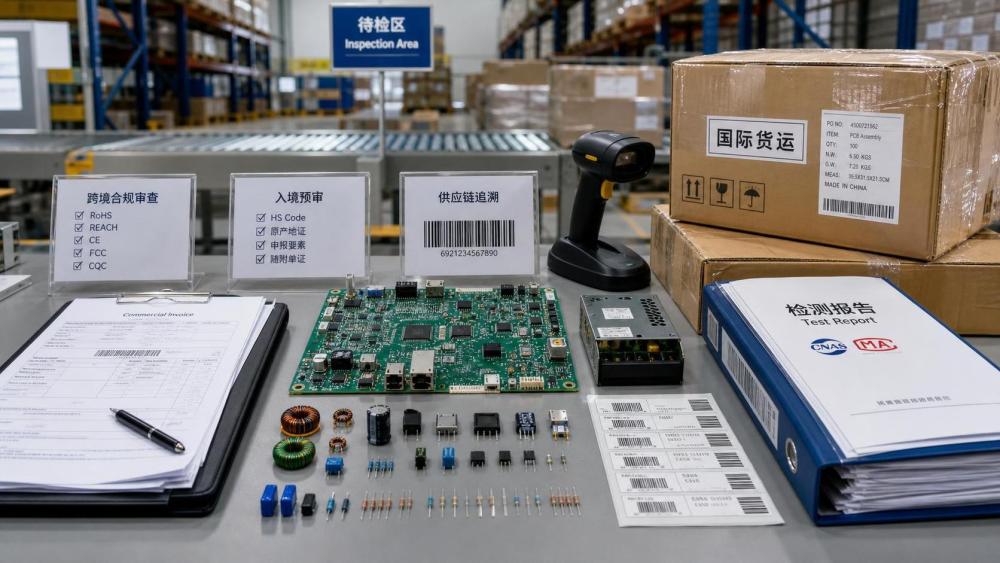
What the interim CBP instruction requires
According to the information provided, CBP issued an interim instruction on August 5, 2026. Starting August 15, all covered electronic components of Chinese origin, including those transshipped through third countries or relabeled, must complete export declaration pre-review and supply-chain traceability verification before entering the United States.
The required traceability materials include factory codes, BOM-level information and uploads of original test reports. The scope specifically mentioned in the provided information includes PCB products, passive components and power modules.
The same information also states that the measure directly affects customs clearance timing and compliance costs for global distributors, with particular pressure on small and mid-sized suppliers that do not operate ISO/IEC 17025-certified laboratories.
Where the operational pressure may appear first
Documentation-intensive roles in distribution
From an industry perspective, distributors are among the first groups likely to feel the practical effect because clearance speed often depends on how quickly shipment files can be assembled and validated. Where a shipment includes factory identifiers, BOM-level details and original test reports, documentation readiness becomes a more immediate operational issue than under a lighter filing process.
Suppliers with limited traceability infrastructure
Analysis shows that smaller suppliers may face more pressure if they have not established the laboratory and documentation capabilities referenced in the provided information. The stated relevance of ISO/IEC 17025 suggests that proof quality, report origin and internal test-data management may become closer points of scrutiny in transactions involving covered components.
Trading structures involving transshipment or relabeling
Companies using third-country routing or private-label arrangements also need to pay attention because the requirement, as described, still follows the goods back to Chinese origin. In practical terms, that means trading structures that once separated branding, shipping and manufacturing paperwork may now face a tighter need to connect those records before entry.
Procurement and downstream users
Buyers and downstream manufacturing users may not be the direct filing party, but they could still be affected through lead-time uncertainty, document requests and shipment release timing. What deserves closer attention is whether procurement teams can confirm in advance that upstream suppliers are able to provide the required traceability materials without delaying delivery commitments.
What companies should monitor now
Whether official wording changes after implementation
Companies should continue monitoring whether CBP issues clarifications, technical guidance or adjustments to the interim instruction. The current information confirms the existence of the requirement and its effective date, but operational interpretation often becomes clearer only after initial implementation.
Which product lines need immediate document checks
Businesses handling PCB products, passive components, power modules and similar component categories should review which active shipments or near-term orders may fall within the stated scope. A practical focus is whether existing shipment files already contain factory codes, BOM-level documentation and original test reports in a form that can be submitted without rework.
How supplier qualification links to delivery risk
Observably, supplier qualification now overlaps more directly with customs readiness. Firms sourcing from smaller suppliers should pay closer attention to whether testing records, report retention and traceability files are complete enough to support pre-review, especially where the supplier does not have an ISO/IEC 17025-certified laboratory.
How to align customer communication with filing reality
There is also a difference between a rule taking effect and day-to-day execution becoming stable. For that reason, sales, logistics and procurement teams may need aligned customer communication on documentation lead times, possible filing checks and the conditions under which a shipment could require additional verification before entry.
Why this reads as more than a short-term paperwork issue
Analysis shows that this development is not simply about one extra customs form. The requirement, as described in the provided information, reaches into origin identification, BOM visibility and original testing records. That combination suggests a stronger compliance emphasis on verifiable supply-chain history rather than on shipment-level declarations alone.
At the same time, it is more appropriate to understand this as an industry signal that still requires continued observation, rather than as a fully settled long-term outcome. The instruction is described as interim, and the practical effect will depend on how consistently the review is enforced and whether later guidance changes the documentation threshold or review mechanics.
How the industry may best frame this development
A balanced reading is that the August 15 measure matters immediately for companies moving China-origin electronic components into the U.S., especially where customs timing and supporting records are already tight. The confirmed facts point to higher compliance demands around pre-entry review and traceability, while the broader commercial impact still depends on implementation details that may become clearer over time.
For now, it is more appropriate to understand this as both an active compliance change and a broader signal that documentation depth, source traceability and original testing support are becoming more central in cross-border component trade.
Basis of this article and points for continued verification
This article is based on the user-provided news title, event date and event summary. For developments of this type, source categories commonly relevant to verification include official notices, company statements, industry association updates, authoritative media coverage and standards-related documentation.
No specific official source link was provided in the input, so the exact official publication path still needs continued verification. Follow-up attention should focus on any later CBP clarification, implementation guidance and further explanation of how pre-review and traceability verification will be applied in actual entry processing.
Weekly Insights
Stay ahead with our curated technology reports delivered every Monday.
Recommended News
 Supply ChainSep 22, 2026How heavy equipment lifecycle data can reduce unexpected downtime
 Supply ChainSep 21, 2026How export regulations affect logistics lead times and delivery risk
 Industry StandardsSep 20, 2026What evidence is needed to pass a carbon reporting audit?
 Industry StandardsSep 19, 2026When does manufacturing compliance consulting reduce audit risk?