ACE filing rule now covers all China industrial goods
Effective July 1, 2026, U.S. Customs and Border Protection has expanded the ACE electronic filing requirement to all industrial goods imported from China. For companies moving machinery, electronics, building materials, and other industrial products into the U.S., this is not just an administrative update. It directly affects customs clearance, shipment timing, and delivery planning, especially where procurement and distribution depend on just-in-time supply chains. The rule change deserves attention because non-compliant entries now face automatic hold, longer clearance times, and possible re-export exposure.
What Has Changed as of July 1
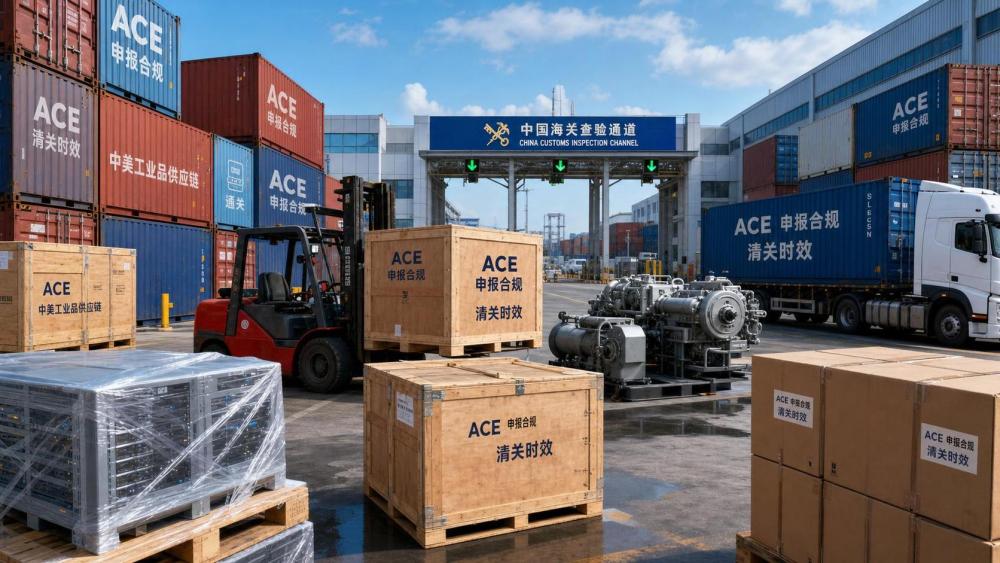
The confirmed change is that CBP has broadened its Automated Commercial Environment (ACE) electronic filing mandate so that it applies to all China-origin industrial goods from July 1, 2026. The stated consequence for non-compliant shipments is automatic hold, with average clearance delays extended by 3.8 days, alongside potential re-export penalties. The change affects importers, distributors, and procurement teams, with particular relevance to machinery, electronics, and building materials.
Where the Pressure Will Show Up First
Import operations and customs entry teams
These teams are the first to feel the rule change because ACE filing sits directly in the customs submission process. If filing is incomplete or non-compliant, the impact is immediate at the clearance stage rather than later in the transaction. From an operational perspective, what deserves closer attention is whether current entry workflows, internal data handoff, and shipment release planning are aligned with the expanded filing requirement.
Distributors managing inventory flow
Distributors may be affected where inventory turnover depends on predictable port release and onward delivery. Automatic holds and longer average clearance times can disrupt replenishment timing, warehouse scheduling, and customer delivery commitments. Analysis shows that for this group, the practical issue is less about the announcement itself and more about whether existing stock and transit planning can absorb a customs delay without creating downstream fulfillment pressure.
Procurement teams tied to just-in-time supply
Procurement functions relying on tightly timed inbound shipments may face a higher execution risk once filing compliance becomes a broader gate for industrial goods from China. The effect can surface in purchase scheduling, supplier coordination, and delivery-date assumptions built into sourcing plans. For these teams, the rule change raises a compliance-linked supply continuity issue rather than a purely customs issue.
Product segments with narrower delivery tolerance
Machinery, electronics, and building materials are specifically identified in the event summary, which suggests closer exposure for categories where installation schedules, project sequencing, or production continuity depend on shipment arrival windows. Observably, these sectors may need to pay closer attention to document readiness and delivery buffers, because even a moderate clearance delay can carry through to production or project timelines.
What Companies Should Watch Now
Check whether filing readiness matches the expanded scope
Companies importing China-origin industrial goods should review whether their ACE-related filing processes are already set up for the full range of covered industrial products they move. Analysis shows this is best treated as a scope-expansion question first: businesses need to know which shipments now fall within the mandate and whether existing internal compliance routines were built for a narrower product set.
Review shipment documents and handoff points
Because the confirmed risk sits at the point of customs compliance, businesses should pay close attention to the document chain used to support entry filing. What deserves closer attention is whether product information, shipment data, and supporting trade paperwork are transferred cleanly between suppliers, procurement teams, brokers, and receiving operations. The input provided does not specify detailed document standards, so this remains an area to monitor rather than a point on which to assume settled practice.
Reassess lead-time assumptions in procurement and delivery plans
The stated average delay of 3.8 days for non-compliant shipments is material for businesses operating with narrow delivery windows. From an industry perspective, companies should revisit planning assumptions that depend on routine release timing, especially where procurement, installation, production, or customer delivery are sequenced tightly around inbound goods. This is a practical planning issue even before broader market effects become visible.
Monitor how enforcement language is applied in practice
The event summary confirms automatic hold, delay exposure, and potential re-export penalties, but it does not provide fuller execution detail. It is therefore more appropriate to understand the current position as a rule with direct consequences already attached, while still watching for further clarity in enforcement practice, compliance interpretation, and any shipment-level distinctions that may matter in day-to-day operations.
Why This Looks Like an Execution Signal
Analysis shows this development is better understood as an operational enforcement signal than as a general policy discussion. The effective date is clear, the scope expansion is explicit, and non-compliance consequences are already defined at a practical level. At the same time, the input does not provide broader implementation detail, so the market still needs to observe how consistently the requirement is applied across product categories, documentation scenarios, and supply chain arrangements. For that reason, the announcement points to a live compliance change, but not yet to a fully mapped execution landscape.
How the Market May Need to Read It
In practical terms, this update should be read as a landed rule change with immediate relevance for trade execution, especially for companies importing industrial goods from China into the U.S. The most rational conclusion is not that every supply chain outcome is already determined, but that customs filing compliance has become a more direct factor in delivery reliability. For industry participants, the key issue now is whether internal trade, procurement, and logistics processes are robust enough to prevent avoidable clearance friction under the expanded ACE mandate.
Basis of This Article and What Still Needs Verification
This article is based on the user-provided news title, event date, and event summary. For developments of this type, relevant source categories typically include official notices, releases from regulatory authorities, customs or trade administration information, industry association updates, standards-related documents, and reporting by authoritative trade or business media. A specific official source link was not provided in the input, so the underlying release and any subsequent clarifications still need to be verified on an ongoing basis. Further observation is also needed around detailed implementation language, compliance interpretation, procurement document changes, tender or contract wording adjustments, industry feedback, and how affected companies are managing execution in practice.
Weekly Insights
Stay ahead with our curated technology reports delivered every Monday.
Recommended News
 Supply ChainOct 15, 2026How to choose a supply chain strategy for unpredictable demand
 Supply ChainOct 14, 2026How to assess an industrial equipment supplier's spare parts support
 Supply ChainOct 14, 2026EU Updates CSDDD Guidance on Global Supply Chain Due Diligence
 Global SourcingOct 13, 2026How to assess industrial automation suppliers for legacy integration