Industrial Compliance Documentation: Common Gaps That Trigger Audit Risk
Industrial Compliance Documentation: Common Gaps That Trigger Audit Risk
Industrial compliance documentation often looks complete until an audit tests the details.
A signed form, a certificate, or a procedure can appear acceptable, yet still fail against current standards.
That is where audit risk usually begins.
In industrial operations, documentation is not just evidence of work.
It is proof that controls exist, that people follow them, and that outputs remain traceable.
When records are fragmented, outdated, or inconsistent, auditors usually treat that as a process weakness.
For GTIIN, this matters across global sourcing, export compliance, supplier qualification, and resilient supply chain design.
From recent market changes, a clearer signal is emerging.
Industrial compliance documentation is now reviewed as part of wider operational credibility, not only regulatory formality.
That also means technical gaps can quickly influence supplier approval, shipment release, and contract confidence.
Why Documentation Gaps Create Immediate Audit Risk
Auditors rarely start with dramatic failures.
They start by checking whether documents align with actual operating conditions.
If revision dates conflict, signatures are missing, or control limits differ between files, confidence drops fast.
In practice, industrial compliance documentation supports four basic questions:
- What requirement applies
- How the requirement is controlled
- Who verified conformity
- Whether the evidence is current and traceable
When one answer is weak, the rest of the file becomes harder to trust.
This is especially true in cross-border production networks, where multiple plants, suppliers, and standards interact.
The Most Common Industrial Compliance Documentation Gaps
Most audit findings come from recurring patterns rather than unusual exceptions.
The following weak points appear across manufacturing, sourcing, warehousing, and regulated export operations.
1. Obsolete versions still in use
This is one of the fastest ways to trigger audit risk.
A shop floor instruction may differ from the controlled master file.
Calibration criteria may also reflect a withdrawn standard revision.
Once auditors find one outdated file, they often widen the sample immediately.
2. Missing traceability between records
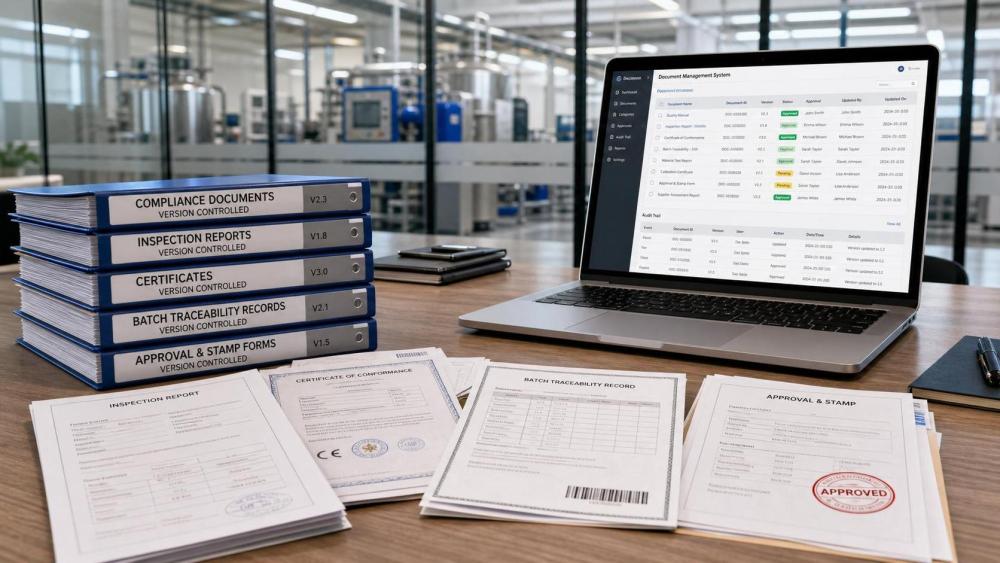
Industrial compliance documentation should connect material, process, inspection, and release data.
Too often, batch records sit in one system, certificates in another, and deviations in email chains.
That breaks the evidence chain.
3. Incomplete change control documentation
Equipment settings, raw material substitutions, and supplier changes often move faster than paperwork.
But if the record does not show review, approval, impact assessment, and implementation timing, auditors see uncontrolled change.
4. Weak training evidence
A signed attendance sheet is rarely enough.
Training records should link people to document versions, job roles, and competency checks.
Without that link, execution cannot be defended.
5. Certificates without scope validation
Many teams collect certificates but never confirm whether the scope actually covers the supplied part, site, or process.
A valid certificate outside the relevant scope still creates compliance exposure.
6. CAPA records that stop at correction
Closing a defect is not the same as proving systemic correction.
Industrial compliance documentation must show root cause, action ownership, deadline, and effectiveness review.
That is where many corrective action files fail.
Where Technical Evaluators Should Look First
A practical review starts with interfaces, not isolated files.
That is usually where industrial compliance documentation breaks under pressure.
Focus attention on these checkpoints:
- Document control versus live operations. Check whether current instructions match equipment, tooling, and inspection plans.
- Supplier file versus purchase specification. Verify that approved materials, grades, and standards align across both sides.
- Test report versus release decision. Make sure nonconforming data cannot be released without documented review.
- Change log versus validation records. Confirm that process changes triggered the required requalification steps.
- Training matrix versus controlled documents. People should be trained on the exact revision they must execute.
This approach is useful because it tests control logic, not just filing discipline.
It also gives a clearer picture of whether a supplier is operationally ready for scale, export scrutiny, or customer qualification.
How to Strengthen Industrial Compliance Documentation
The strongest systems are usually simple, consistent, and enforced.
They do not rely on heroic manual follow-up.
Several actions reduce audit exposure quickly.
Standardize evidence requirements
Define the minimum record set for each regulated activity.
This may include specifications, approvals, inspection results, exceptions, and retention rules.
Build traceability across systems
Use consistent identifiers for batches, lots, parts, suppliers, and deviations.
Even without a full digital platform, shared naming logic closes many gaps.
Control revision access tightly
Remove obsolete files from active use points.
Where paper remains necessary, add visible issue dates and retrieval rules.
Link changes to risk review
Not every change needs the same depth.
But every relevant change should show why it matters and what controls were updated.
Test the system before the audit
Run short internal document walks using real production cases.
Start with one shipment, one batch, or one equipment change.
Then test whether all required industrial compliance documentation can be retrieved quickly and consistently.
A Simple Audit-Readiness Table
Final Takeaway
Industrial compliance documentation becomes a real strength when it mirrors how operations actually run.
That is the standard auditors, customers, and sourcing teams increasingly expect.
The most common gaps are rarely hidden.
They appear in outdated versions, broken traceability, weak change records, incomplete training evidence, and shallow corrective actions.
In actual industrial business, fixing these areas improves more than audit scores.
It strengthens supplier reliability, technical transparency, and cross-border execution confidence.
Start with the highest-risk document links, test them against live operations, and close the weakest evidence paths first.
That is usually the fastest route to lower audit risk and stronger industrial compliance documentation.
Weekly Insights
Stay ahead with our curated technology reports delivered every Monday.
Recommended News
 Supply ChainOct 15, 2026How to choose a supply chain strategy for unpredictable demand
 Supply ChainOct 14, 2026How to assess an industrial equipment supplier's spare parts support
 Supply ChainOct 14, 2026EU Updates CSDDD Guidance on Global Supply Chain Due Diligence
 Global SourcingOct 13, 2026How to assess industrial automation suppliers for legacy integration