When does cross-border fulfillment reduce total delivery costs?
Cross-border fulfillment reduces total delivery costs when inventory is positioned close enough to end demand to remove repeated premium freight, but not so fragmented that stockholding, handling, and compliance costs rise faster than transport savings. In practice, the cost advantage appears when the full landed-to-delivered chain is measured as one system: origin packing, export handling, main-leg freight, import clearance, bonded or domestic storage, order picking, parcel injection, returns routing, and the cost of service failures. A low line-haul rate alone rarely proves the model.
For many industrial and trade categories, the strongest savings case emerges when products are stable, repeatable, and predictable in movement. Standard fasteners, electrical accessories, maintenance parts, packaged chemicals within permitted transport classes, light machinery components, and replacement items with consistent carton geometry are easier to place in a foreign fulfillment node. Their dimensions, pallet patterns, and handling requirements usually remain controlled over time. That allows better container utilization, cleaner customs documentation, and fewer warehouse exceptions. Once exception handling drops, the delivered cost per order often falls even if the storage bill is slightly higher.
Where the savings usually start
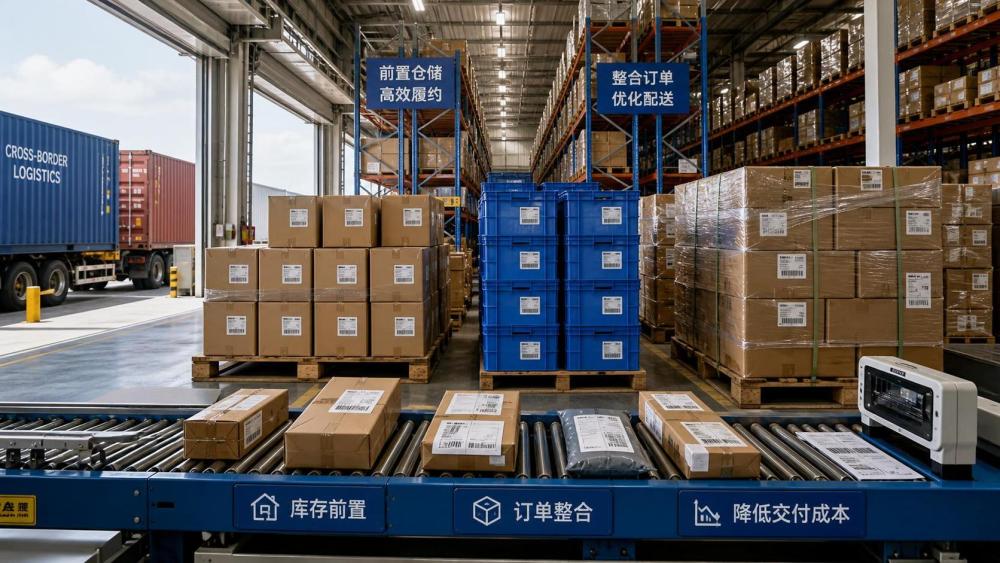
Cross-border fulfillment becomes financially attractive when direct shipping from origin creates avoidable duplication. A common example is shipping many small orders internationally one by one. Each parcel may carry its own export paperwork, airline or integrator surcharge, destination brokerage event, and last-mile handoff premium. Consolidating those orders upstream into ocean, rail, road, or deferred air movements and then breaking them down near destination can replace repeated border-touch costs with one larger inbound movement and a simpler domestic dispatch pattern.
The same logic applies when a product mix contains a large share of low-complexity SKUs but only a smaller set of urgent items. If the urgent subset keeps forcing air freight for whole mixed orders, regional fulfillment can separate the flows. The slower-moving base inventory travels by economical modes, while only true shortages need expedited replenishment. That distinction matters in categories where cartons cube out before they weigh out, where protective packaging adds volume, or where master cartons are durable enough to tolerate longer transport cycles without repacking.
Customs behavior can also decide the outcome. Some lanes produce stable, routine clearance when declarations are standardized and product classification is mature. In those lanes, cross-border fulfillment can reduce the hidden cost of uncertainty: demurrage risk, storage pending inspection, split deliveries caused by clearance delays, and customer service interventions needed to explain late arrivals. If clearance at parcel level is unpredictable but clearance at pallet or container level is more controllable, the economics generally favor stocking closer to destination demand.
Inventory placement has to match demand shape
The model usually works best when demand is broad enough to justify a regional stock position but concentrated enough to avoid scattering inventory across too many nodes. One warehouse serving several nearby markets may lower total delivery cost; three warehouses serving the same demand with thin order density may do the opposite. The issue is not only rent. Every extra node creates duplicate safety stock, extra cycle counting, more replenishment planning, and a higher chance that one site will run short while another holds excess.
SKU behavior matters more than total catalog size. A business with a large catalog may still be a good fit if most revenue and order frequency come from a narrow group of stable items. By contrast, a smaller catalog with volatile demand, frequent engineering revisions, and many low-turn spare parts can become expensive under cross-border fulfillment because aging stock, write-down risk, and reverse logistics absorb the freight gains. Products with batch sensitivity, shelf-life constraints, firmware versioning, or serial-number traceability need especially careful costing. A regional warehouse may shorten delivery time but also increase obsolescence exposure if replenishment cycles are long.
Packaging discipline is often underestimated. If export cartons are not designed for downstream parcel handling, cross-border fulfillment adds touchpoints: relabeling, repacking, dunnage replacement, hazmat segregation, or moisture inspection after ocean transit. Savings improve when the original pack configuration already supports destination handling. This includes predictable carton dimensions, barcode readability after long transit, pallet stability, adequate corner protection, and packaging materials that can tolerate compression, humidity change, and repeated scanning.
Freight economics change when orders are consolidated correctly
The clearest transport savings come from converting a high number of international parcels into fewer dense international movements. That sounds obvious, but the result depends on product physics. Dense metal components may benefit quickly from pallet or container consolidation because packaging overhead per unit drops and domestic parcel charges remain reasonable. Bulky but low-value goods are different. They may save on customs events yet still lose money if domestic storage and final-mile dimensional-weight charges are high. In those cases, the question is whether consolidation improves cube utilization enough to offset the local parcel profile.
Mode selection also matters. Cross-border fulfillment often performs well when replenishment can move by ocean or rail on a planned cadence, with only narrow use of air. If replenishment repeatedly falls into emergency air freight because forecasting is weak or lead time buffers are too thin, the warehouse simply relocates the problem. The cost model should test normal replenishment, delayed vessel arrival, and one-cycle demand spikes. A fulfillment setup that saves money only under perfect forecast conditions is fragile.
Another important detail is destination parcel zoning. A regional warehouse may reduce average last-mile distance and improve carrier zone mix, but only if the customer base is geographically aligned with the warehouse location. If demand is dispersed across far-apart inland markets, one imported fulfillment center might still leave a large share of orders in expensive domestic zones. In that situation, the tradeoff becomes a network design question rather than a simple international-versus-domestic freight comparison.
When customs and compliance stop being a cost amplifier
Cross-border fulfillment lowers total delivery costs when customs formalities become more standardized at inbound level than at order level. One controlled import filing for a replenishment shipment is often easier to manage than many separate parcel declarations, especially when products have multi-part bills of materials, accessory bundles, or country-of-origin sensitivities. The value is not just broker efficiency. Better classification consistency reduces rework, shipment holds, retroactive duty disputes, and manual document corrections.
That said, savings disappear quickly when the inventory placed abroad triggers a tax structure, product registration burden, labeling obligation, or local representation requirement that did not exist under direct shipment. This is where companies often misread the model. They compare freight alone and overlook that warehoused inventory may be treated differently from goods shipped on a direct cross-border basis. The right evaluation maps each landed step: importer-of-record structure, commodity code discipline, packaging labels, language requirements, restricted-material declarations, and return disposition rules. If any of these add recurring administrative labor or force local rework, the fulfillment advantage narrows.
Returns deserve separate treatment. For categories with frequent fitment issues, cosmetic claims, or installation-sensitive damage, a local returns path can reduce total cost by shortening inspection and resale cycles. For heavy industrial items or products that require technical evaluation before disposition, the opposite may be true. Local return handling can create stranded inventory, nonconforming stock, and duplicate testing activity. Cross-border fulfillment works better when returned units can be triaged with simple criteria: unopened resale, minor repack, component salvage, or controlled disposal.
Product characteristics can support or undermine the model
Products that tolerate longer replenishment transit without degradation are better candidates. Corrosion-prone metal parts may require vapor-phase inhibitors, sealed barrier bags, or desiccant planning during ocean transit. Precision components may need shock monitoring, clean handling, and tighter humidity limits. If these controls are already part of standard export packaging, stocking regionally may still save money. If they require a separate packaging program only for the fulfillment route, the economics change.
Installation context matters as well. Components used in scheduled maintenance, assembly lines, or repeat field service often fit cross-border fulfillment because demand timing is visible and service windows are narrow. Goods tied to project cargo, one-off construction milestones, or site-specific engineering changes are harder to place in forward inventory. A delayed design release can leave the wrong variants sitting abroad while urgent replacements are still shipped directly from origin.
Another operational issue is unit of measure conversion. Some products are bought in coils, rolls, bars, sheets, drums, or master packs but sold in smaller field quantities. If the fulfillment node must cut, relabel, decant, or re-bundle, warehouse labor and compliance complexity rise. Cost savings are more credible when the destination node handles intact units rather than value-added transformation.
Common mistakes in cost evaluation
One common error is treating warehouse storage as the main added cost while ignoring the labor created by direct international shipping: repetitive invoice review, document amendments, split-order customer support, exception tracking, and carrier claim follow-up. Those tasks rarely appear in transport quotes, yet they consume real operating budget.
Another mistake is using average lead time instead of lead-time variability. Cross-border fulfillment often shows its value when it dampens volatility rather than when it merely trims the mean transit time. A slightly longer but more predictable replenishment cycle can lower safety stock emergencies and reduce the need for premium freight interventions.
A third mistake is assuming every SKU should move into the foreign node at once. The lower-cost model is often selective. Stable A-items, service parts with repeat movement, and low-exception accessories may belong in regional stock first, while engineered assemblies, low-turn variants, and compliance-sensitive goods remain on direct shipment until the demand pattern is proven.
A practical decision frame
Cross-border fulfillment usually reduces total delivery costs when five conditions are present at the same time: demand has enough repetition to support pooled inventory; products can travel in consolidated replenishment loads without special rework; customs treatment is more controllable at inbound bulk level than at parcel level; last-mile delivery improves materially from local injection; and the added stockholding risk remains lower than the current spend on premium freight, clearance exceptions, and service recovery.
If one of those conditions is missing, the model may still work, but only with careful lane design and SKU selection. The evaluation should follow the physical journey of the product, not just the quoted transport rates. Where cartons are built, how pallets are secured, when documents are created, who absorbs clearance risk, where returns are opened, and whether the product survives transit without intervention all determine whether cross-border fulfillment becomes a real cost reduction or simply a different cost mix.
In that sense, the answer is rarely universal. It becomes persuasive when the supply chain is repetitive enough to consolidate, controlled enough to standardize, and local enough after import to make domestic delivery cheaper than repeating the border for every order.
Weekly Insights
Stay ahead with our curated technology reports delivered every Monday.
Recommended News
 Supply ChainOct 15, 2026How to choose a supply chain strategy for unpredictable demand
 Supply ChainOct 14, 2026How to assess an industrial equipment supplier's spare parts support
 Supply ChainOct 14, 2026EU Updates CSDDD Guidance on Global Supply Chain Due Diligence
 Global SourcingOct 13, 2026How to assess industrial automation suppliers for legacy integration