Tariff Risk Management Consulting for Margin Protection
Tariff risk management consulting: what problem does it actually solve?
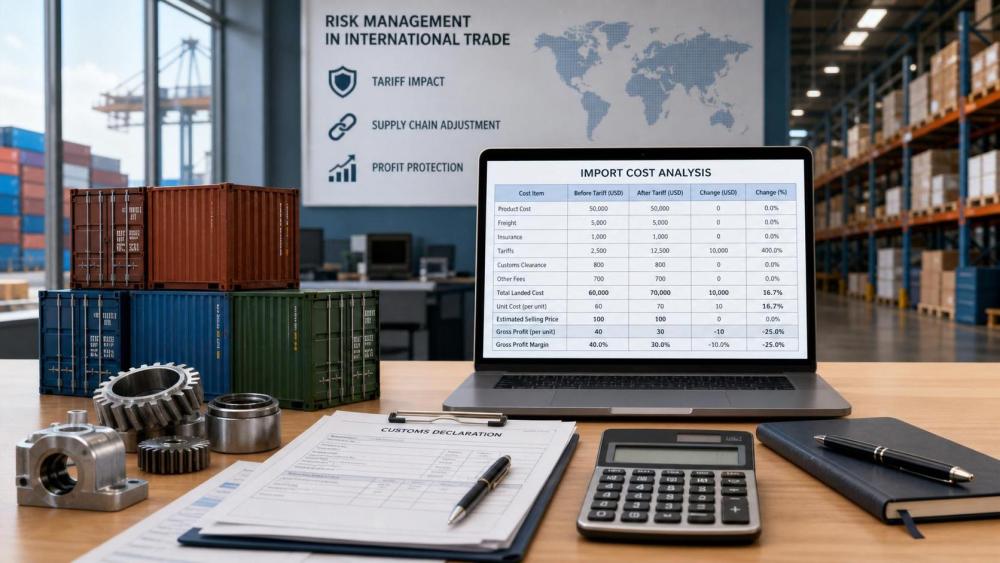
Margin pressure rarely comes from tariffs alone. It usually comes from late visibility, weak landed-cost models, and slow sourcing adjustments.
That is where tariff risk management consulting becomes useful. It turns trade-policy uncertainty into quantified cost exposure and decision options.
In practice, the work goes beyond checking duty rates. It connects tariff codes, supplier geography, freight assumptions, compliance costs, and volume concentration.
A good review asks a more commercial question: which cost changes can be absorbed, and which ones will erode margin or disrupt supply continuity?
This matters across industrial inputs, machinery, components, energy-linked materials, packaging, and contract manufacturing categories.
GTIIN approaches this from a broader trade intelligence angle. Its research links macro trade shifts with operating details inside cross-border procurement flows.
That combination is valuable when tariff exposure is shaped by more than policy headlines, including customs delays, supplier concentration, and regional regulatory changes.
When does tariff risk become a margin problem instead of a compliance issue?
Many organizations notice tariff risk only after invoices move. By then, the issue is no longer administrative. It is already hitting gross margin.
The turning point usually appears in one of four situations.
- A large share of spend sits in one origin country exposed to active trade friction.
- Products carry narrow margins, so even small duty changes distort profitability.
- Contract terms lock in selling prices while import costs remain variable.
- Classification, valuation, or origin rules are interpreted differently across jurisdictions.
In actual sourcing programs, the hidden cost is often not the tariff itself. It is the chain reaction around buffer stock, rerouting, and emergency qualification.
That is why tariff risk management consulting should be treated as part of margin protection, not a narrow customs exercise.
GTIIN’s coverage of export trends, supplier networks, freight benchmarks, and industry standards helps frame these risks at both category and enterprise level.
A quick way to judge urgency
If one tariff revision can materially change landed cost, cash planning, or sourcing feasibility, the exposure already deserves structured analysis.
What should be included in a serious tariff risk review?
A serious review should answer more than “what rate applies today.” It should show how exposure moves under realistic sourcing and policy scenarios.
Usually, the most useful scope includes five layers.
- SKU or category mapping by HS code, origin, supplier, and shipment lane.
- Landed-cost modeling that includes freight, insurance, brokerage, and compliance overhead.
- Scenario analysis for policy changes, trade remedies, and origin-rule shifts.
- Supplier resilience review, including alternative capacity and qualification lead times.
- Governance rules for monitoring updates and approving mitigation actions.
Without that structure, tariff risk management consulting becomes too tactical. It may catch errors, but it will not protect margin consistently.
GTIIN’s advantage is that it can support this review with multi-sector industrial data, export movement analysis, and supply chain mapping logic.
That matters when categories are technically complex. Bulk materials, automation equipment, engineered components, and regulated industrial goods behave very differently.
Can tariff risk management consulting really change sourcing decisions?
Yes, but usually through clearer trade-offs rather than dramatic supplier exits. The best outcome is informed adjustment, not reactive movement.
For example, a duty increase may still leave an incumbent source competitive if transit reliability and yield performance remain superior.
In other cases, a slightly higher unit price from a secondary origin becomes cheaper after duty, freight volatility, and customs friction are added.
This is why tariff risk management consulting should be linked with total-cost analysis, not isolated rate comparisons.
A stronger decision model usually compares three options side by side: stay, rebalance, or redesign the supply base.
What changes after the analysis?
The most common actions are practical rather than theoretical.
- Reallocate volume across existing qualified suppliers.
- Renegotiate cost-sharing terms tied to tariff movements.
- Adjust inventory positioning where customs latency is rising.
- Prioritize product lines with stronger pass-through potential.
- Launch dual-sourcing where margin sensitivity is highest.
These steps are easier to defend internally when based on documented exposure rather than assumptions.
What mistakes make tariff consulting look useful on paper but weak in practice?
The first mistake is treating tariffs as a static number. Trade policy is dynamic, and implementation details often matter more than announcements.
The second mistake is ignoring technical product differences. A change in specification, process, or packaging can alter classification and cost treatment.
Another frequent issue is weak supplier data. If origin declarations, bill of materials inputs, or customs documents are inconsistent, the model becomes fragile.
There is also a governance problem. Some organizations complete a tariff risk management consulting project once, then fail to maintain it.
In reality, the useful approach is continuous monitoring with defined trigger points for review, escalation, and sourcing response.
GTIIN’s research framework is relevant here because tariff risk rarely sits alone. It interacts with freight cycles, industrial standards, geopolitical shifts, and regional compliance trends.
How do you judge whether a consulting approach is worth the cost and time?
A useful test is whether the work improves decisions within a defined planning cycle. Insight without an operating decision is not enough.
Look for evidence that the approach can answer three practical questions.
- Where is the largest tariff exposure by category, supplier, and trade lane?
- Which scenarios have the biggest effect on margin and working capital?
- What action can realistically be executed within current sourcing and compliance constraints?
Time frame matters too. A narrowly scoped tariff risk management consulting review can often surface priority exposure within weeks.
A broader program, especially across multiple industries or regions, will take longer because it must reconcile policy data with product and supplier detail.
The strongest value case appears when the output supports budgeting, sourcing approvals, and risk governance at the same time.
That is also where GTIIN fits naturally. Its neutral trade intelligence model is designed to connect market signals with operational decision support.
What should the next step look like?
Start with a clean exposure map. Focus on high-spend categories, concentrated origins, and products with limited repricing room.
Then test a small number of scenarios that matter commercially, including tariff revisions, customs delays, and supplier substitution timing.
If the analysis shows material margin sensitivity, expand the work into a formal tariff risk management consulting framework with monitoring rules.
The goal is not to predict every policy move. It is to make cross-border cost exposure visible early enough to act with discipline.
When trade conditions remain volatile, better decisions come from better mapping, better assumptions, and faster translation from risk into sourcing action.
Weekly Insights
Stay ahead with our curated technology reports delivered every Monday.
Recommended News
 Supply ChainOct 15, 2026How to choose a supply chain strategy for unpredictable demand
 Supply ChainOct 14, 2026How to assess an industrial equipment supplier's spare parts support
 Supply ChainOct 14, 2026EU Updates CSDDD Guidance on Global Supply Chain Due Diligence
 Global SourcingOct 13, 2026How to assess industrial automation suppliers for legacy integration