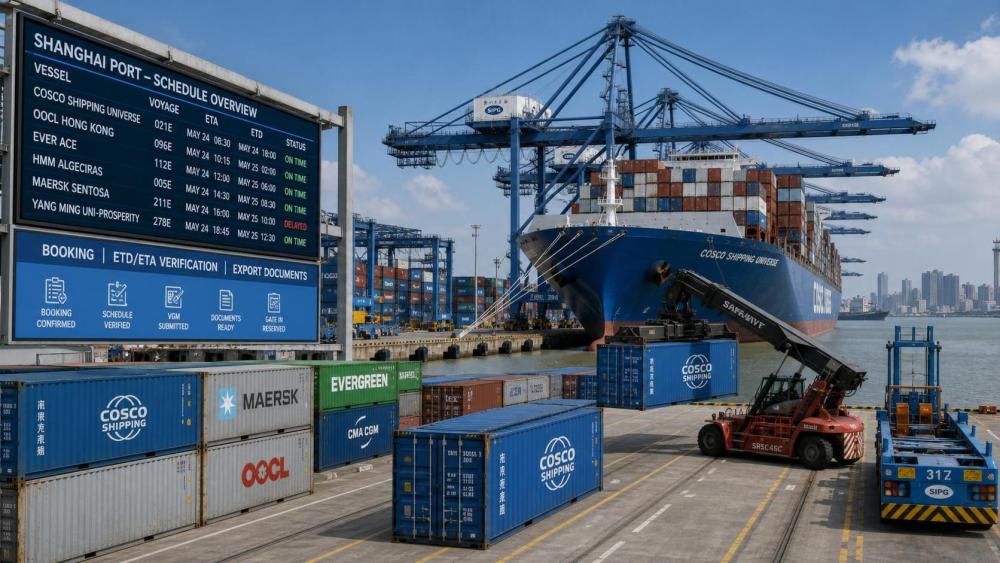
Shanghai Port Tightens ETD/ETA Checks for Exports
On July 14, 2026, Shanghai International Port Group (SIPG) began requiring real-time vessel schedule synchronization through the China Customs Single Window API for all export container bookings. The change matters well beyond port operations because any gap of more than 15 minutes between declared and actual ETD or ETA can now trigger an automatic cargo hold and priority inspection. For exporters, importers, manufacturers, buyers using just-in-time delivery, and supply chain service providers, this is worth close attention because Shanghai handles more than 68% of Asia-Europe and trans-Pacific containerized exports, turning a local control measure into a broader signal for shipment timing discipline.
What the new verification rule confirms
According to the information provided, SIPG has mandated real-time synchronization of vessel schedules for all export container bookings through the China Customs Single Window API as of July 14, 2026. The rule applies to ETD and ETA data used in export booking processes.
The confirmed enforcement threshold is also clear: when the difference between declared and actual ETD or ETA exceeds 15 minutes, the shipment is subject to automatic cargo hold and priority inspection. The information provided further indicates that this may affect lead time reliability for buyers that depend on just-in-time delivery.
It is also confirmed that more than 68% of Asia-Europe and trans-Pacific containerized exports pass through Shanghai. That scale is the key reason this development is being read as a systemic supply chain signal rather than an isolated operational adjustment.
Where the operational pressure may appear first
Exporters and trading companies face tighter timing exposure
From an industry perspective, exporters and direct trading companies may be the first group to feel the operational effect because booking declarations now need to stay aligned with live vessel schedule data. The main pressure point is not only booking submission itself, but also the consistency of timing information across documentation, internal planning, and handoff to logistics partners.
What deserves closer attention is whether shipment timing assumptions that were previously treated as manageable buffers now become compliance-sensitive data points once the 15-minute discrepancy threshold is applied.
Manufacturers and procurement teams may need to reassess lead time confidence
Analysis shows that manufacturers, especially those tied to fixed shipping windows or customer delivery commitments, may see the issue less as a customs detail and more as a delivery reliability variable. If a hold or priority inspection is triggered, the effect may appear in outbound dispatch rhythm, customer promise dates, or replenishment planning.
For procurement teams and buyers working with just-in-time models, the most relevant concern is not simply transit duration, but whether a shipment that appears booked and scheduled can still face an additional control step due to timing discrepancies.
Logistics and supply chain service providers carry a coordination burden
For freight forwarders, booking agents, and other supply chain service providers, the likely impact sits in data coordination and exception handling. Their role may become more sensitive where vessel schedule updates, booking details, and declared timing data need to remain synchronized in real time.
Observably, service quality may be judged less by standard booking execution and more by how quickly schedule discrepancies are identified and corrected before they cross the stated threshold.
What companies should monitor now
Watch for further official clarification
Companies should closely follow whether additional official wording explains operational details around synchronization, discrepancy calculation, or enforcement handling. The current information confirms the rule and the trigger threshold, but businesses still need to distinguish between the policy signal itself and any later clarification on how it is applied in daily workflows.
Review schedule data ownership across the shipment process
What deserves closer attention is who inside the shipment chain is responsible for maintaining consistency between declared ETD/ETA and actual vessel schedules. Where multiple parties touch the same booking, unclear ownership can increase the chance of timing mismatches reaching the control threshold.
Prepare customer communication around delivery reliability
For suppliers serving time-sensitive buyers, especially those using just-in-time delivery models, communication discipline becomes a practical issue. Analysis shows that even when the rule is aimed at schedule accuracy, the commercial effect may surface in customer confidence, promised delivery windows, and response expectations when a hold or priority inspection occurs.
Identify shipments and lanes with the highest timing sensitivity
Businesses should pay particular attention to export flows routed through Shanghai into Asia-Europe and trans-Pacific lanes, because the information provided indicates that Shanghai represents a very large share of containerized exports on those routes. The immediate question is not whether every shipment will be disrupted, but which shipments are least able to absorb schedule verification friction.
Why this looks bigger than a routine port procedure
Analysis shows that this development is more appropriately understood as a control signal on schedule accuracy rather than only a technical booking adjustment. The combination of real-time synchronization, a specific discrepancy threshold, and automatic enforcement consequences suggests that vessel timing data is being treated as an active compliance variable within export operations.
At the same time, it would be premature to describe the measure as a settled long-term outcome for all supply chains. Observably, the current information points to a meaningful operational change, but the full business effect will still depend on how consistently the rule is enforced in practice and how quickly market participants adapt their booking and communication processes.
How the market may best read this development
The most balanced reading at this stage is that the Shanghai port measure should be taken seriously as an immediate operational change with broader supply chain implications. It is not just a short-term headline because of Shanghai's central role in Asia-Europe and trans-Pacific container flows, yet it is also not a basis for sweeping conclusions beyond the facts provided. Current conditions make it more appropriate to understand this as a strong industry signal: timing accuracy in export booking is becoming more consequential, and shipment reliability assessments may need to account for that more explicitly.
Basis of this article and what still needs verification
This article is based on the user-provided news title, event date, and event summary concerning Shanghai Port's implementation of a real-time ETD/ETA verification system for all export containers. In this type of industry update, commonly relevant source categories may include official port notices, company announcements, customs-related notices, industry association updates, authoritative media coverage, and standard-setting or regulatory documents.
A specific official source link was not provided in the input, so the exact original document path still requires ongoing verification. Follow-up attention should focus on whether further official clarification is issued regarding enforcement practice, operational interpretation, and any adjustments affecting export booking execution through Shanghai.
Tags
Weekly Insights
Stay ahead with our curated technology reports delivered every Monday.
Recommended News
 Supply ChainOct 15, 2026How to choose a supply chain strategy for unpredictable demand
 Supply ChainOct 14, 2026How to assess an industrial equipment supplier's spare parts support
 Supply ChainOct 14, 2026EU Updates CSDDD Guidance on Global Supply Chain Due Diligence
 Global SourcingOct 13, 2026How to assess industrial automation suppliers for legacy integration