
Trade Compliance Management in North America: Common Gaps That Trigger Delays
Trade compliance management North America: why do delays still happen in well-run operations?
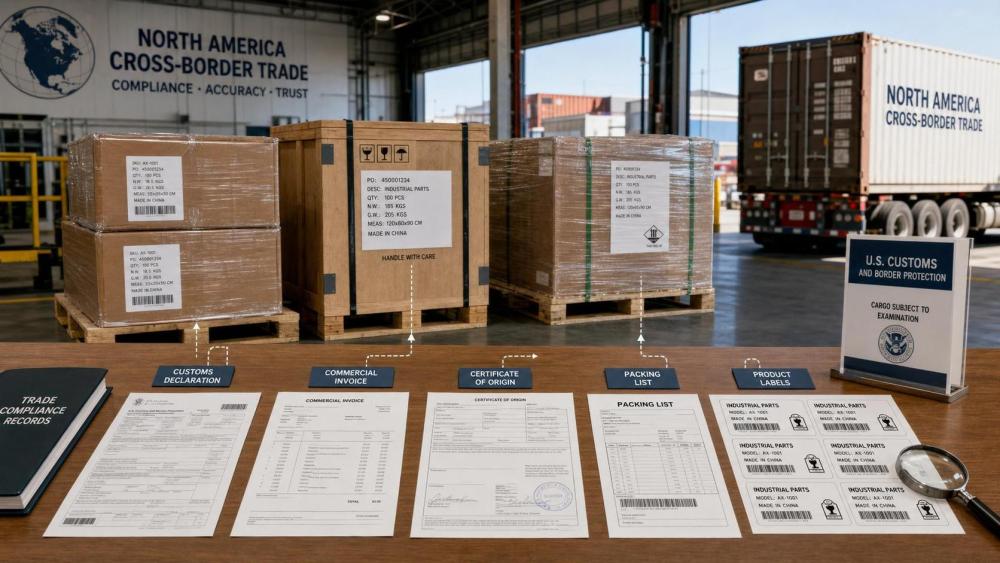
Cross-border trade in North America looks familiar on paper, yet delays often begin with small control failures.
A shipment may have the right product, but the wrong tariff code, outdated supplier declaration, or inconsistent country-of-origin record.
That is why trade compliance management North America has moved beyond customs filing alone.
It now sits close to quality controls, product traceability, safety documentation, and supplier governance.
In practice, the biggest disruptions rarely come from one dramatic violation.
More often, they come from routine gaps that no team fully owns.
GTIIN’s cross-border intelligence work often highlights this pattern across industrial sourcing, export trends, and supply chain resilience reviews.
The useful question is not whether compliance matters.
The real question is which weak points trigger inspections, document holds, and preventable border friction.
Where do the most common compliance gaps usually start?
Many teams expect problems to start at customs clearance.
In reality, the first error often appears much earlier, during sourcing, item setup, packaging review, or supplier onboarding.
Trade compliance management North America breaks down when operational data and regulatory data are stored separately.
A part description in the ERP may differ from the commercial invoice description.
A safety data sheet may be current, while the customs value support file is not.
A supplier may change a subcomponent without updating origin or material declarations.
These gaps matter because North American border agencies increasingly compare records across systems and partners.
When one field conflicts with another, the shipment looks uncertain, even if the goods are legitimate.
The most common root causes usually include:
- HTS or HS classification assigned once and never reviewed after design changes.
- Country-of-origin logic based on assumptions instead of documented transformation analysis.
- Broker instructions that do not match current invoice, packing, or valuation practice.
- Supplier certificates collected during onboarding, then left to expire quietly.
- Product compliance files and trade files managed by different owners with no shared checkpoint.
Simple controls help more than large policy binders.
A clean item master, version-controlled declarations, and periodic classification review usually remove a large share of avoidable delay risk.
Which records trigger the most scrutiny at the U.S., Canada, and Mexico border?
Some documents are checked more often because they connect duty, admissibility, and product identity.
If these records are weak, trade compliance management North America becomes reactive very quickly.
The table below helps separate routine paperwork from records that deserve tighter control.
Needless delay often begins when these records exist, but do not agree with each other.
That is especially true for industrial goods with technical specifications, mixed materials, or multi-country assembly paths.
Why do classification and origin errors keep slipping through reviews?
Because both topics look stable until the product changes in a small but meaningful way.
A revised coating, firmware-loaded module, replacement fastener, or packaging change may alter admissibility, valuation, or origin support.
Many reviews focus on the final product name, not the regulatory logic behind it.
That leaves teams vulnerable when authorities ask how the code or origin decision was reached.
A stronger trade compliance management North America process uses trigger-based review, not one-time setup.
Useful triggers include engineering changes, new suppliers, alternate factories, material substitutions, and revised transfer pricing.
In practical terms, a classification file should include enough technical detail to survive an audit.
That means composition, function, principal use, configuration, and any exclusion logic that ruled out nearby codes.
For origin, the file should show where substantial transformation occurred, or how USMCA rules were evaluated.
When this reasoning is missing, teams end up defending a result without evidence.
How should quality, safety, and trade records work together instead of in parallel?
This is where many operations can improve quickly.
Product quality files often contain the exact technical facts that trade files need, but the records are rarely linked.
A material change notice, for example, may affect restricted substance declarations, tariff code logic, and origin status at the same time.
If only one control stream is updated, the shipment becomes inconsistent.
GTIIN’s broader supply chain mapping perspective is useful here.
It treats compliance, sourcing, logistics, and industrial specifications as connected data, not separate reporting layers.
A workable internal model usually includes three linked checkpoints:
- Before approval: confirm technical description, composition, and intended use are complete enough for classification.
- Before supplier release: collect origin, declaration, and certificate evidence in one controlled record set.
- Before shipment: verify invoice data, labels, quantities, and broker instructions against the current revision.
This approach reduces rework because it catches trade issues while product data is still being reviewed anyway.
What does a realistic improvement plan look like without overbuilding the process?
The best answer is usually modest and disciplined.
Trade compliance management North America improves faster through targeted controls than through a major system project alone.
Start with the lanes, products, and suppliers that already create the most exceptions.
Look for repeat holds, broker clarifications, missing certificates, and invoice corrections.
Those are useful signals because they show where process friction is already visible.
A practical first-stage plan often includes:
- Build a controlled list of high-risk SKUs and review their classification support files.
- Set expiry tracking for supplier declarations, origin evidence, and free trade support records.
- Create one standard for invoice description quality and quantity units.
- Define when engineering or sourcing changes must trigger trade review.
- Measure border delay reasons, not just total transit time.
From there, the next step is to compare internal data with external reality.
Regional customs latency, regulatory shifts, and supplier-country risk patterns matter, especially when sourcing strategies are changing.
That is where independent trade intelligence becomes valuable.
Not as promotion, but as a decision layer that helps connect documentation quality with actual border performance.
What should be reviewed next if delays are already happening?
Begin with evidence, not assumptions.
Review a sample of delayed entries and map each one to the missing or conflicting record.
If the same defect appears across multiple shipments, fix the source record, not only the shipment-level error.
In many cases, the fastest gains come from tighter control over item data, origin support, and broker-facing instructions.
That is the core of effective trade compliance management North America.
It is less about adding paperwork and more about making trade, quality, and safety records tell the same story.
A useful next move is to rank shipments by delay frequency, duty exposure, and documentation volatility.
Then set a review standard for the records that drive those risks.
When the underlying files are consistent, border clearance usually becomes more predictable, and supply continuity becomes easier to defend.
Have questions about this sector analysis, or seeking best practices specific to your niche? Drop us a line below and let the senior consultants at GTIIN assist you.
“We respect your privacy. Your information is strictly confidential.”
Weekly Insights
Stay ahead with our curated technology reports delivered every Monday.
Recommended News
 Supply ChainNov 10, 2026China Extends Pause on 24% Additional Tariff on US Goods by Two Months
 Industry StandardsNov 10, 2026Which imports are subject to EU carbon border compliance?
 Global SourcingNov 09, 2026USTR Extends 178 China Section 301 Tariff Exclusions to January 2027
 Supply ChainNov 09, 2026How can a tariff risk management dashboard track cost exposure?



