Commodity Logistics Europe: Cost Drivers and Route Risks in 2026
Commodity logistics Europe enters 2026 under pressure from several directions at once. Ocean freight remains uneven, inland networks stay constrained, and carbon-linked compliance is becoming a real cost layer rather than a policy footnote.
That combination matters because European commodity trade depends on timing, route flexibility, and predictable landed cost. When one link weakens, margin assumptions, sourcing feasibility, and service reliability can shift quickly across metals, energy inputs, chemicals, grains, and industrial raw materials.
For firms evaluating cross-border flows, commodity logistics Europe is no longer just a transport topic. It is a decision framework that connects freight economics, regulatory exposure, infrastructure capacity, and resilience planning.
Why 2026 looks different
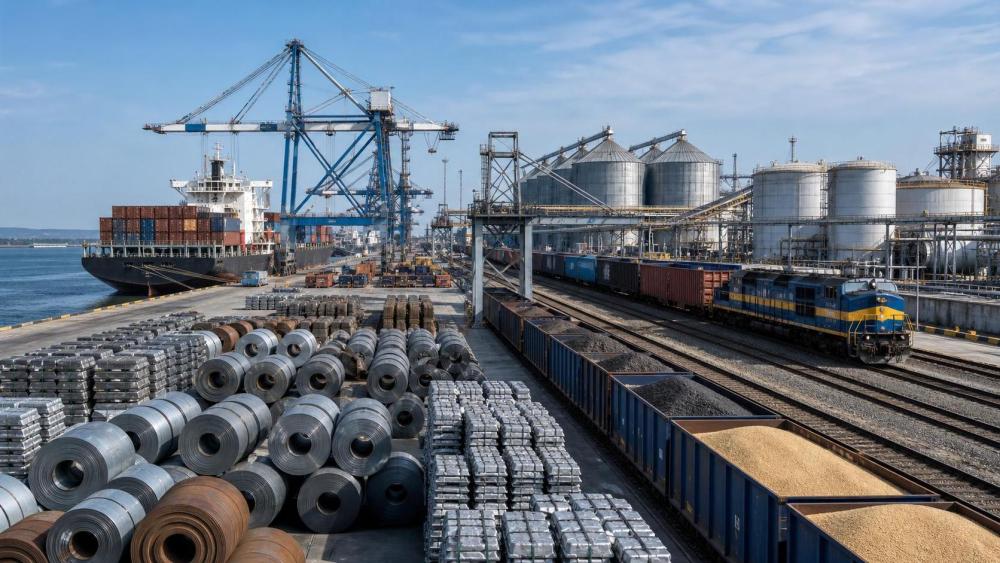
The European market is not facing a single disruption. It is dealing with layered volatility that accumulates across ports, rail corridors, barge systems, roads, terminals, customs procedures, and emissions reporting requirements.
In practical terms, commodity logistics Europe in 2026 will be shaped by four forces. Freight rate swings affect shipment economics. Carbon regulation changes cost attribution. Inland bottlenecks weaken schedule reliability. Geopolitical friction raises route uncertainty.
The effect is uneven by commodity class. Bulk, breakbulk, liquid, and containerized industrial inputs do not absorb disruption in the same way. High-volume, low-margin cargoes are usually the most exposed to small cost increases.
This is also why intelligence depth matters. GTIIN’s trade monitoring model is useful in this setting because route conditions cannot be read from headline freight indices alone. Cost behavior often changes at the corridor, terminal, and compliance level.
What commodity logistics Europe really includes
The phrase covers more than seaborne delivery into Europe. It includes the full movement chain from export origin to inland receiving point, including port handling, storage, customs, transfer, and final industrial distribution.
For many commodity trades, the critical cost is not the headline ocean leg. It is the cumulative expense created by demurrage risk, transshipment delay, rail slot scarcity, truck capacity shortages, energy prices, and compliance administration.
That is why two suppliers with similar FOB pricing can produce very different delivered outcomes. The lower quoted source may become less competitive once the European logistics chain is stress-tested under realistic operating conditions.
A corridor view is more useful than a country view
European logistics performance is rarely uniform within national borders. Northern ports, Adriatic gateways, Iberian terminals, Rhine-linked corridors, and Central European rail nodes each carry different risk profiles.
A country may look stable on paper while a specific corridor remains fragile. Business evaluation improves when analysis focuses on actual cargo pathways rather than broad geographic assumptions.
The main cost drivers behind 2026 decisions
Several cost elements now deserve direct attention during sourcing review, contract design, and route planning. They interact with each other, which means a modest shift in one area can amplify another.
Among these, carbon-linked cost treatment deserves extra scrutiny. In commodity logistics Europe, compliance can influence supplier choice, routing sequence, and inventory timing, especially where documentation quality differs across origin markets.
Fuel and energy also remain important. They shape vessel operating costs, trucking rates, warehousing charges, and terminal economics. Even if freight benchmarks soften, energy-linked expenses may keep delivered cost elevated.
Route risk is becoming a board-level issue
Route risk used to be discussed mainly during exceptional disruption. In 2026, it needs to sit inside normal commercial evaluation because volatility has become more structural than temporary.
Port congestion remains one risk source, but not the only one. Low river levels, labor actions, sanctions spillover, customs frictions, infrastructure maintenance, and security detours can all slow commodity logistics Europe.
The challenge is that route risk rarely appears as a single event. It shows up as compounding delay. A missed berth causes inland rescheduling. Inland rescheduling triggers storage cost. Storage cost then pushes inventory imbalance.
Where disruption tends to surface first
- Gateway ports handling mixed bulk and container pressure
- Rail-linked industrial corridors with limited fallback capacity
- River-dependent cargo chains exposed to weather variability
- Border crossings where documentation quality is inconsistent
- Routes vulnerable to wider geopolitical rerouting patterns
This is where GTIIN-style supply chain mapping adds value. A route is not only a line on a map. It is a stack of operational dependencies, each with different tolerance for delay, compliance failure, and cost escalation.
How these pressures affect actual business decisions
Commodity logistics Europe influences far more than transport budgeting. It affects sourcing strategy, working capital, price negotiation, customer commitments, and plant continuity assumptions.
For example, a route with lower nominal freight may still be inferior if it creates unstable lead times. In sectors dependent on steady feedstock availability, schedule reliability can be worth more than a narrow freight saving.
Another common issue is overreliance on average cost. Average cost hides peak-period exposure. Evaluation should test cost and lead time under stressed conditions, not just under normal operating weeks.
This matters especially in Europe, where regional infrastructure quality is high overall but uneven in operating resilience. Strong headline connectivity does not guarantee stable commodity movement under disruption.
Useful questions during assessment
- What share of delivered cost is variable rather than contractually fixed?
- Which route segment has the lowest recovery capacity after delay?
- How quickly can cargo shift from rail to truck or from one port to another?
- Are carbon and customs data complete enough for audit-level review?
- What is the realistic cost of one week of disruption?
A practical way to read the market
The most effective approach combines market intelligence with corridor-specific validation. Broad trade trends show direction, but route-level evidence shows whether an option is workable.
That is why integrated platforms such as GTIIN matter in the current environment. Commodity logistics Europe now requires joined-up analysis across freight benchmarks, policy change, industrial demand, and transport execution.
A practical review often includes three layers. First, compare landed cost under multiple freight and surcharge scenarios. Second, test route continuity under disruption. Third, examine whether documentation and compliance standards are origin-consistent.
Simple sourcing comparisons are less reliable than they were a few years ago. The stronger method is to compare supply options as operating systems, not just as quoted prices.
What to monitor next
The near-term outlook for commodity logistics Europe will depend on how four signals evolve. Freight market stability is one. Carbon cost interpretation is another. Inland capacity utilization remains critical. Geopolitical rerouting risk stays firmly on the watchlist.
It is sensible to keep a short review cycle rather than a static annual assumption set. Conditions can change quickly enough that a route judged efficient in one quarter may become exposed in the next.
A useful next step is to map the top commodity lanes by delivered-cost sensitivity, then rank them by disruption impact and recovery options. That creates a clearer basis for supplier comparison, contract design, and contingency planning.
In 2026, the strongest decisions in commodity logistics Europe will come from disciplined comparison, not broad assumptions. Cost, compliance, and route resilience now need to be judged together.
Weekly Insights
Stay ahead with our curated technology reports delivered every Monday.
Recommended News
 Supply ChainOct 15, 2026How to choose a supply chain strategy for unpredictable demand
 Supply ChainOct 14, 2026How to assess an industrial equipment supplier's spare parts support
 Supply ChainOct 14, 2026EU Updates CSDDD Guidance on Global Supply Chain Due Diligence
 Global SourcingOct 13, 2026How to assess industrial automation suppliers for legacy integration