Sanctions Compliance Requirements: Key Checks to Avoid Trade Violations
Why are sanctions compliance requirements now a board-level trade issue?
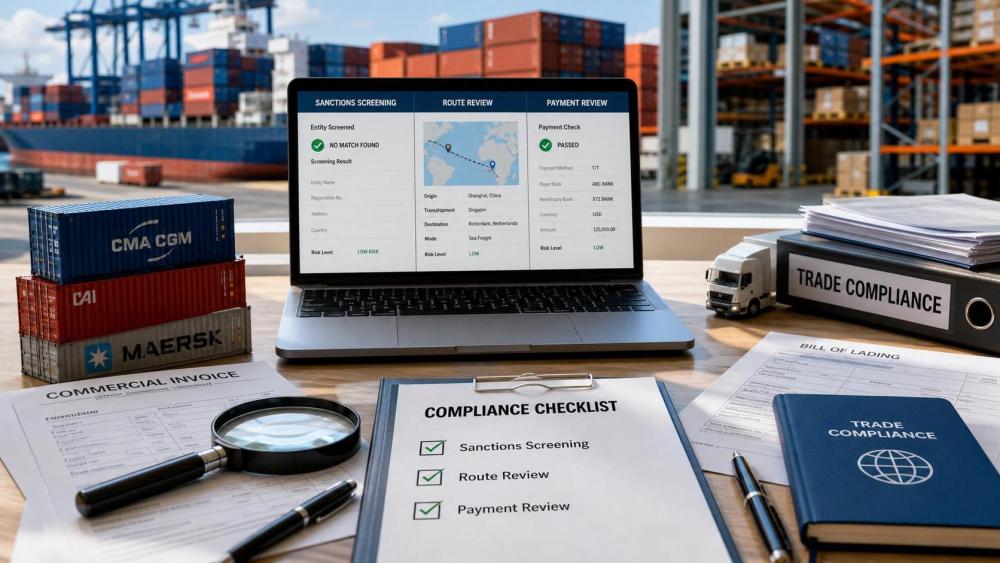
Sanctions compliance requirements have moved far beyond legal fine print. They now affect routing, payment release, customs clearance, insurance access, and supplier continuity.
A single missed screening result can freeze a shipment mid-transit. In some cases, the commercial loss appears before any regulator makes contact.
That is why many cross-border operations treat sanctions checks as a transaction control, not just a policy statement.
The pressure is practical. Restricted party lists change quickly. Ownership structures are opaque. Product end use can shift after a quotation is issued.
In heavy industry, bulk commodities, equipment sourcing, and multi-country fulfillment, exposure often sits across several touchpoints at once.
GTIIN’s trade intelligence perspective is useful here. Sanctions risk rarely appears in isolation. It usually intersects with freight routes, export trends, and industrial sourcing decisions.
A workable compliance program therefore needs to connect market intelligence with operational controls. That is the real meaning of meeting sanctions compliance requirements today.
What do sanctions compliance requirements actually cover in daily trade operations?
Many teams assume sanctions apply only to obvious embargoed countries. In practice, the scope is wider and more technical.
Sanctions compliance requirements usually cover five layers of review:
- Who the counterparty is, including aliases, local names, and ultimate beneficial owners.
- Where goods are shipped, transshipped, financed, or stored.
- What the product is, especially if it has dual-use, controlled, or sensitive industrial applications.
- How the transaction is funded, insured, or settled across banks and intermediaries.
- Why the goods are being used, including the declared end user and end use.
This is where companies often underestimate complexity. A customer may pass name screening, while the vessel, financing bank, or end-use destination triggers a different issue.
In industrial trade, product context matters even more. The same valve, alloy, sensor, or automation component may carry different risk depending on application.
That is why sanctions compliance requirements should be embedded into quoting, onboarding, shipping, and payment review, rather than left for a final export check.
Which checks matter most before goods move or money changes hands?
The most effective programs rely on a short list of high-value checks. They are not glamorous, but they prevent most avoidable trade violations.
1. Restricted party screening
Screen all relevant names, not only the direct buyer. Include parent entities, consignees, notify parties, freight forwarders, banks, and known owners.
Rescreen when shipment details change. A clean result at onboarding is not enough for a transaction shipped weeks later.
2. Ownership and control review
Some sanctions rules capture entities owned or controlled by blocked persons, even when the entity itself is not listed by name.
This check is especially important in markets where holding structures, nominee arrangements, and state-linked ownership are common.
3. Destination and routing validation
Review final destination, transit hubs, free trade zones, and vessel history where relevant. Diversion risk often sits in the route, not the invoice.
4. Product and end-use assessment
Check whether the item supports restricted sectors, military-linked projects, energy extraction controls, or prohibited industrial applications.
5. Payment path review
A deal can fail at the banking stage even after the shipment is packed. Confirm banks, currencies, intermediaries, and document consistency early.
These checks work best when documented in a repeatable review trail. Regulators usually care not only about the result, but also about the decision process.
How can you tell whether a transaction needs standard screening or deeper review?
Not every transaction carries the same exposure. A practical model separates low-friction orders from cases that need escalation.
The table below helps frame that judgment.
This kind of decision table helps teams avoid two common mistakes. One is over-screening low-risk orders until operations slow down. The other is waving through high-risk exceptions because the paperwork looks familiar.
In practice, stronger sanctions compliance requirements rely on escalation thresholds that are simple enough to use during live transactions.
Where do companies usually fail even when they already have a sanctions policy?
The policy itself is rarely the weak point. The gap is usually between written rules and trade execution.
Several failure patterns appear again and again:
- Screening only at onboarding, then never again before shipment or payment.
- Reviewing the buyer but ignoring vessel operators, intermediaries, and beneficial owners.
- Treating product classification as a customs issue only, without sanctions relevance.
- Accepting incomplete end-use statements for technically sensitive equipment.
- Leaving compliance decisions undocumented, which makes internal review impossible later.
Another frequent problem is fragmented information. Sales records, logistics data, supplier files, and payment instructions often sit in separate systems.
That fragmentation matters because sanctions compliance requirements are evidence-based. A risk signal only becomes visible when those records are connected.
This is one reason trade intelligence platforms matter. GTIIN’s cross-border lens, especially around supply chain mapping and industrial risk context, supports earlier identification of routing, sector, and counterparty anomalies.
What does a practical sanctions compliance workflow look like?
A useful workflow is usually shorter than expected. The goal is consistent control, not procedural theater.
Build the process around transaction stages
Start with counterparty onboarding. Then add review points at quotation, order acceptance, pre-shipment, and pre-payment release.
Define escalation triggers in advance
Do not leave difficult calls to improvisation. Set clear rules for ownership red flags, route changes, sensitive products, and third-party payments.
Keep evidence with the transaction file
Store screening results, ownership notes, end-use documents, and approval records together. This shortens audits and reduces repeat work.
Use external intelligence where internal visibility is weak
That includes regulatory updates, sector-specific exposure signals, freight pattern changes, and geopolitical developments affecting industrial corridors.
Sanctions compliance requirements are easier to manage when legal review, operations, and market intelligence use the same risk language.
So what should be reviewed next if controls already exist?
The first question is not whether a policy exists. It is whether the current controls can catch real transaction changes in time.
Review where sanctions compliance requirements meet live operations: name screening refresh cycles, ownership checks, route validation, product sensitivity review, and payment-path approval.
Then test the process against recent orders. Look for cases with rerouted shipments, revised consignees, urgent banking changes, or technically sensitive items.
A mature program is not the one with the longest manual. It is the one that can explain, document, and defend each trade decision under changing conditions.
For ongoing cross-border exposure, the next sensible step is to align compliance review with broader trade intelligence. That includes watching regulatory shifts, supplier structure changes, and route-level risk signals before they turn into violations.
Weekly Insights
Stay ahead with our curated technology reports delivered every Monday.
Recommended News
 Supply ChainOct 15, 2026How to choose a supply chain strategy for unpredictable demand
 Supply ChainOct 14, 2026How to assess an industrial equipment supplier's spare parts support
 Supply ChainOct 14, 2026EU Updates CSDDD Guidance on Global Supply Chain Due Diligence
 Global SourcingOct 13, 2026How to assess industrial automation suppliers for legacy integration