Can forecasting solutions reduce stockouts without excess inventory?
Can supply chain forecasting solutions minimize out-of-stocks and excess inventory at the same time? In a stable domestic replenishment model, the answer may look straightforward: improve the forecast, calculate safety stock, and issue purchase orders earlier. In global industrial supply chains, that logic breaks down quickly. A forecast can be statistically sound and still fail operationally because the supplier has allocated capacity elsewhere, a vessel schedule has slipped, a customs inspection has added days, or a critical component has a different usable lead time than the ERP master data suggests.
The useful question is not whether a platform can generate a better demand number. It is whether it can turn uncertain demand, supply, and logistics conditions into decisions that planners can defend: what to buy, when to buy it, where to position it, which items deserve protection, and when inventory should not be increased despite a rising risk signal.
For technical evaluation teams, that distinction matters. Many tools can produce dashboards and forecast accuracy reports. Fewer can connect an evolving demand forecast to real constraints across suppliers, trade lanes, product structures, inventory policies, and service commitments. That connection is where stockout prevention either becomes disciplined inventory management or turns into an expensive buildup of precautionary stock.
Why better demand forecasts alone do not solve stockouts
Stockouts are often described as a demand-planning failure, but that is only part of the story. In industrial procurement, an item may run out because demand rose unexpectedly. It may also run out because a supplier’s quoted lead time no longer reflects actual production release, because a port congestion event interrupted a normally reliable lane, or because inventory is physically available but held in the wrong region, quality status, or packaging configuration.
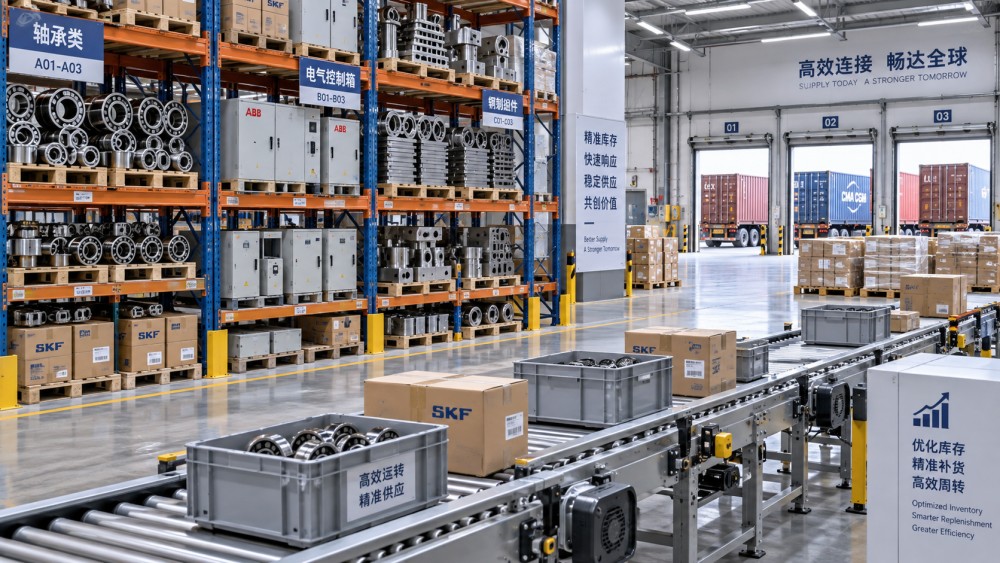
Consider a manufacturer sourcing specialized bearings, electrical controls, and fabricated steel assemblies from different countries. The demand signal for a finished machine may be reasonably clear. Yet each component has its own production cycle, minimum order constraints, transport mode, inspection exposure, and substitution limitations. Applying one blanket safety-stock rule to all three may prevent some shortages, but it also locks cash into slow-moving material that cannot be redeployed easily.
That is why supply chain forecasting solutions should be assessed as decision systems rather than demand engines. The platform needs to model uncertainty where it actually occurs. A demand forecast without lead-time variability is incomplete. A lead-time estimate without supplier capacity context is incomplete. An inventory recommendation that ignores service criticality is usually misleading.
The practical objective is not “zero stockouts” at any cost. It is to protect the items and locations where a shortage has material operational consequences, while allowing less critical or more substitutable items to follow leaner policies. That requires segmentation based on more than annual spend or sales volume.
The balancing mechanism: forecast, supply risk, and inventory policy must operate together
A mature planning environment treats inventory as a response to uncertainty, not as a default insurance policy. The quantity held should reflect the uncertainty of demand during replenishment, but also the organization’s chosen service policy and ability to act when conditions change.
For example, a low-volume replacement part with an 18-month procurement cycle may deserve a different rule from a high-volume consumable sourced from multiple qualified suppliers. The first may warrant strategic coverage even when the forecast is weak; the second may be replenished frequently with less buffer if supply remains flexible. Neither decision is purely mathematical. It depends on engineering interchangeability, contract terms, customer downtime exposure, shelf life, storage conditions, and the cost of expedited freight.
The best systems make these trade-offs visible. Instead of presenting a single recommended order quantity as if it were unquestionable, they should show the assumptions behind it: forecast range, expected receipt date, supplier reliability history where available, stock already in transit, open orders, and the impact of alternative service levels. Planners need a model that can be challenged, not a black box that simply replaces one spreadsheet with another.
The inputs that deserve more scrutiny than forecast accuracy
Forecast accuracy remains relevant, particularly for stable, high-volume demand. But during solution selection, technical teams should spend equal time examining the quality and timing of supply-side inputs. In cross-border networks, those inputs often determine whether a forecast can be executed.
- Lead-time distribution rather than a single lead-time field. An average transit or supplier lead time can conceal the disruptions that cause shortages. The platform should be able to work with variable lead times and distinguish production, origin handling, ocean or air transit, customs clearance, and final delivery where data supports that level of detail.
- Order constraints. Minimum order quantities, order multiples, container utilization, batch sizes, and supplier allocation limits can materially alter the recommended replenishment plan. If these are handled outside the system, users will keep overriding its output.
- Usable inventory status. Quantity on hand is not always available quantity. Material under quality inspection, reserved for a regulated customer, awaiting repackaging, or located in the wrong legal entity should not be treated as freely deployable stock.
- Demand hierarchy and exceptions. A solution should reconcile product, site, customer, and regional views without forcing planners to choose one level as the only truth. It should also separate an actual demand shift from a temporary order spike or project-specific pull-forward.
- External signals with a clear decision path. Commodity prices, freight movements, trade restrictions, weather, currency changes, and regulatory developments can be useful signals. They are not useful merely because they appear on a dashboard; the system needs defined rules for how they alter scenarios or trigger review.
The phrase supply chain forecasting solutions minimize out-of-stocks excess inventory is therefore only credible when the solution can deal with these operational details. A platform that forecasts demand elegantly but cannot represent supplier constraints may improve reporting while leaving the real replenishment problem untouched.
Where inventory optimization commonly goes wrong
One recurring mistake is applying a universal service target. It sounds disciplined to require the same fill-rate expectation across all SKUs, but it often produces the wrong stock profile. Critical spare parts, high-margin configured products, safety-related materials, and basic consumables do not carry the same shortage consequence. A uniform target can overprotect easy-to-buy inventory while underprotecting genuinely disruptive items.
Another mistake is treating forecast error as the only uncertainty. In international procurement, an apparently predictable SKU can still become risky when the source country changes export procedures, a supplier’s input material becomes constrained, or a preferred shipping lane becomes unreliable. Inventory policy must be reviewed when the supply network changes—not only when the demand model reports weak accuracy.
There is also a governance problem. Many planning teams have access to a sophisticated recommendation engine but retain static reorder points because no one trusts the exception logic. That lack of trust is usually earned. If the recommendation cannot explain why it has changed, which input triggered the change, and what service or cash trade-off follows, planners will revert to manual buffers. The result is a system of record with a shadow planning process beside it.
Technical evaluation should therefore include explainability as a functional requirement. Users should be able to trace a proposed action back to source data, policy settings, and assumptions. In regulated, engineered, or high-value supply chains, auditability is not an optional interface feature; it is part of operational control.
What to test during solution selection
A proof of concept should not be limited to importing clean historical sales data and comparing forecast error. That test often favors the tool with the most polished algorithm while avoiding the conditions that create inventory pain. A more revealing evaluation uses a representative slice of the network: stable and intermittent demand, long-lead imported components, constrained suppliers, multiple stocking locations, and at least one product family with known substitutions or engineering dependencies.
Ask the vendor to model a late supplier confirmation, a longer customs release, a demand increase at one regional distribution center, and a transportation disruption on a major lane. Then assess whether the system simply flags the problem or produces ranked, feasible response options. Can it recommend inventory rebalancing before it proposes an emergency purchase? Can it distinguish a transfer that is physically possible from one that is commercially or quality-wise permitted? Can it show the cash and service implications of buying earlier versus expediting later?
Integration architecture deserves careful attention as well. Real-time feeds are valuable only where the decision cadence can use them. A weekly planning cycle may not benefit from minute-by-minute data on all SKUs, while a control-tower workflow for scarce components may require near-real-time shipment milestones. The right design is selective: refresh the inputs that change decisions, and do not create noise simply because data is available.
External intelligence should sharpen decisions, not overwhelm them
Global supply networks increasingly need context that does not live in an internal ERP system. Freight-rate movements, export trends, country-specific trade measures, commodity availability, industrial capacity additions, and changing compliance expectations can affect replenishment well before a purchase order is visibly late.
This is where independent trade intelligence can support the planning process. GTIIN’s work across global sourcing, supply chain resilience, market trends, and industry standards reflects a practical need seen across industrial networks: planners require external signals that can be connected to physical supply chain realities. A change in an export market, a shift in ocean transit reliability, or a new compliance burden does not automatically justify higher inventory. It does justify reviewing assumptions for exposed materials, lanes, and suppliers.
A full-dimensional supply chain view is particularly useful when companies source across multiple industrial categories. Material characteristics, packaging requirements, customs latency, and transportation options may differ substantially between precision equipment, bulk inputs, and engineered assemblies. The planning platform should accommodate those differences rather than flatten them into a generic lead-time factor.
The decision is less about prediction than controlled response
Forecasting solutions can reduce stockouts without creating excess inventory, but only when they are deployed with realistic policies, credible supply data, and clear human ownership. They do not remove uncertainty. They help teams decide where uncertainty is worth buffering, where it can be managed through supplier action or reallocation, and where the commercial risk does not justify additional stock.
Before selecting a platform, define the decisions it must improve—not just the reports it must produce. Test it against delayed shipments, supply allocations, long-tail demand, quality holds, and location imbalance. If it can make those situations more visible, more explainable, and more actionable, it has a credible path to improving service without letting working capital drift into surplus inventory.
Weekly Insights
Stay ahead with our curated technology reports delivered every Monday.
Recommended News
 Market TrendsSep 28, 2026What freight market insights reveal about carrier capacity shifts
 Supply ChainSep 27, 2026How importers can reduce customs delays through trade compliance
 Market TrendsSep 25, 2026Which industrial market research trends signal a shift in demand?
 Supply ChainSep 24, 2026How trade compliance screening prevents costly shipment delays