
How to build a supplier risk assessment matrix that flags critical risks
A supplier can pass an onboarding audit and still become the source of a serious disruption months later. A batch may begin to show inconsistent test results, a safety certificate may approach expiry, a key sub-tier supplier may be located in a restricted region, or delivery dates may slip just as production demand rises. When these signals sit in separate spreadsheets, emails, and audit files, teams often react only after the issue affects incoming quality, worker safety, regulatory status, or customer commitments.
A supplier risk assessment matrix solves this by converting scattered evidence into a consistent priority system. The goal is not to label every supplier as simply “good” or “bad.” It is to identify which risks have a realistic path to causing severe harm, decide who owns the response, and distinguish routine monitoring from immediate escalation. A practical matrix combines likelihood, impact, control strength, and the supplier’s ability to recover.
Start with the decision the matrix must support
Before assigning scores, define what the matrix is meant to trigger. A matrix built only for annual supplier reviews will use different thresholds from one used to protect a safety-critical production line. Quality and safety teams should agree on the decisions that follow each rating, such as whether a supplier can be approved, needs a corrective action plan, requires increased inspection, or should be blocked from new orders.
It helps to set the scope at the supplier-site or supplier-material level rather than relying only on a company-wide rating. A manufacturer may operate several facilities with different process controls, certifications, subcontracting practices, or transport routes. Likewise, one supplier may provide a low-consequence consumable and a highly regulated component. Treating both supplies as equal can hide the actual exposure.
At minimum, define:
- the supplier, site, product family, or service being assessed;
- the business process affected, such as incoming materials, contract manufacturing, warehousing, or calibration services;
- the risk owner responsible for maintaining evidence and initiating action;
- the rating period and review frequency;
- the thresholds for normal monitoring, mitigation, management review, and stop-use escalation.
Clear decisions prevent a common failure: building a detailed scorecard that nobody uses because its scores have no operational consequence.
Build risk categories around failure modes, not generic labels
Broad headings such as “supplier quality” or “supply chain risk” are useful, but they are too vague for scoring. Each category should describe what could fail, what evidence would reveal the weakness, and what the organization would lose if it occurred. The matrix becomes more reliable when quality, safety, compliance, continuity, and commercial exposure are separated before they are combined.
Not every category carries equal weight. A supplier of protective equipment, food-contact materials, electrical components, or hazardous chemicals may require a heavier safety and compliance weighting than a supplier of noncritical packaging. The weighting should reflect the consequence of failure in the actual application, not the size of the purchase order.
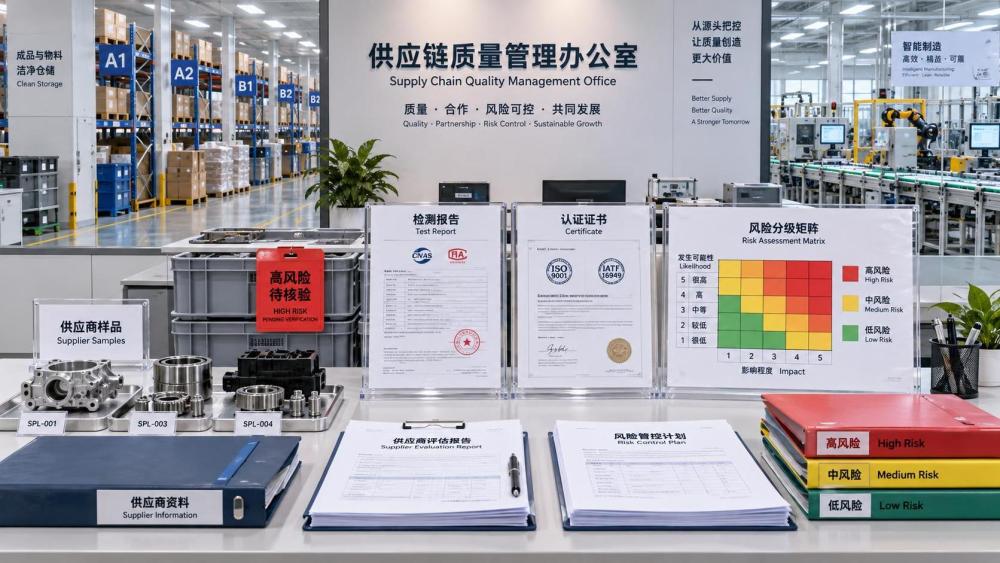
Use scoring scales that people can apply consistently
A five-point scale is usually detailed enough without suggesting false precision. The important part is writing score definitions that describe observable conditions. “High risk” is not a definition; “repeated major nonconformities without verified corrective action” is one.
Score likelihood based on the chance that the specific failure mode will occur during the review period. Consider trend direction, process complexity, previous deviations, reliance on manual controls, supplier responsiveness, and changes in materials or production conditions. A low likelihood score should require evidence of stable, effective controls, not merely the absence of reported incidents.
Score impact based on the credible worst consequence if the failure reaches your organization. Effects may include product recall exposure, worker injury potential, legal noncompliance, production stoppage, inability to ship, major rework, or loss of traceability. Impact should remain high for a safety-critical item even when the supplier’s recent performance looks good. Good performance lowers likelihood; it does not reduce the inherent consequence of a failed part.
Add a separate score for control effectiveness. This is where many matrices become more useful than a simple likelihood-times-impact chart. Two suppliers can have the same inherent risk, while one has validated process controls, documented change management, tested contingency plans, and timely corrective actions. The other may rely on informal assurances. Control effectiveness measures the confidence that a risk will be prevented or detected before harm occurs.
A workable scoring approach can use:
- Likelihood: 1 for rare and well-controlled conditions through 5 for recurring, emerging, or poorly understood exposure.
- Impact: 1 for limited operational inconvenience through 5 for serious safety, regulatory, or continuity consequences.
- Control weakness: 1 when controls are evidenced and effective through 5 when controls are absent, unverified, or repeatedly ineffective.
One formula is to multiply likelihood by impact, then increase the resulting priority where controls are weak. Another option is to use a heat map for inherent risk and a separate residual-risk rating after mitigation. Whichever method is chosen, retain the individual component scores. A total score alone cannot show whether a supplier is risky because the consequence is severe, because failures are frequent, or because assurance is poor.
Set red-flag rules that override the arithmetic
Not every critical condition should wait for a high calculated score. A matrix is a decision aid, not permission to average away an unacceptable issue. Predefine “automatic escalation” conditions that place a supplier or supplied item into the highest review category regardless of its composite rating.
Examples may include expired mandatory certification where certification is required for use, evidence of falsified traceability documents, an unresolved safety-related nonconformity, unauthorized process or material substitution, a confirmed regulatory restriction, or loss of a sole-source production capability. The exact triggers depend on the product and jurisdiction, but the principle is consistent: certain failures have such high consequence that they demand immediate containment and verification.
For each red flag, specify the first action. It might be quarantine of affected stock, temporary enhanced inspection, suspension of new releases, document verification, a controlled deviation review, or activation of an alternate source. Avoid vague instructions such as “monitor closely.” The person receiving the alert should know what must happen before the next shipment is accepted or used.
Map evidence to each score before holding a review meeting
Risk discussions can become subjective when participants arrive with impressions rather than evidence. Prepare a short evidence pack for every material supplier under review. This does not need to be burdensome; it should bring together the records already generated by quality, procurement, logistics, safety, and operations.
Incoming defect trends, missed delivery patterns, corrective action aging, audit observations, certificate validity, complaint signals, change notifications, and supply-route dependencies should be visible in one place. Date each item and identify whether it is verified, supplier-reported, or inferred from a known dependency. An unverified statement should not be treated as proof of a control.
Separate historical performance from forward-looking exposure. A supplier may have perfect recent delivery but still depend on one vulnerable port, one specialized processor, or one unapproved subcontractor. Conversely, a past defect may have been contained by a corrective action that has been verified over subsequent lots. The matrix should show both the past event and the current residual risk, rather than permanently punishing or prematurely clearing the supplier.
Turn the matrix into different actions for different risk bands
A color-coded grid is useful only when each color leads to a proportionate response. Low-risk suppliers generally need routine performance monitoring and document renewal checks. Moderate risks should have a named mitigation action, due date, and evidence requirement. High risks need management visibility, more frequent review, and a plan that reduces the specific exposure rather than merely requesting reassurance from the supplier.
Critical risks require containment and a decision on continued supply. Depending on the situation, that may involve qualified alternative sources, revised inspection controls, controlled inventory allocation, technical requalification, or suspension until the supplier demonstrates effective correction. Quality and safety personnel should not be left to carry this decision alone when operational continuity, legal exposure, and commercial consequences are involved.
Assign each action to an owner on both sides where appropriate. “Supplier to improve quality” is not actionable. “Supplier to submit root-cause analysis for recurring labeling mismatch; internal quality team to verify first subsequent lots against revised control plan” can be tracked and closed. Define what evidence closes the action: revised procedure, validated test result, audit verification, updated declaration, successful trial shipment, or confirmed alternate-source qualification.
Review changes, not only scheduled dates
Annual reassessment is often too slow for volatile supply conditions. Keep the full review cycle proportionate to risk, but require an out-of-cycle reassessment when a meaningful change occurs. Triggers can include a change in manufacturing site, ownership, key raw material, transport route, safety incident, regulatory status, subcontractor, capacity commitment, or product specification.
Change notification clauses are valuable only when internal teams have a route for acting on them. Establish who receives the notice, who decides whether revalidation is needed, and whether existing inventory must be segregated. A supplier risk assessment matrix should be connected to supplier change control, corrective action management, incoming inspection planning, and approved-supplier status. Otherwise, it remains a static document detached from daily controls.
Watch for scoring mistakes that hide critical exposure
One frequent mistake is allowing good delivery performance to compensate for serious compliance or safety uncertainty. These dimensions should not always be offsettable. Another is scoring the supplier’s general reputation instead of the specific site and item being purchased. A third is using audit completion as proof that controls work. An audit can reveal evidence, but its age, scope, findings, and follow-up status all matter.
Teams also understate concentration risk when a nominal second supplier depends on the same raw-material processor, country, logistics corridor, or certification body. An alternate supplier is not a true contingency if it fails under the same disruption. Mapping critical sub-tier dependencies is especially important for materials with specialized processing, controlled substances, or limited approved sources.
Finally, do not treat an old score as current evidence. The matrix should retain history, but risk ratings must reflect recent performance, open actions, new dependencies, and verified changes in control effectiveness. A concise, regularly updated matrix is more valuable than a complex document revisited only when a disruption has already occurred.
Questions that often arise during implementation
Should every supplier use the same scoring criteria?
The core definitions should remain consistent so ratings can be compared, but weighting and red-flag thresholds should vary by supplied item. A critical component, hazardous material, or regulated service needs a more stringent model than an indirect, easily replaceable purchase.
Can a supplier with a high inherent risk remain approved?
Yes, where the supply is necessary and residual risk is controlled to an acceptable level. Approval should depend on documented controls, verification activities, contingency arrangements, and clear escalation rules. High inherent risk is not automatically disqualifying; unmanaged residual risk is the problem.
Who should own the matrix?
Quality may coordinate the process because it often maintains supplier qualification records, but the evidence and actions should be shared. Procurement contributes commercial and sourcing information, operations provides demand and interruption consequences, logistics identifies route dependencies, and safety or compliance personnel review risks within their remit.
Have questions about this sector analysis, or seeking best practices specific to your niche? Drop us a line below and let the senior consultants at GTIIN assist you.
“We respect your privacy. Your information is strictly confidential.”
Weekly Insights
Stay ahead with our curated technology reports delivered every Monday.
Recommended News
 Supply ChainNov 08, 2026He Lifeng Holds Trade Talks With Bessent and Greer
 Market TrendsNov 08, 2026How to use industrial commodity market analysis to forecast costs
 Supply ChainNov 07, 2026EU Opens Safeguard Investigation into PET Resin Imports
 Industry StandardsNov 07, 2026Which ISO quality management standard can a company be certified to?



