How importers can reduce customs delays through trade compliance
A shipment can be commercially ready, loaded on time, and still become a problem the moment it reaches the border. A missing declaration, an inconsistent product description, an unsupported country-of-origin claim, or a tariff code selected from an old spreadsheet can move cargo from a normal clearance queue into an examination, document request, or post-entry review.
For operating teams, the consequences are immediate: production waits for parts, warehouse appointments are missed, containers accumulate storage charges, and customers ask questions that purchasing teams cannot yet answer. This is why trade compliance for importers should be treated as an operating discipline rather than a task reserved for customs brokers or legal departments.
Well-managed compliance does not eliminate every border disruption. Customs authorities may still inspect cargo, update enforcement priorities, or respond to geopolitical and security concerns. What it does provide is control: accurate data before shipping, a clear evidence trail when questions arise, and faster decisions when an exception occurs.
Why customs delays usually begin before the shipment moves
Many import delays are described as “customs issues,” but their origin is often much earlier in the procurement process. A buyer may place an urgent order using a supplier’s broad catalog description. The supplier prepares an invoice with language that does not match the purchase order. The forwarder receives incomplete shipment details shortly before departure. By the time the customs broker files the entry, the information is fragmented and difficult to defend.
Customs declarations are built from commercial data, not from assumptions. Authorities assess whether the declared classification, customs value, origin, quantity, licensing status, and importer identity are consistent with the goods actually entering the country. Even a small mismatch can trigger a hold when it affects duties, trade remedies, sanctions screening, product safety rules, or eligibility for a free trade agreement.
The practical lesson is simple: clearance begins when a product is sourced, not when the vessel arrives.
For import operations teams, this changes the working question. Instead of asking, “Has the broker cleared the goods yet?” ask, “Do we have the validated information required to clear these goods before they are dispatched?”
Build a pre-shipment compliance gate that people can actually use
A compliance gate should not become an impractical checklist that slows routine purchasing. Its purpose is to identify the shipments that need more attention before money, inventory, and transport capacity are committed. The most useful version is built into existing workflows: supplier onboarding, purchase order release, booking approval, and shipping-document review.
For a repeat import program, the gate can be concise. For a new supplier, a new product, or a regulated destination, it should become more detailed. The key is to establish ownership. Procurement gathers product and supplier information; engineering or product teams confirm technical characteristics; compliance validates regulatory data; logistics confirms document timing; and the broker receives a complete, approved file.
The information that should be confirmed before booking
- Precise product identity: part number, commercial name, material composition, intended use, technical function, model, and supporting specifications.
- Tariff classification: the appropriate Harmonized System code for the importing market, together with the reasoning used to support it.
- Country of origin: where the goods were manufactured or substantially transformed, which may differ from the country of export or the seller’s address.
- Customs value: transaction value and any additions that may be dutiable, such as assists, royalties, packing, commissions, or certain freight-related charges.
- Restrictions and approvals: permits, licenses, labeling obligations, testing requirements, product registrations, quotas, or safety documentation.
- Party screening: checks on suppliers, manufacturers, intermediaries, and other relevant parties against applicable restricted-party and sanctions requirements.
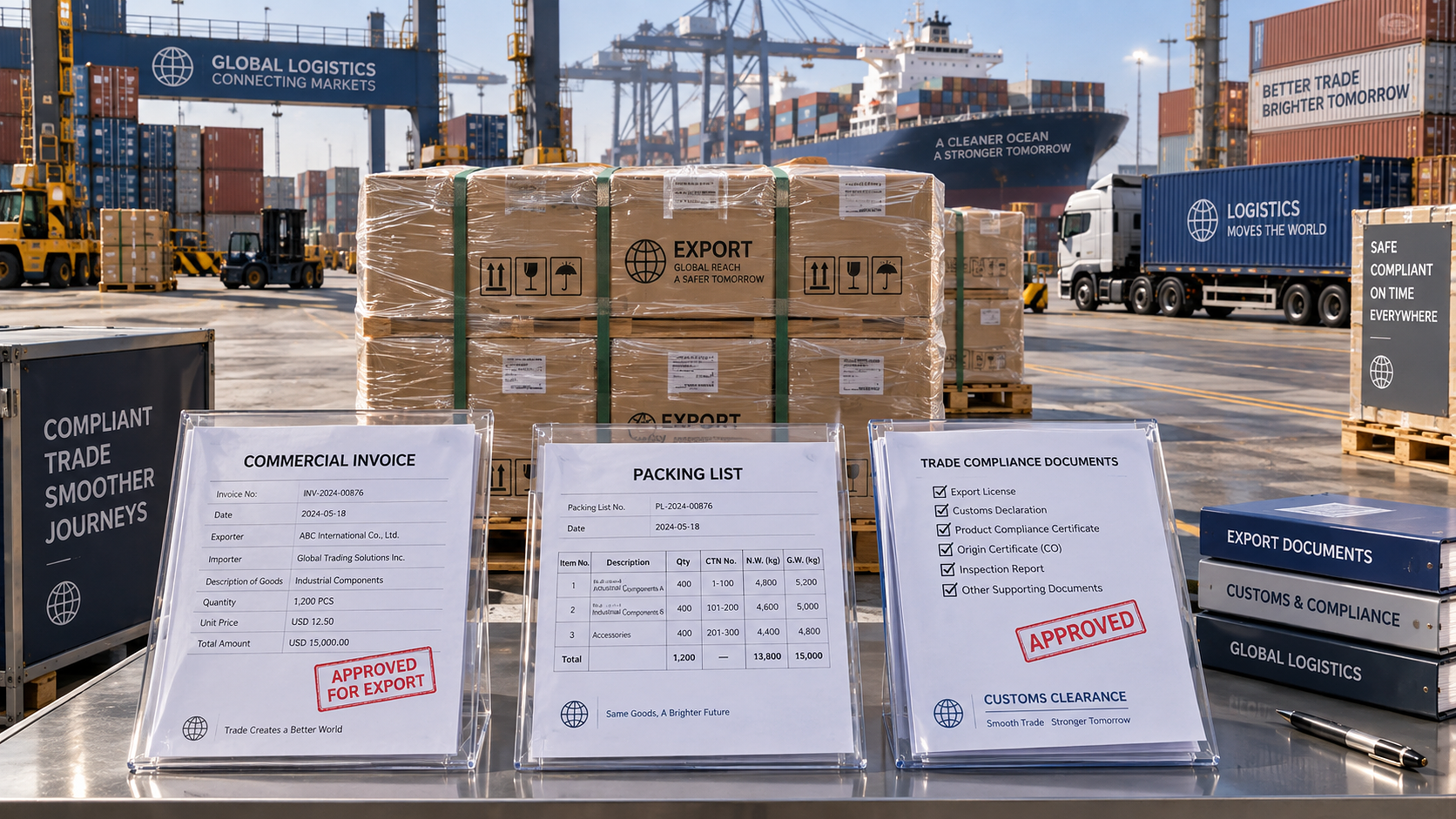
- Document consistency: purchase order, commercial invoice, packing list, bill of lading or air waybill, certificates, and broker instructions should tell the same story.
A team does not need to recreate this work for every shipment. Once a product has been reviewed, create a controlled master record. The record should contain the approved tariff code, origin logic, description standard, supporting documents, and a defined review date. When a supplier changes a component, production process, factory, price structure, or shipping terms, the record should be reopened rather than copied forward without question.

Classification is more than choosing a code from a database
Incorrect classification remains one of the most common causes of customs friction because products rarely fit neatly into the short descriptions used in purchasing systems. “Steel component,” “electrical accessory,” or “machine spare part” may be useful internally, but they are often too vague for a customs declaration.
Tariff classification depends on what the item is, how it works, what it is made of, and sometimes whether it is a part of a larger machine or a complete article in its own right. A customs authority reviewing an industrial sensor, for example, may need to know its sensing method, output function, housing material, intended equipment, and whether it performs a separate electrical function. Those details can affect the heading, duty treatment, and potential regulatory controls.
Importers should give brokers product data that can withstand a technical question, not merely a sales description. Useful evidence includes datasheets, drawings, bills of materials, photographs, user manuals, test reports, and manufacturer statements. For high-volume or high-duty goods, consider seeking a formal advance ruling where available. A ruling is not necessary for every SKU, but it can bring stability to classifications that are complex, disputed, or commercially significant.
Do not confuse the HS code with a universal answer
The Harmonized System provides a common international structure, but national tariff schedules often add country-specific digits, notes, statistical requirements, and duty measures. A code used by an exporter may not be sufficient for the importing country. Nor should the importer assume that a code accepted in one market will be accepted elsewhere.
Maintain classification decisions by destination market. This is especially important for companies moving industrial machinery, chemicals, electronics, metal products, textiles, food ingredients, or products that may be subject to anti-dumping, countervailing, environmental, or security-related measures.
Origin verification deserves the same attention as pricing
Country of origin has become a major operational issue, not a line item added at the end of an invoice. Origin may determine ordinary duty rates, free trade agreement eligibility, marking requirements, trade remedy exposure, sanctions risk, and reporting obligations. In some sectors, customs authorities expect importers to show how they reached their origin conclusion.
A supplier’s statement that goods are “made in” a particular country is a starting point, not always sufficient evidence. The country where goods are shipped from may be a distribution hub. The supplier may assemble imported components in a third country. For multi-stage manufacturing, the origin analysis may turn on the nature of the processing performed, the tariff shift of inputs, regional value content, or product-specific rules under a trade agreement.
Operations teams can reduce uncertainty by asking origin questions during supplier qualification, when there is still time to compare factory information and production flows. Request origin declarations in a usable format, retain them with the product record, and set expiration or review dates. If a supplier moves production, changes a key input, or begins using a different subcontractor, treat the origin declaration as potentially outdated.
Free trade agreement claims require particular care. Preferential duty savings can be meaningful, but an unsupported claim may result in denied preference, retroactive duties, penalties, and a more difficult relationship with customs authorities. The best approach is not to claim preference because a certificate exists; it is to claim it only after the underlying qualification analysis is documented.
Make the commercial invoice a clearance document, not an afterthought
When cargo is held, the invoice is often the first document customs and brokers examine. Yet many invoices still use vague descriptions, incomplete values, or shipment terms that do not explain what is included in the price.
A strong commercial invoice should identify the seller, buyer, importer of record where relevant, detailed goods description, quantity and unit of measure, unit and total price, currency, Incoterms, country of origin, terms of sale, and any information needed to reconcile the goods with transport and packing documents. Descriptions should be intelligible to a person who has never seen the product before. “Parts” is weak. “Machined stainless-steel valve body for industrial fluid-control equipment, non-electrical” is far more useful when accurate.
Value issues are often missed because procurement focuses on the purchase price. Customs valuation may require consideration of tooling supplied free of charge, design work provided by the buyer, royalties linked to imported goods, commissions, rebates, or transfer-pricing adjustments. A finance or tax team may hold part of this information, so import compliance needs a route for those details to reach the customs entry process.
Give brokers instructions, not just documents
A customs broker is an essential partner, but the importer remains responsible for the accuracy of its declarations in many jurisdictions. Brokers work best when they receive clear, timely instructions and are informed about changes that may affect entries.
Create a broker instruction sheet for each import program or destination. It can include importer registration details, approved classifications, valuation guidance, origin treatment, preference-claim rules, permit references, contact escalation paths, and instructions for exceptions. Avoid sending multiple versions through scattered email threads. A controlled folder, trade compliance platform, or shared workflow can reduce the risk that an old spreadsheet becomes the source of the declaration.
When a broker asks a question, treat it as useful intelligence rather than a nuisance. Repeated questions about the same product description, certificate, or value component signal that the master data needs improvement. Over time, a simple log of broker queries can reveal where sourcing and logistics processes are creating avoidable exposure.
Use customs holds as data, not just disruption
Every hold has a reason, even if the reason is initially broad. It may involve a document mismatch, a missing agency filing, an origin concern, an examination selection, or a request for supporting evidence. After the shipment is released, conduct a short review while details are fresh: What triggered the issue? Which team owned the source data? Was the document unavailable, inaccurate, or late? Does the corrective action apply to one shipment or an entire product family?
This approach matters because recurring delays usually come from recurring process gaps. If a particular supplier repeatedly submits inconsistent packing lists, the solution may be supplier training and a revised document template. If industrial equipment is regularly questioned at classification, engineering specifications may need to be included in the standard broker packet. If a market introduces new carbon, environmental, or product-safety reporting requirements, procurement needs an earlier compliance checkpoint.
GTIIN’s supply chain resilience perspective is useful here: customs latency should be reviewed alongside transit time, port congestion, supplier lead time, and inventory exposure. A route that appears cheaper on a freight quote may be more costly if weak documentation practices create unpredictable clearance time. Trade intelligence is most valuable when it helps operational teams decide where to build buffer, where to improve data, and where to change sourcing behavior before disruption becomes expensive.
A practical rhythm for day-to-day import control
Trade compliance for importers becomes sustainable when it follows a regular rhythm rather than relying on emergency intervention. Before a new product is ordered, validate its classification, origin, restrictions, and documentation needs. Before shipment, check that commercial data and transport documents match the approved record. At entry, respond quickly to broker queries and preserve the final declaration package. After release, review corrections, duty variances, holds, and supplier performance.
Not every import requires the same level of review. Risk-based control is usually more workable than trying to examine every carton with equal intensity. Apply deeper review to new suppliers, unfamiliar products, high-duty items, changing origins, controlled goods, first shipments to a new market, and transactions involving complex related-party pricing. Routine, stable products can move through a lighter process, provided their master data remains current.
The goal is not paperwork for its own sake. It is a supply chain in which the people buying, shipping, declaring, and receiving goods share the same dependable facts. When product data is clear, origin is supportable, values are complete, and brokers have timely instructions, customs clearance becomes less of a last-minute gamble—and far more of a manageable part of cross-border operations.
Weekly Insights
Stay ahead with our curated technology reports delivered every Monday.
Recommended News
 Market TrendsSep 28, 2026What freight market insights reveal about carrier capacity shifts
 Supply ChainSep 27, 2026How importers can reduce customs delays through trade compliance
 Market TrendsSep 25, 2026Which industrial market research trends signal a shift in demand?
 Supply ChainSep 24, 2026How trade compliance screening prevents costly shipment delays