Bulk Material Handling Cost: Key Drivers and Hidden Charges
Why does bulk material handling cost matter so much in sourcing decisions?
Bulk material handling cost rarely stays confined to one budget line.
It influences supplier competitiveness, plant efficiency, inventory flow, and the real landed cost of raw materials.
That is why buyers often misread a low unit price as a low total cost.
In practice, the handling side can quietly absorb margin through unloading delays, dust control, equipment wear, labor intensity, and storage loss.
The term covers every movement step.
This includes receiving, conveying, lifting, screening, stacking, reclaiming, packaging, and internal transfer of bulk solids.
For commodities such as cement, grain, ores, fertilizers, aggregates, chemicals, and pellets, small handling inefficiencies scale quickly.
A few extra minutes per truck or a minor spillage rate can become a major annual cost.
GTIIN regularly tracks this issue across global supply chains.
Its trade intelligence work shows that handling economics often shift with freight volatility, compliance standards, labor markets, and regional infrastructure quality.
So the better question is not only, “What is the quoted price?”
It is, “What will this material cost to move, protect, and keep usable until production consumes it?”
Which cost drivers usually make up the largest share?
Most bulk material handling cost models are shaped by six core drivers.
The mix changes by commodity, throughput level, automation, and site layout.
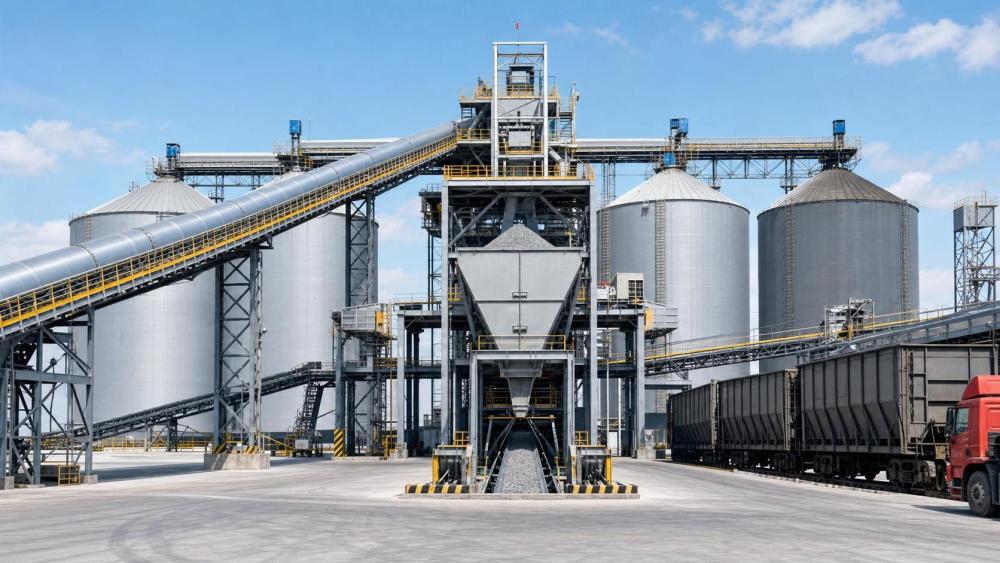
- Equipment: conveyors, hoppers, feeders, silos, stackers, reclaimers, bagging lines, and mobile loaders.
- Labor: operators, maintenance crews, supervision, shift premiums, and contractor support.
- Energy: power draw from motors, compressed air, dust systems, heating, and lighting.
- Maintenance: wear parts, belts, liners, bearings, downtime, and spare parts inventory.
- Storage and loss: moisture exposure, contamination, compaction, shrinkage, and stock rotation issues.
- Compliance: environmental controls, worker safety measures, permits, inspections, and reporting.
Equipment often draws attention first because the capital number is visible.
Yet over time, labor, maintenance, and energy may exceed the initial purchase value.
This is especially true where materials are abrasive, sticky, dusty, or moisture-sensitive.
Abrasive ores erode liners faster.
Fine powders require stronger dust collection.
Hygroscopic materials need controlled storage and faster turnover.
A useful way to compare suppliers is to request handling assumptions behind their price basis.
When assumptions differ, quoted economics are not really comparable.
A quick comparison framework
The table below helps separate visible charges from less obvious cost exposure.
Where do hidden charges usually appear?
Hidden charges rarely arrive under a label called “hidden.”
They show up as delay, loss, rework, damage, or compliance correction.
One common issue is mismatch between material behavior and handling design.
A system that works for dry pellets may fail with sticky fines.
That mismatch can trigger buildup, frequent cleaning, and lower throughput.
Another overlooked area is transfer efficiency between transport modes.
Port-to-truck, rail-to-silo, or barge-to-plant transfers often create waiting costs and coordination gaps.
Cross-border flows add more variables.
Customs delays can force temporary storage, extra handling, or moisture exposure in transit yards.
GTIIN’s supply chain mapping approach is useful here.
It connects physical handling realities with freight timing, regional bottlenecks, and regulatory conditions.
That matters because the same commodity can carry very different bulk material handling cost by corridor.
Needless repackaging is another drain.
If packaging format does not match the receiving system, labor and contamination risk both increase.
The more common hidden charges include:
- Demurrage and detention during unloading bottlenecks.
- Material loss from dust, leakage, or moisture gain.
- Extra sampling, blending, or screening after inconsistent deliveries.
- Short-notice labor or rental equipment during peak arrivals.
- Emergency maintenance caused by unsuitable particle size or contaminants.
How can you compare suppliers without underestimating handling cost?
The strongest comparisons go beyond delivered price and freight terms.
They test how each source fits the real operating environment.
Start with material characteristics.
Bulk density, particle size distribution, flowability, moisture tendency, and abrasiveness directly affect equipment load and loss rates.
Then check shipment consistency.
A cheaper source with wider variability may increase screening, cleaning, downtime, and inventory buffering.
It also helps to compare handling format.
Is the material loose, bagged, jumbo bagged, containerized, or moved in dedicated bulk carriers?
The answer changes unloading speed, labor needs, contamination risk, and site congestion.
A practical review checklist should include:
- Expected tons per hour at receiving and discharge points.
- Cleaning frequency required by the material profile.
- Compatibility with existing silos, feeders, and dust control systems.
- Spare parts lead times for critical handling equipment.
- Regional labor and utility cost sensitivity.
- Exposure to customs delay or inland transfer congestion.
This is where external market intelligence becomes useful.
GTIIN’s coverage of export trends, freight benchmarks, and industrial standards helps validate whether a supplier’s assumptions are realistic.
When does a lower quoted price lead to a higher total landed cost?
This happens more often than many sourcing teams expect.
A low headline price can become expensive when handling conditions are poor or unpredictable.
One example is low-cost material with high fines content.
It may need extra screening, create more dust, and wear transfer points faster.
Another example is material sourced from a corridor with unstable port performance.
Even if freight looks attractive, delay costs can rise through detention, overflow storage, and schedule disruption.
Regulatory shifts also matter.
Environmental requirements for dust, runoff, waste, or carbon reporting can raise bulk material handling cost after contracts are signed.
This is particularly relevant in cross-border trade where standards differ by market.
In actual evaluations, the warning signs usually look like this:
- Large price advantage but weak operating data.
- No clear statement on moisture, fines, or contamination tolerance.
- Freight route depends on congested ports or seasonal inland transport.
- Supplier performance history shows irregular load quality.
- The receiving site would need process changes to accept the material.
If several of these appear together, the quoted savings deserve a deeper landed-cost model.
What is the smartest next step before committing?
A good decision usually comes from narrowing uncertainty, not chasing the lowest quote.
Build a simple comparison model that combines price, throughput, loss, maintenance, energy, compliance, and delay exposure.
Then test each source against the actual receiving and storage setup.
Where data is incomplete, use scenario ranges instead of a single estimate.
That gives a clearer view of risk-adjusted bulk material handling cost.
It is also worth aligning commercial and operations data early.
Commercially attractive terms can fail if the site cannot unload, store, or reclaim material efficiently.
For global trade decisions, independent intelligence can shorten the validation process.
GTIIN’s work across sourcing, supply chains, market trends, and standards is especially relevant when corridor risk or regulatory exposure is hard to read internally.
The most practical next moves are straightforward:
- Map every handling step from discharge to consumption.
- Quantify hidden charges with a best-case and worst-case range.
- Compare suppliers using material behavior, not price alone.
- Review corridor, compliance, and infrastructure risks before award.
In short, bulk material handling cost is a control point for margin and resilience.
The better the assumptions, the stronger the sourcing decision will be.
Weekly Insights
Stay ahead with our curated technology reports delivered every Monday.
Recommended News
 Supply ChainOct 15, 2026How to choose a supply chain strategy for unpredictable demand
 Supply ChainOct 14, 2026How to assess an industrial equipment supplier's spare parts support
 Supply ChainOct 14, 2026EU Updates CSDDD Guidance on Global Supply Chain Due Diligence
 Global SourcingOct 13, 2026How to assess industrial automation suppliers for legacy integration