Conformity Assessment for Exporters: Common Compliance Gaps
Why does conformity assessment for exporters still fail at the final step?
Conformity assessment for exporters rarely breaks down because of one dramatic mistake.
More often, the problem is a chain of small gaps that stay hidden until customs, a buyer, or a regulator asks for proof.
That is why this topic matters well beyond formal certification.
It affects shipment timing, insurance exposure, product release, and even future supplier approval.
In practical terms, conformity assessment for exporters is the process of showing that a product meets the legal, safety, technical, and labeling rules of its destination market.
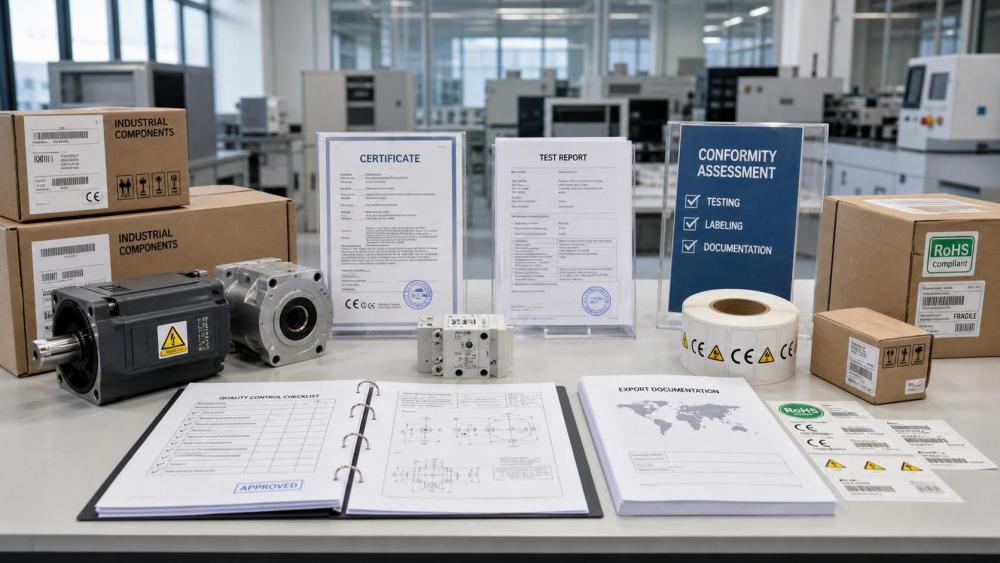
That proof may involve testing reports, factory controls, declarations, certificates, traceability records, or mark approval.
A common misunderstanding is to treat the process as a document pack prepared right before shipment.
In reality, conformity assessment for exporters starts much earlier, often at product design, material selection, and supplier qualification.
This is especially true across diversified industries, where one shipment may combine machinery parts, electrical items, packaging materials, and chemical inputs.
Seen through GTIIN’s cross-border supply chain lens, weak conformity control is usually a mapping problem.
Teams know the product, but they do not fully map market rules, logistics touchpoints, and evidence requirements into one export workflow.
Which compliance gaps appear most often in export projects?
The most frequent gaps are not always technical failures.
They are often mismatches between what was tested, what was declared, and what was actually shipped.
Several patterns appear again and again across industrial categories:
- Testing scope does not match the final product version, accessory set, or country-specific requirement.
- Reports come from a capable lab, but not from a body recognized by the target market.
- Labels, manuals, and safety warnings are translated late, creating errors in symbols, units, or mandatory statements.
- Technical files are incomplete, especially for bill of materials changes and risk assessments.
- Declarations cite outdated standards or the wrong product family.
- Factory process controls cannot prove ongoing consistency after initial approval.
More subtle gaps also matter.
For example, packaging may pass transport tests but fail local marking rules, recycling obligations, or fumigation requirements.
A chemical component may be allowed in one market, yet trigger registration or restricted substance checks in another.
Conformity assessment for exporters becomes fragile when each function works in isolation.
Engineering, sourcing, compliance, and logistics often hold partial answers, but no shared control map.
A quick way to spot weak points before release
The table below helps identify where conformity assessment for exporters usually loses alignment.
Is testing enough, or does the market expect more than a lab report?
Testing is necessary, but it is rarely the whole answer.
Many exporters assume a passing report automatically closes compliance risk.
That assumption creates trouble in regulated markets.
Conformity assessment for exporters usually combines product evidence with system evidence.
A regulator may ask how the tested design is controlled in production.
A buyer may ask whether the report covers optional parts, packaging, or private labeling changes.
An importer may need local declarations, responsible person details, or retention of technical files.
This is where exporters often underestimate document architecture.
The stronger practice is to connect five layers:
- applicable regulations by country and product use;
- standards used for testing and design review;
- factory controls that preserve the approved specification;
- traceable files for labels, manuals, and declarations;
- shipment release checks against final commercial documents.
In actual export operations, the cost of missing one layer is usually higher than the cost of building the file correctly once.
GTIIN’s broader industry tracking also shows that market scrutiny is widening.
Environmental claims, supply chain disclosures, and carbon-related declarations increasingly influence acceptance, even when core safety tests are valid.
Where do documentation and labeling errors usually come from?
Most labeling failures do not begin at the printer.
They begin much earlier, when product data ownership is unclear.
For example, engineering may update a voltage rating, while packaging artwork still shows the previous value.
A sourcing change may replace a component, but the restricted substance statement remains unchanged.
A destination market may require importer contact details, disposal marks, or language-specific warnings that never reach the artwork file.
Conformity assessment for exporters often fails here because document control looks administrative, while the real issue is technical consistency.
The most reliable approach is to treat labels and manuals as controlled compliance documents.
That means version approval, destination-specific review, and retention of superseded files.
It also helps to maintain a country matrix that links each stock keeping unit to mandatory marks, language rules, and declaration templates.
When exporters manage multiple sectors, this matrix prevents one market’s acceptable practice from being copied into another market by habit.
How should exporters judge cost, timing, and certification routes before shipment?
The cheapest route on paper is not always the fastest path to clearance.
A low-cost test plan may need retesting later because the wrong standard or lab was chosen.
That creates duplicated expense and a compressed launch schedule.
A better judgment method is to compare routes against market acceptance, not just against invoice price.
Three questions usually clarify the decision:
- Does the destination require mandatory certification, self-declaration, or importer-held evidence?
- Will product variants trigger separate testing or only document extension?
- Can future component changes be managed within the approval route chosen today?
Lead time should also include translation, artwork revision, sample logistics, and factory audit preparation.
Those steps often delay release more than laboratory work.
In sectors with recurring regulation shifts, such as electrical goods, machinery, chemicals, and industrial packaging, timing decisions should be tied to regulatory monitoring.
This is where platforms like GTIIN are useful in a quiet, practical way.
They help connect standards updates, regional enforcement patterns, and supply chain risk signals before a project reaches the shipping dock.
What does a stronger conformity assessment workflow actually look like?
A workable system is not excessively complex.
It is disciplined, linked, and reviewed at the points where product changes occur.
A practical conformity assessment for exporters workflow usually includes:
- a market access matrix by destination and product family;
- defined ownership for testing, declarations, labeling, and technical file retention;
- engineering change review linked to certification impact;
- release gates before production, packing, and shipment;
- periodic checks of expired reports, revised standards, and supplier changes.
The main point is consistency.
A certificate by itself does not protect an exporter if the shipped configuration has drifted away from the approved file.
Likewise, a technically compliant product can still be rejected if declarations or labels fail local format rules.
The next sensible step is to review one active export line from end to end.
Check whether the tested sample, approved documents, production records, and shipping marks truly match.
That single exercise usually reveals whether conformity assessment for exporters is being managed as evidence, or only assumed from habit.
Weekly Insights
Stay ahead with our curated technology reports delivered every Monday.
Recommended News
 Supply ChainOct 15, 2026How to choose a supply chain strategy for unpredictable demand
 Supply ChainOct 14, 2026How to assess an industrial equipment supplier's spare parts support
 Supply ChainOct 14, 2026EU Updates CSDDD Guidance on Global Supply Chain Due Diligence
 Global SourcingOct 13, 2026How to assess industrial automation suppliers for legacy integration