Which Safety Standards Should Imported Industrial Equipment Meet?
A production line can be mechanically sound, priced competitively, and ready to ship—yet still become unusable after arrival because its safety documentation does not match the destination market. The problem often appears late: during customs review, installation, insurer inspection, a customer audit, or after an incident exposes missing guards, unsuitable electrical components, or unclear operating instructions.
So, what safety standards should imported industrial equipment meet? It should meet the legally applicable product-safety, electrical, machinery, environmental, and workplace requirements of the country where it will be placed on the market and used. International standards such as ISO and IEC are often valuable evidence of sound design, but they do not automatically replace local legal obligations. The correct standard set depends on the machine type, its hazards, the destination jurisdiction, how it will be installed, and whether it is supplied as a complete machine, partly completed machinery, or a production-line assembly.
Start with the destination market, not the supplier’s certificate
Buyers sometimes begin with a simple request: “Please provide CE,” “Please provide UL,” or “Please provide ISO certification.” That request can be too broad and, in some cases, misleading. A mark or test report may apply to only one electrical part, one previous equipment configuration, or a market other than the buyer’s destination. Compliance has to be assessed against the actual machine being imported, including its controls, motors, guards, safety functions, language materials, and intended use.
The main distinction is between mandatory market rules and technical standards used to demonstrate conformity. A regulation may require an importer, manufacturer, or authorized representative to complete a conformity assessment and retain technical documentation. Harmonized, national, or consensus standards can then provide a recognized method for showing that particular risks have been addressed. A supplier’s statement that a machine is “ISO compliant” is therefore not enough unless it identifies the relevant ISO standards and shows how the actual equipment meets them.
Before issuing a purchase order, identify four facts:
- The country or economic area where the equipment will first be placed on the market.
- Whether the unit is new, refurbished, substantially modified, or second-hand.
- Whether it will operate alone or be integrated with other machinery, robots, conveyors, extraction systems, or process controls.
- The intended operating environment, such as food processing, explosive atmosphere, outdoor use, cleanroom production, chemical handling, or ordinary industrial premises.
These details determine which requirements are relevant. A standard hydraulic press, for example, raises different issues from a packaging line with servo drives, a dust-collection system installed near combustible powder, or a mobile machine used outdoors in wet conditions.
Machinery safety: guarding, controls, and foreseeable misuse
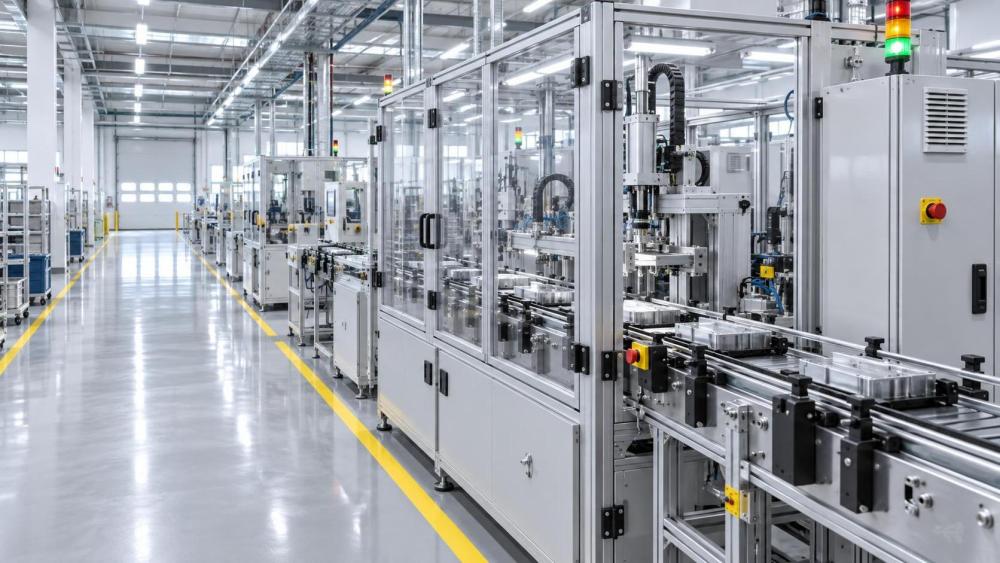
For machinery, the central question is not whether the machine has a protective cover somewhere on the frame. It is whether the supplier has performed a credible risk assessment and controlled the hazards created throughout the equipment’s life cycle: transport, assembly, normal operation, cleaning, maintenance, jam clearing, tool changes, fault recovery, and decommissioning.
Widely used machinery-safety frameworks draw on standards such as ISO 12100 for risk assessment and risk reduction. The precise standard used in a destination market may differ, but the underlying discipline is consistent. Hazards should be identified, eliminated through design where feasible, reduced through guards and protective devices, and supported by instructions and warnings only where residual risk remains.
During document review, look for evidence addressing the following areas:
- Mechanical hazards: crushing, shearing, cutting, entanglement, drawing-in points, ejected materials, unstable loads, and moving parts that remain hazardous after a cycle stops.
- Physical guards: fixed guards, interlocked movable guards, safe distances, access prevention, guard strength, and protection against easy bypassing or removal.
- Emergency stopping: accessible emergency-stop devices where appropriate, clear reset behavior, and assurance that resetting an emergency stop does not restart the machine.
- Unexpected start-up: protection during maintenance, cleaning, clearing blockages, and restoration of power after an interruption.
- Control-system reliability: safety relays, safety PLC functions, redundant circuits, diagnostic coverage, and validated performance appropriate to the severity of the hazard.
- Ergonomics and access: safe operator positions, visibility, loading and unloading arrangements, platforms, stairs, handrails, and maintenance access.
Two machines can look nearly identical while having very different safety integrity. For example, a door interlock may stop a motion command on one model but may not remove stored pneumatic, hydraulic, electrical, thermal, or gravitational energy. The procurement specification should state what safe state is required when access doors open, when a guard is removed, or when maintenance isolation is applied.
Electrical compliance is more than matching voltage and plug type
Electrical mismatch is one of the most frequent import problems because buyers focus on nominal supply voltage while overlooking the full installation conditions. A machine designed for one region may have unsuitable cable ratings, panel components, enclosure protection, earthing arrangements, short-circuit ratings, or control-panel construction for another region.
Industrial electrical equipment commonly relies on principles reflected in IEC 60204-1 for the electrical equipment of machines, while local electrical codes and nationally recognized standards may impose additional requirements. In North America, authorities may expect equipment or electrical panels to be certified by a recognized testing body where applicable. In other markets, conformity may be demonstrated through different national schemes or technical-file requirements. The applicable route must be confirmed before manufacture, not inferred from a label on a motor or circuit breaker.
It is also important to separate component approval from machine-level conformity. A control cabinet can contain certified components and still fail a machine-level review because of unsuitable wiring, undocumented modifications, inadequate protection, or an incomplete safety circuit.
Compare the main compliance pathways
Different destination markets use different legal mechanisms. The following comparison is a practical starting point, not a substitute for confirming the rules applicable to the exact product and country.
CE marking deserves particular care. It is not a universal export passport and should not be requested for equipment intended solely for a non-European market unless another valid reason exists. Conversely, a machine shipped into the European Economic Area cannot rely on a generic “CE certificate” issued without reference to the applicable legal requirements, the manufacturer’s technical documentation, and the machine’s declared configuration.
For North American installations, a CE-marked machine may still face issues with local electrical inspection or customer requirements. The same principle applies in reverse: a machine accepted under one national scheme may require a different conformity route elsewhere. The safest purchasing position is to write destination-specific compliance obligations into the technical specification.
Do not overlook EMC, pressure, emissions, and hazardous locations
Some obligations are easy to miss because they are not visible in a basic factory acceptance test. Variable-frequency drives, servo systems, radio modules, industrial computers, and switching power supplies can create electromagnetic emissions or be vulnerable to electromagnetic disturbance. Equipment that stops unexpectedly, loses position feedback, or resets during electrical noise may create a safety issue even when its mechanical guards are well designed. Electromagnetic compatibility requirements and installation instructions should address shielding, grounding, cable routing, filters, and the intended industrial environment.
Pressure equipment requires its own review. Pneumatic receivers, steam systems, hydraulic accumulators, pressurized vessels, and certain piping assemblies may be subject to separate design, testing, marking, and inspection requirements. Do not assume that a compressor package or hydraulic machine is covered only by general machinery rules.
Environmental compliance can also affect import eligibility. Depending on the market and product category, buyers may need to check restrictions concerning hazardous substances, chemical disclosures, refrigerants, batteries, energy-related components, noise emissions, waste obligations, or fuel-engine emissions. These are not always “machine safety” rules in the narrow sense, but non-compliance can delay market access and create downstream disposal or reporting obligations.
Where flammable gas, vapor, dust, fibers, or combustible powder may be present, hazardous-area classification becomes critical. Motors, lighting, sensors, junction boxes, control equipment, and static-control measures must match the zone or division classification assigned to the location. Retrofitting ordinary equipment after arrival is often more expensive and less reliable than procuring correctly rated equipment from the outset.
Documentation should be treated as part of the equipment
A machine that arrives without usable documents is not fully deliverable. Installation teams cannot safely verify connections, configure safety functions, train operators, or plan maintenance using a sales brochure and a one-page certificate.
The document package should be reviewed before final payment or shipment release. It commonly includes a declaration or certificate required by the destination market, risk assessment summary, electrical and pneumatic or hydraulic schematics, safety-circuit information, component list, operating manual, maintenance instructions, spare-parts identification, warning-label artwork, test records, and information about residual risks. Manuals and safety labels should be supplied in the language or languages required by the destination market.
Pay particular attention to the machine serial number, model designation, and revision level. Documents should identify the delivered equipment, not merely a product family. If a supplier substitutes a safety relay, drive, guard design, motor, or control software after testing, the buyer should ask whether the change affects the conformity assessment or declared safety performance.
Build compliance checks into the purchasing sequence
Compliance is harder to repair once a machine is crated and in transit. A more reliable approach is to divide responsibility across the procurement process.
- Define the intended use. Describe material handled, operator tasks, production rate, installation environment, utilities, cleaning method, and integration points. Include foreseeable non-routine tasks such as jam clearing and blade replacement.
- Map applicable requirements. Identify legal market-entry rules, workplace requirements, electrical inspection expectations, and sector-specific obligations. Imported equipment may need to meet both product rules and local installation rules.
- Convert requirements into contract language. Specify required standards, certificates, markings, documentation, language, testing, and responsibility for correcting non-conformities. Avoid vague wording such as “international standard quality.”
- Review design evidence before fabrication is complete. Check drawings, guarding concept, safety functions, electrical architecture, component approvals, and labels while changes remain practical.
- Witness or document acceptance testing. Confirm that guards, interlocks, emergency stops, alarms, safe restart behavior, and declared operating modes function as specified. A factory test does not replace commissioning, but it can reveal major gaps before shipment.
- Validate after installation. Site conditions can change the risk profile. Integration with upstream and downstream equipment, local power supply, floor layout, extraction systems, and access routes should be assessed before production begins.
When used or modified equipment needs extra scrutiny
Used equipment can be attractive, but age does not remove safety obligations. Missing manuals, obsolete controls, damaged labels, altered wiring, defeated interlocks, and unavailable spare parts are common concerns. The buyer should establish whether the equipment is being imported as used machinery in its original configuration or whether refurbishment and modification have changed its legal status in the destination market.
A major rebuild can create new responsibilities for the party placing the revised equipment on the market. Replacing a worn motor is not the same as changing a machine’s control architecture, adding automation, removing a guard, increasing speed, or combining separate machines into one automated cell. Once an importer integrates equipment into a line, the line-level emergency-stop logic, safeguarding boundaries, and control-system interactions may need a fresh assessment.
The most practical rule is simple: request evidence for the delivered configuration, verify it against the destination market before shipment, and treat installation as a final safety-validation stage rather than a formality. That approach reduces the chance that imported industrial equipment becomes a costly compliance project after it has already reached the factory floor.
Weekly Insights
Stay ahead with our curated technology reports delivered every Monday.
Recommended News
 Supply ChainSep 22, 2026How heavy equipment lifecycle data can reduce unexpected downtime
 Supply ChainSep 21, 2026How export regulations affect logistics lead times and delivery risk
 Industry StandardsSep 20, 2026What evidence is needed to pass a carbon reporting audit?
 Industry StandardsSep 19, 2026When does manufacturing compliance consulting reduce audit risk?