What makes an environmental compliance audit report finding actionable?
An environmental compliance audit report delivers value when its findings tell teams exactly what needs to change—and how to verify the fix. “Improve waste management” may describe a concern, but it leaves a quality control or safety manager with unanswered questions: Which area failed? Against what requirement? Is immediate containment necessary? What evidence will demonstrate closure?
An actionable finding connects a specific, applicable requirement to objective evidence of a gap, then provides a clear basis for corrective action and verified closure. It also gives managers enough context to prioritize the issue without confusing a confirmed violation, an unresolved question, and an improvement opportunity.
For manufacturers and cross-border procurement teams, that distinction matters beyond the facility gate. An unresolved environmental finding may affect operating continuity, supplier approval, or customer commitments. The report should make those implications understandable without presenting every deficiency as a business-critical emergency.
Start with a finding someone else can reproduce
A useful test is simple: could a competent colleague visit the same location, review the same records, and understand how the auditor reached the conclusion? If not, the finding probably needs stronger evidence or a clearer requirement.
Reproducibility does not require an exhaustive narrative. It requires precision in the right places.
Identify the actual obligation
“Does not meet environmental standards” is too broad to support corrective action. Cite the relevant permit condition, regulation, approved operating procedure, or contractual requirement, including its identifier and applicable version where practical.
Confirm applicability before classifying the gap. Requirements can depend on the facility’s jurisdiction, process, discharge destination, waste classification, or operating threshold. A corporate standard may exceed local law, but failure against that standard should not automatically be labeled a regulatory violation.
Keep these categories visible:
- Regulatory or permit noncompliance: evidence demonstrates failure against an applicable legal obligation.
- Internal or contractual nonconformity: a corporate procedure, customer specification, or supplier agreement has not been met.
- Observation requiring investigation: available evidence is insufficient to reach a defensible conclusion.
- Improvement opportunity: a stronger control is recommended, but no breached requirement has been established.
Describe what was actually observed
Record the location, date, equipment or process, relevant document references, and the extent of the review. Photographs, monitoring results, waste transfer records, maintenance logs, and interviews can support a finding, but their evidentiary value differs.
A statement from an operator that “the alarm sometimes fails” warrants investigation; it does not, by itself, establish the frequency or cause of failure. Similarly, finding three missing inspection records in a sample of twelve does not prove that every inspection was missed. State the sample and its limitations.
Where a conclusion depends on analytical data, identify the sampling point, applicable limit, units, reporting period, and relevant quality controls. Concentration limits, mass-loading limits, and averaging periods are not interchangeable.
Explain the gap without guessing the cause
The finding should show how the evidence fails to satisfy the requirement. Avoid unsupported explanations such as “poor staff awareness” or “inadequate supervision.” Those may be hypotheses for a later root-cause investigation, not established audit facts.
There is also a difference between an activity not being performed and records not being available to demonstrate performance. Either may matter, depending on the obligation, but the report should describe the gap the evidence actually supports.
From a vague observation to an executable finding
Consider this illustrative situation at a manufacturing facility. Its approved site procedure requires weekly documented inspections of a hazardous-waste accumulation area. The auditor reviews twelve weeks of records and finds three missing entries. This example concerns an internal procedural requirement; any separate legal inspection obligation would need to be checked independently.
This wording neither understates the control failure nor invents a spill. It also avoids claiming that inspections definitely did not occur. That restraint makes the finding more defensible and gives the responsible manager a practical starting point.
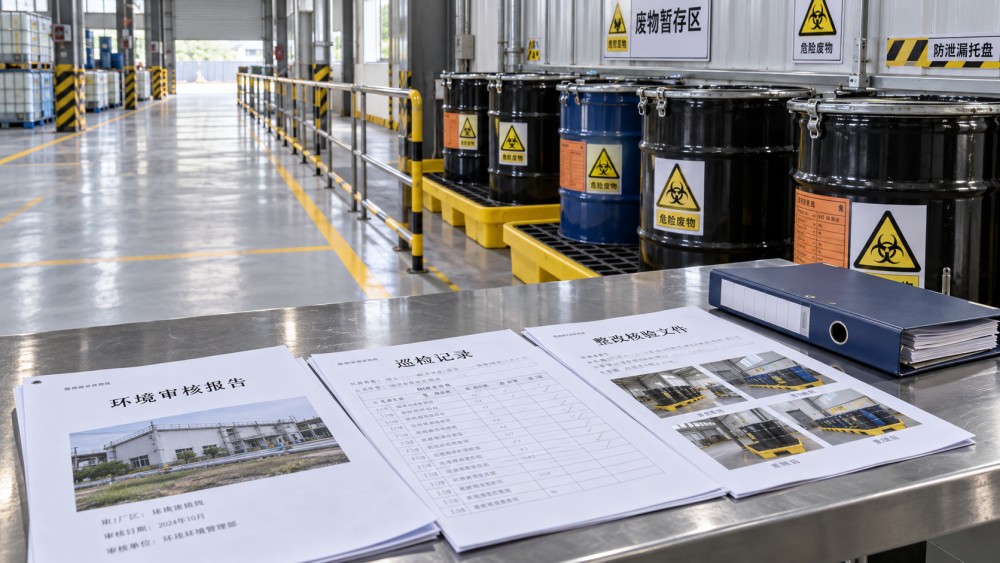
The resulting action plan should distinguish immediate correction from recurrence prevention. Completing today’s inspection addresses current conditions. Establishing backup coverage, resolving access problems in the inspection system, or changing the scheduling control may address why records were missing. Backfilling records as though inspections had occurred would not be an acceptable correction.
Prioritize exposure, not just the number of findings
When a report contains twenty findings, teams need more than a list. They need to know which conditions require immediate attention and which can be resolved through planned improvements.
An effective environmental compliance audit report explains its rating method. Labels such as “major,” “minor,” and “critical” are not universally defined, so a severity label without criteria can create false confidence—or unnecessary alarm.
Consider several dimensions together:
- Actual or potential environmental harm: the nature of the pollutant, quantity, release pathway, and sensitivity of nearby receptors.
- Legal significance: a missed permit obligation, potentially unauthorized discharge, or time-sensitive reporting requirement.
- Control reliability: whether independent safeguards remain available or the failed control was the only meaningful barrier.
- Extent and recurrence: an isolated documentation error differs from repeated failures across shifts or facilities.
- Operational consequences: the potential for process restrictions, interrupted waste collection, or disruption to an approved supplier’s output.
Do not let a numerical score obscure an urgent obligation. A possible ongoing release may require immediate assessment and response under site procedures. A statutory notification deadline cannot be extended because an internal action-tracking system assigned a later completion date.
Where compliance status remains uncertain, assign responsibility and a prompt deadline for determining applicability or obtaining qualified advice. Uncertainty is a task to resolve, not a reason to leave the finding dormant.
Build the handoff from audit finding to corrective action
The auditor establishes the gap; operational management normally owns the remedy. Keeping those responsibilities distinct helps preserve audit independence and prevents an impractical recommendation from becoming the only permitted solution.
The report and its linked corrective-action register should make the handoff explicit. Each finding needs a unique identifier, a responsible owner with sufficient authority, a target date, and defined closure expectations. If several departments contribute, appoint one accountable owner rather than assigning the action to “EHS/Operations/Maintenance.”
Separate containment, correction, and prevention
These steps answer different questions:
- Containment: What must happen now to limit exposure while the issue is assessed?
- Correction: What restores the specific condition to compliance?
- Corrective action: What addresses the verified cause so the failure is less likely to recur?
For a failed wastewater monitoring instrument, containment might involve an authorized alternative monitoring arrangement or an operating restriction, subject to applicable requirements. Correction may involve repair and calibration. Recurrence prevention could require changes to preventive maintenance, spare-parts availability, or alarm escalation, depending on the investigation.
“Retrain personnel” should not be the default response. Training will not fix an inaccessible sampling point, an unreliable sensor, or a purchasing system that permits unapproved waste contractors.
Set deadlines that reflect both risk and feasibility
Some actions can be completed during the audit. Others require engineering design, procurement, permitting, or a shutdown. For longer projects, establish milestones and documented interim controls rather than accepting one distant due date.
Extensions should record the reason, remaining exposure, interim protections, and approving authority. Internal approval of an extension does not waive a permit deadline or other legal requirement.
Define closure before anyone uploads evidence
A frequent source of frustration is discovering, weeks later, that the action owner and verifier had different ideas about “complete.” Agreeing on acceptance criteria early prevents that avoidable rework.
Closure should demonstrate that the required condition has been restored and, where relevant, that the revised control works over time. An invoice proves a purchase; it does not prove installation, commissioning, or effective operation.
Match verification depth to risk. A corrected label may need a field check and photograph. A recurring treatment-system failure may require operating data under representative conditions. For higher-risk findings, use a competent verifier who is sufficiently independent of the work performed.
If an effectiveness check needs more time, record that status transparently. “Implemented, awaiting effectiveness verification” is more informative than prematurely marking the finding closed.
Make findings usable across suppliers and jurisdictions
Global manufacturing networks benefit from consistent reporting fields, but not from assuming identical legal requirements everywhere. A common supplier-audit template should capture the site-specific obligation, local evidence, finding category, owner, and closure criteria while allowing jurisdiction-specific details.
Distinguish the supplier’s corrective-action responsibility from the buyer’s sourcing decision. Procurement may need to assess alternative capacity or monitor an improvement plan; it should not imply that conditional supplier approval authorizes continued regulatory noncompliance.
For trade-intelligence and supply-chain teams, including GTIIN’s readership, the useful connection is between a documented environmental gap and a credible continuity scenario. A waste-storage finding may warrant checking collection arrangements and remaining authorized capacity—not automatically predicting a plant shutdown. Escalate business implications in proportion to the evidence.
The final test: can the next person act without guessing?
Before issuing the report, ask whether the recipient can answer six questions: What requirement applies? What evidence supports the gap? What needs attention now? Who owns the response? When must it be completed? What will prove closure?
If any answer depends on an undocumented conversation with the auditor, strengthen the finding or its linked action record. The best environmental compliance audit report is not the one with the most observations. It is the one that turns defensible evidence into proportionate action—and leaves a clear record that the control has actually improved.
Have questions about this sector analysis, or seeking best practices specific to your niche? Drop us a line below and let the senior consultants at GTIIN assist you.
“We respect your privacy. Your information is strictly confidential.”
Weekly Insights
Stay ahead with our curated technology reports delivered every Monday.
Recommended News
 Global SourcingNov 02, 2026How to assess database coverage in a trade intelligence platform
 Market TrendsNov 02, 2026CFLP Forecasts 17.6% Rise in China's Average Commodity Price Index for 2026
 Industry StandardsNov 01, 2026How to build an ESG compliance framework for your business
 Supply ChainNov 01, 2026China-Peru FTA Upgrade Takes Effect, Adding Global Supply Chain Chapter