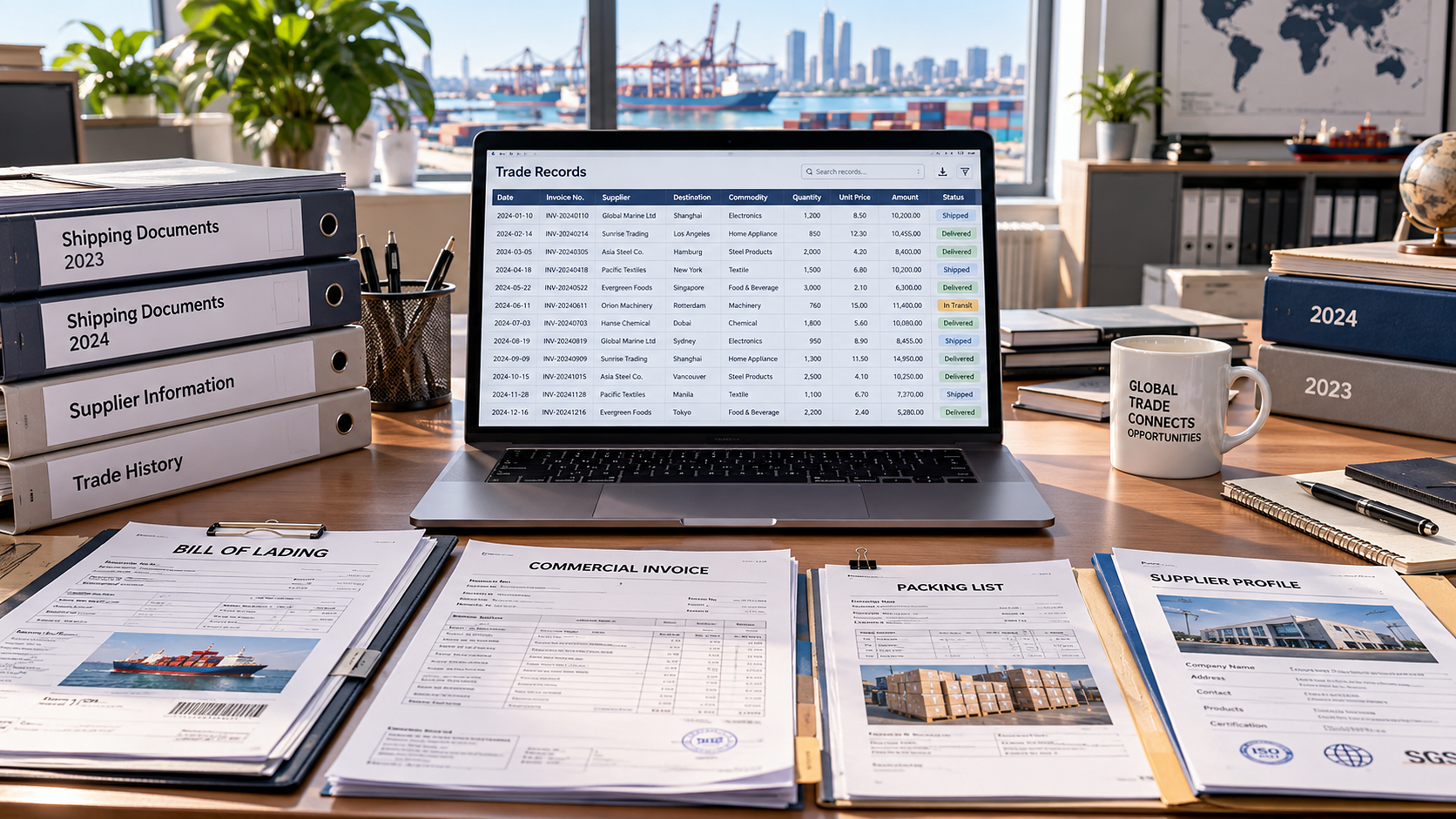
How to assess database coverage in a trade intelligence platform
A trade intelligence platform database is only as useful as the markets, transactions, and entities it represents. For technical evaluators, assessing coverage means looking beyond headline record counts to examine geographic reach, data sources, historical depth, update frequency, and gaps in customs or supplier records. The challenge is not simply finding the largest database; it is determining whether the available evidence is reliable enough for the sourcing and supply chain decisions your organization needs to make.
Two platforms may both claim broad international coverage while answering very different questions. One might offer detailed shipment records for a limited set of countries. Another might cover more markets through aggregated statistics but provide little visibility into individual suppliers. A useful evaluation makes those differences visible before a subscription, integration, or procurement workflow depends on the data.
Define coverage around the decision, not the dashboard
Start with a small set of real questions from procurement, market intelligence, compliance, or supply chain teams. For example: Can the organization identify exporters of a particular industrial component into a target market? Can it monitor changes in sourcing routes over several years? Can analysts distinguish a manufacturer from a trading intermediary?
Each question imposes different data requirements. Supplier discovery may depend on company names, product descriptions, and recent shipment activity. Market sizing requires consistent values, quantities, and comparable historical data. A resilience assessment may need visibility across multiple tiers and transport routes, although customs records alone rarely establish a complete supply chain.
Translate these questions into an evaluation matrix before contacting vendors. Specify the countries, product categories, entities, time periods, and fields that matter. Mark each as essential or desirable. This prevents an impressive global total from compensating for a missing market or field that is critical to your use case.
Map geographic coverage at the source level
A country listed on a coverage page is a starting point, not proof that the relevant transactions are available. Ask whether the platform provides import records, export records, both, or only aggregated trade statistics for each priority market. Availability may also vary by transport mode, declaration type, reporting authority, and period.
Pay particular attention to the difference between direct and mirror data. Direct data comes from the reporting market; mirror data uses a trading partner’s reported imports or exports to infer activity. Mirror data can fill an important gap, but it is not a like-for-like replacement. Reporting periods, valuation methods, product classification, transit routes, and partner attribution can differ.
For every critical country, request a source-level inventory that identifies:
- The issuing authority or original source, where disclosure is permitted.
- Whether records are transaction-level, company-level, or aggregated.
- Import and export direction, transport modes, and known exclusions.
- The earliest and latest available periods, including historical interruptions.
- Whether access to company names or other fields is restricted, redacted, or unavailable.
Commercial confidentiality and national disclosure rules can limit what any provider can supply. A missing importer name is not necessarily a platform error; it may reflect a restriction in the underlying source. The practical question is whether that limitation prevents the intended analysis.
Examine what a record actually represents
“Shipment,” “transaction,” and “record” are not always interchangeable. A platform may count a bill of lading, a customs declaration, a line item, or a derived company-to-company relationship as one record. Some shipments generate multiple line items; some declarations are amended; and some records may be duplicated across sources.
Before comparing record counts, ask vendors to define their unit of observation and explain how they handle amendments, duplicates, re-exports, and consolidated shipments. A large count built from line items should not be compared directly with a count of declarations.
Then inspect the fields your analysts will actually use. For industrial sourcing, an HS code alone may be too broad to distinguish a finished machine from a component, or one material specification from another. Product descriptions can add useful detail, but they may be inconsistent, abbreviated, translated, or absent. Test whether users can search both structured classifications and original descriptions, and whether the platform preserves the source text alongside normalized fields.
Quantity and value fields deserve the same scrutiny. Units may differ across sources, and declared value does not necessarily equal the final commercial price. If a platform converts currencies or standardizes units, ask for the conversion method and whether the original values remain accessible. Avoid comparing unit prices until the product, unit, reporting basis, and transaction context are sufficiently comparable.
Check history, freshness, and revision behavior
A database can have deep historical coverage and still be unsuitable for current supplier monitoring. Conversely, a frequently updated feed may offer too little history to analyze sourcing shifts or seasonality. Evaluate these dimensions separately, by country and source rather than through a single platform-wide claim.
Ask for the date of the underlying event, the date the source released the data, and the date the platform made it available. The difference between those dates reveals reporting and ingestion delays. A daily platform refresh does not mean every country contributes new customs records every day.
For historical analysis, look for changes in source availability, HS classification versions, reporting conventions, and company-name rules. An apparent decline in trade may reflect a coverage break rather than a market change. Request documentation of revisions and backfills, including whether corrected records overwrite earlier versions and whether users can identify when a dataset changed.
Test entity coverage, not just entity counts
Company matching is often where a promising search becomes difficult to operationalize. A supplier may appear under different spellings, local-language names, former names, subsidiaries, or freight-forwarder details. A platform may group these records into a single profile, but automated grouping can also merge unrelated companies.
Build a test set of known organizations that includes manufacturers, exporters, importers, logistics intermediaries, and companies with similar names. For each, check whether the platform finds relevant aliases, separates distinct legal entities, and exposes the evidence behind claimed relationships. Where identifiers or addresses are available, compare them with independent sources such as company registers or verified corporate disclosures.
Distinguish three outcomes: a company is absent from the underlying source; it exists in the source but is not retrieved by the search; or it is retrieved but linked to the wrong entity. These failures require different remedies. No matching algorithm can recover a company name that the source never disclosed.
Also ask whether a supplier profile represents observed trade activity, a directory listing, a modeled relationship, or a combination. A shipment involving a company does not by itself prove that the company manufactured the goods, currently has capacity, or is an approved supplier.
Run a reproducible coverage test
A vendor demonstration usually follows successful searches. Your evaluation should include difficult ones. Select a representative sample across priority countries, products, company sizes, and periods. Include known records where you have lawful access to reference data, as well as searches where the expected answer is uncertain.
Use the same scope and definitions across platforms: reporting country, trade direction, date range, HS version, and unit of observation. Export the results where permitted, retain query parameters, and document any manual adjustments. Without that discipline, differences in search configuration can masquerade as differences in coverage.
Interpret these measures carefully. A reference set may itself be incomplete or unrepresentative, so a retrieval rate is not automatically a true market-wide coverage rate. Record why each reference item was eligible, investigate mismatches, and report sample size alongside the result. For entity matching, review both missed matches and false positives; a high match rate is not reassuring if unrelated businesses are routinely combined.
Where a comparable official aggregate exists, compare platform totals by country, period, direction, and product classification. Treat the comparison as a diagnostic rather than definitive proof: confidentiality exclusions, valuation bases, reporting thresholds, and subsequent revisions can produce legitimate differences. If totals diverge, ask the vendor to explain the methodology before attributing the gap to missing data.
Assess whether the data can survive production use
Coverage is not only a search-interface issue. Technical teams need to know whether the same fields and history are available through exports or an API, whether access is subject to different limits, and whether the license permits storage, internal redistribution, and the intended downstream analysis.
Review schema documentation, identifiers, pagination, filters, rate limits, and error handling. Ask how deletions, corrections, and schema changes are communicated. If you plan to maintain a local warehouse, determine whether incremental updates are supported and how to reconcile them with backfills. A useful pilot should include an actual extraction and reload, not just an API specification.
Provenance matters here as well. Ideally, an analyst can trace a normalized company, product category, or route back to its source record and understand which transformations were applied. When a field is inferred rather than reported, that distinction should be visible. Otherwise, downstream users may treat a modeled relationship as a confirmed transaction.
Make gaps part of the selection decision
No platform will provide complete visibility into every market and supplier. The better choice is the one whose limitations are understood and acceptable for the work. Score vendors against the essential requirements in your matrix, but keep critical failures separate from weighted averages: excellent coverage in secondary markets cannot replace missing data in a market that drives the project.
Document each material gap, its likely effect, and a fallback. An aggregate source might support market sizing where company-level records are unavailable; company registries and direct supplier verification may supplement entity research. For supply chain resilience, combine trade data with operational evidence rather than assuming that an observed shipment reveals every upstream dependency.
Before signing, request written confirmation of the tested sources, fields, historical periods, update expectations, and permitted uses. A well-documented evaluation gives procurement and engineering teams a shared basis for decision-making—and gives analysts a clearer understanding of where the database can inform a decision and where further verification is needed.
Have questions about this sector analysis, or seeking best practices specific to your niche? Drop us a line below and let the senior consultants at GTIIN assist you.
“We respect your privacy. Your information is strictly confidential.”
Weekly Insights
Stay ahead with our curated technology reports delivered every Monday.
Recommended News
 Global SourcingNov 02, 2026How to assess database coverage in a trade intelligence platform
 Market TrendsNov 02, 2026CFLP Forecasts 17.6% Rise in China's Average Commodity Price Index for 2026
 Industry StandardsNov 01, 2026How to build an ESG compliance framework for your business
 Supply ChainNov 01, 2026China-Peru FTA Upgrade Takes Effect, Adding Global Supply Chain Chapter