Where to verify EU battery carbon footprint declaration requirements
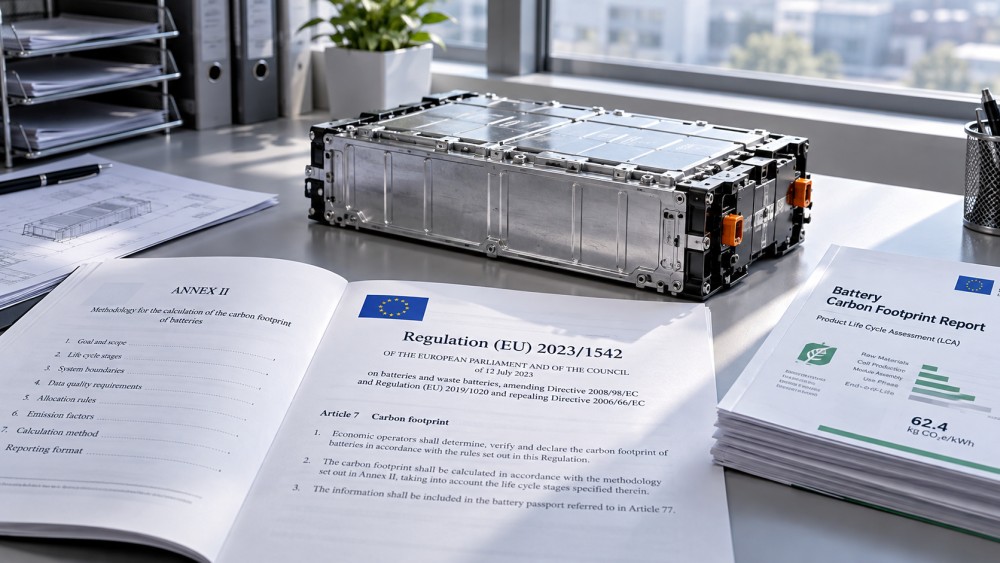
Start with Regulation (EU) 2023/1542 on EUR-Lex, particularly Article 7 and Annex II, then verify the relevant delegated and implementing acts published in the Official Journal of the European Union. European Commission battery-policy pages help locate supporting material, but supplier summaries, consultation drafts and methodology studies do not establish the applicable legal requirements on their own.
This distinction matters when a battery supplier submits a carbon-footprint report during technical approval. The report may contain credible lifecycle calculations yet cover the wrong battery category, use an unsuitable methodology or omit required declaration information. Before accepting it as compliance evidence, establish which requirements apply to the battery, when they become applicable and which published legal texts support that conclusion.
Use each official source for a different verification task
No single webpage answers every compliance question. The basic regulation defines the obligation; subsequent acts supply important technical and procedural details. Use the following source hierarchy to avoid treating explanatory material as legislation.
Search EUR-Lex using the regulation number rather than a broad phrase such as “battery carbon certificate.” Open the document information and consolidated-text options, inspect the consolidation date, and check for amendments or related acts. The consolidated version is convenient for reading, but the authentic Official Journal texts remain the legal reference.
Classify the battery before checking its declaration
Article 7 does not impose the same carbon-footprint requirements on every battery covered by the regulation. Its framework addresses electric-vehicle batteries, rechargeable industrial batteries with a capacity greater than 2 kWh, and light means of transport batteries, with differentiated implementation arrangements. Industrial batteries with exclusively external storage also require separate attention.
Begin with the definitions in Article 3. Record the battery’s intended use, capacity, design and regulatory category. A supplier’s commercial label—such as “mobility battery,” “industrial pack” or “energy module”—is not sufficient to establish legal classification.
For example, a rechargeable battery supplied for stationary energy storage should not automatically be assessed against the electric-vehicle timetable because it shares cell chemistry with an automotive product. Likewise, a battery used in light means of transport should not be classified solely by voltage or marketing terminology.
Document the classification reasoning alongside the product specification. Where the category is uncertain, resolve that issue before requesting a declaration against a particular deadline. Otherwise, a technically detailed supplier questionnaire may still ask for the wrong evidence.
Read the implementation date as a legal condition, not a headline
One of the most consequential errors is copying a date from an industry presentation without checking the complete wording of Article 7. The declaration timetable uses category-specific calendar dates combined with periods linked to the entry into force of relevant delegated and implementing acts.
For electric-vehicle batteries, for example, Article 7 specifies 18 February 2025 or 12 months after the entry into force of the relevant delegated or implementing acts, whichever is the latest. The calendar date alone therefore does not establish that the declaration obligation has become applicable. Other covered categories have different timing provisions; do not transfer the electric-vehicle rule to them.
- Locate the category-specific provision. Read the complete paragraph, including the references to secondary acts.
- Identify the required acts. Separate the calculation-and-verification methodology from the declaration-format measure.
- Confirm publication and legal status. Find the final act in the Official Journal rather than relying on its consultation page.
- Read the act’s final provisions. Record entry into force, application dates and any transitional arrangements.
- Apply the timing formula. Retain the calculation and source references in the assessment file.
Do not assume that an act is absent because a search returns only a draft. Conversely, an announcement that the Commission has adopted a measure does not, by itself, establish its publication, entry into force or application. A defensible assessment records what was checked and the date of that review.
Find the secondary acts without confusing them with drafts
From the EUR-Lex record for Regulation (EU) 2023/1542, inspect the available document relationships and search for acts referring to Article 7. Useful search combinations include the regulation number with “carbon footprint,” “delegated regulation,” “implementing regulation” or “declaration format.” Repeat the search for the relevant battery category.
Open each result and establish its function. Article 7 separates the methodology for calculating and verifying the footprint from the format of the declaration. Performance classes and maximum lifecycle carbon-footprint thresholds are additional regulatory layers, not interchangeable names for the declaration requirement.
A document headed “draft” or published for feedback should remain in a regulatory-monitoring file, not become the sole basis for declaring a supplier non-compliant. Draft text can inform data preparation, but requirements may change before publication.
Also distinguish legal status from technical usefulness. A Joint Research Centre report may explain modelling assumptions more clearly than a short legislative provision. It can help an evaluator understand a calculation, but the adopted act determines which approach must be followed where it prescribes one.
Match the submitted document to Article 7
Article 7 requires a carbon-footprint declaration for each relevant battery model per manufacturing plant. That granularity matters: a corporate emissions statement, a product-family average or a report covering a different factory cannot automatically substitute for the required declaration.
Use the current Article 7 text and applicable declaration-format act to inspect the submission. The basic regulation identifies information including:
- Administrative information about the manufacturer.
- Information identifying the battery model.
- The geographical location of the manufacturing plant.
- The battery carbon footprint, expressed using the prescribed lifecycle functional unit.
- The footprint differentiated by lifecycle stage.
- The identification number of the battery’s EU declaration of conformity.
- A web link providing access to a public version of the study supporting the declared results.
The functional unit deserves particular scrutiny. Article 7 expresses the footprint in kilograms of carbon-dioxide equivalent per kWh of total energy provided by the battery over its expected service life. A result expressed only per kilogram of battery or per kWh of nominal capacity is not automatically equivalent. Converting it requires justified assumptions, not merely changing the unit label.
Trace the declared product to the actual item being sourced. Model identifiers, plant details and the supporting study should align. Where several production sites supply the same commercial model, ask how the declaration covers each site rather than assuming a single result applies everywhere.
Check the calculation boundary before comparing suppliers
Two declarations can display the same unit while representing different modelling choices. Annex II establishes essential elements for the carbon-footprint framework, including lifecycle coverage. The applicable methodology provides the detailed rules needed to judge whether supplier results are comparable.
Review the treatment of raw-material acquisition and pre-processing, main production, distribution, and end-of-life and recycling. Check the prescribed boundaries rather than assuming that a conventional cradle-to-gate product carbon-footprint report satisfies the battery regulation.
Electricity modelling, allocation, recycled-material treatment, data quality and expected lifetime energy delivery can materially affect the result. Request enough supporting documentation to determine whether those choices follow the applicable rules. Do not substitute a preferred internal lifecycle-assessment convention where the legal methodology prescribes a different approach.
A reference to ISO 14067 or another recognised standard may demonstrate useful methodological discipline. It does not, by itself, prove conformity with Article 7. The question is whether the calculation meets the specific EU requirements applicable to that battery and assessment date.
Separate calculation review from conformity assessment
A consultant’s assurance statement, an accredited laboratory report and an EU conformity-assessment document serve different purposes. Inspect the applicable provisions of Article 17 and Annex VIII, together with relevant Article 7 measures, to establish the required conformity-assessment route and verification arrangements.
Where a notified body is required, check its notification and scope through the Commission’s official notified-body information system, NANDO. A recognised organisation’s name on a report does not establish that it performed the required task within the relevant notified scope. Check the report’s subject, legal basis, model coverage and conclusions.
Resolve evidence gaps without overstating non-compliance
A practical review should distinguish an established legal failure from incomplete evidence and future readiness. These outcomes require different procurement responses.
Keep carbon-footprint obligations separate from other battery requirements. A battery passport, CE marking or compliance with another sustainability provision does not independently demonstrate that the Article 7 declaration requirements have been satisfied. Conversely, an acceptable carbon-footprint declaration does not establish complete compliance with the battery regulation.
Keep a source record that another reviewer can reproduce
For each assessment, retain the battery classification, model and plant identifiers, applicable legal provisions, secondary-act references, timing analysis and supplier evidence. Record the EUR-Lex document identifiers and the date on which legal status was checked. Preserve the relevant document versions rather than relying only on bookmarks to changing webpages.
State the decision narrowly: whether the evidence demonstrates compliance with the applicable carbon-footprint declaration requirements, whether specific evidence remains outstanding, or whether the review concerns preparation for a future obligation. Escalate unresolved classification, timing or conformity-assessment questions before using them as contractual rejection grounds. This gives engineering and procurement teams a traceable decision rather than an unsupported “EU compliant” label.
Have questions about this sector analysis, or seeking best practices specific to your niche? Drop us a line below and let the senior consultants at GTIIN assist you.
“We respect your privacy. Your information is strictly confidential.”
Weekly Insights
Stay ahead with our curated technology reports delivered every Monday.
Recommended News
 Industry StandardsNov 01, 2026How to build an ESG compliance framework for your business
 Supply ChainNov 01, 2026China-Peru FTA Upgrade Takes Effect, Adding Global Supply Chain Chapter
 Global SourcingOct 31, 2026How to use raw material analysis for procurement cost forecasting
 Supply ChainOct 31, 2026G20 Foreign Ministers Meet as Rubio Calls for Cooperation on Supply Chains and Trade