EU EPR Rules Extend to Imported Industrial Equipment
As of October 1, 2026, the EU’s new binding rules on imported industrial equipment move Extended Producer Responsibility from a regional compliance topic to a direct market-access issue for cross-border suppliers. Based on the information provided, Regulation (EU) 2026/1147 requires EPR registration, take-back logistics, and digital product passports for industrial machinery and equipment entering the EU, regardless of where the manufacturer is located. This places immediate attention on OEMs, distributors, and channel partners handling mechanical, electrical, and automation systems, because the change appears to affect not only product entry into the EU market but also the supporting compliance and post-sale responsibility structure around those products.
What the Regulation Confirms
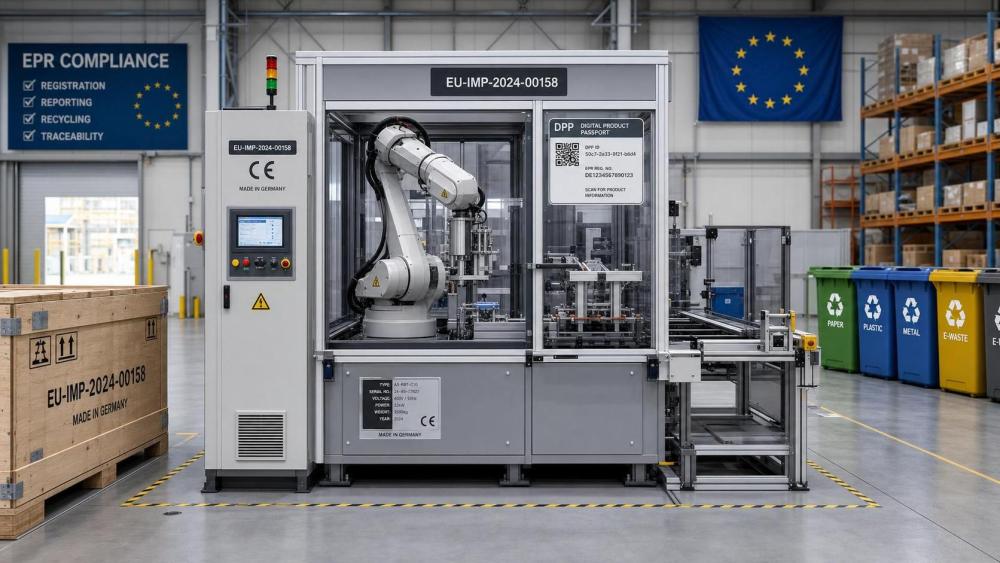
The confirmed information indicates that the European Commission adopted Regulation (EU) 2026/1147 on July 13. The regulation applies to all industrial machinery and equipment imported into the EU, without limiting the requirement based on the manufacturer’s location.
The measure requires three elements: EPR registration, take-back logistics, and digital product passports. It also states that non-EU producers must appoint an authorized EU representative by October 1, 2026.
The stated scope of impact includes OEMs, distributors, and channel partners involved in importing mechanical, electrical, and automation systems into the EU.
Where the Pressure May Appear First
For equipment manufacturers shipping into the EU
From an industry perspective, non-EU manufacturers may be affected first because the regulation explicitly requires an authorized EU representative by October 1, 2026. The likely business impact is not limited to shipment itself; it may also extend to how compliance responsibility is assigned, documented, and maintained for imported machinery and equipment.
What deserves closer attention is whether existing EU market arrangements, distributor relationships, and documentation workflows are already structured to support EPR registration, take-back obligations, and digital product passport requirements.
For distributors and channel importers
Distributors and channel partners are named directly in the provided summary, which suggests that intermediary market participants may face operational exposure where they act as importers or manage EU entry. Analysis shows that the main pressure points may appear in onboarding, product file readiness, after-sales handling, and coordination with upstream producers on who holds which compliance duty.
These businesses should pay close attention to whether their current contracts, import procedures, and customer-facing commitments align with the new requirements tied to imported industrial equipment.
For mechanical, electrical, and automation system suppliers
The summary specifically references mechanical, electrical, and automation systems. Observably, suppliers in these categories may need to review whether their product mix, technical records, and delivery processes can support the digital and logistical requirements named in the regulation.
The practical concern is less about broad market commentary and more about whether specific equipment lines entering the EU can be matched with the required registration, take-back arrangement, and product passport process.
What Companies Should Track Now
Authorized representative readiness
Based on the confirmed requirement, non-EU producers should focus closely on the authorized EU representative deadline of October 1, 2026. The immediate issue is organizational readiness: whether a compliant representative arrangement exists and whether related responsibilities are clearly assigned.
Product documentation and passport preparation
Because digital product passports are explicitly included in the regulation, companies involved in exporting industrial equipment to the EU should watch how product data, technical records, and supporting compliance materials are organized in practice. Analysis shows that this may become a coordination issue across product, compliance, and channel teams rather than a standalone legal task.
Take-back logistics in commercial execution
The requirement for take-back logistics means companies should not treat the rule only as a registration matter. What deserves closer attention is how return, recovery, or post-use handling responsibilities may intersect with customer agreements, distributor roles, and delivery models for imported machinery and equipment.
Difference between legal text and operating reality
Observably, one of the main practical risks is assuming that a published rule automatically translates into a simple operational checklist. Companies should continue monitoring how the stated obligations are interpreted in actual business processes, especially where multiple parties share import, distribution, or service responsibilities.
Why This Reads as More Than a Short-Term Compliance Update
Analysis shows that this development is better understood as a structural policy signal rather than a one-off administrative adjustment. The reason is that the rule, as described in the provided information, combines market entry, post-sale responsibility, and product information requirements in a single framework affecting imported industrial equipment.
At the same time, it is not appropriate to overstate the final business outcome beyond the confirmed facts. The regulation is already identified as binding, but for many affected companies the real issue will be how obligations are mapped into contracts, import operations, and channel execution. That is why this remains a live industry development that still warrants close observation.
How to Read the Current Stage
At this stage, it is more appropriate to understand the news as a confirmed compliance direction with operational consequences for companies selling industrial equipment into the EU. The core significance lies in the fact that non-EU location does not remove responsibility, and that obligations appear to extend across registration, logistics, and product information management.
A neutral reading is that the regulation creates a clearer compliance threshold for affected market participants, while the full commercial impact will depend on how companies translate the rule into day-to-day import and channel practices.
Basis of This Article
This article is based on the user-provided news title, event date, and summary concerning Regulation (EU) 2026/1147 and its application to imported industrial machinery and equipment.
For this type of industry update, relevant source categories typically include official regulatory notices, government or Commission publications, company disclosures, industry association updates, authoritative media reporting, and standards-related documents. No specific official source link was provided in the input, so the exact official publication path still needs ongoing verification.
Further monitoring should focus on any official clarifications, interpretive guidance, or implementation details related to EPR registration, take-back logistics, digital product passports, and the appointment of authorized EU representatives for non-EU producers.
Weekly Insights
Stay ahead with our curated technology reports delivered every Monday.
Recommended News
 Supply ChainOct 15, 2026How to choose a supply chain strategy for unpredictable demand
 Supply ChainOct 14, 2026How to assess an industrial equipment supplier's spare parts support
 Supply ChainOct 14, 2026EU Updates CSDDD Guidance on Global Supply Chain Due Diligence
 Global SourcingOct 13, 2026How to assess industrial automation suppliers for legacy integration